





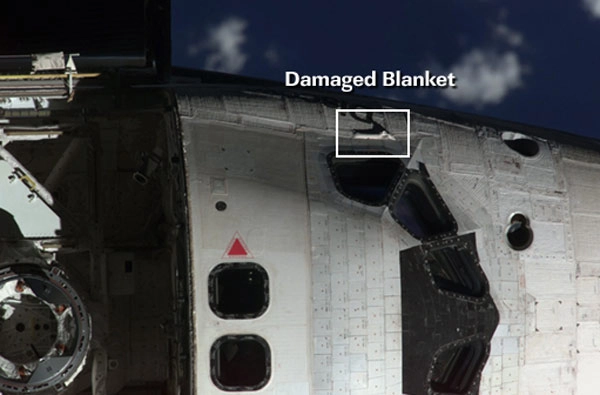
HOUSTON - Despite clearing anotherhurdle in efforts to prove the integrity of the shuttle Discovery's heatshield, mission managers are still studying a puffed-up thermal blanket toensure it won't rip off during reentry and hit the spacecraft.
NASA's deputy shuttle programmanager Wayne Hale said Tuesday that engineers have cleared Discovery's wingleading edges for the return flight to Earth, but are now discussingwhether a damaged thermal blanket just below a crew cabin window on theorbiter's nose could potentially inflict damage to the spacecraft if it pullsfree.
"The biggest work going on is todetermine whether or not it's even possible for that blanket to come off," Halesaid during a briefing here at Johnson Space Center.
The results of that analysis shouldbe presented to the flight's mission management team (MMT) in the next 48hours, he added.
The study comes after engineers had clearedthe orbiter's thermal blankets and heat resistant tiles for reentry, butshuttle managers said that evaluation was based on thermal heating concernswhich are not an issue for the loose piece of fabric.
Meanwhile, Discovery'sseven-astronaut crewis preparing to conduct a 6.5-hour spacewalkearly Wednesday to pluck out two pieces of fillermaterial from the orbiter's heat shield and install new hardware tothe exterior of the International Space Station (ISS).
A thorough inspectionof Discovery's wing leading edges, which are covered heat-resistant reinforcedcarbon carbon (RCC) panels, yielded a few scuffsmarks but nothing shuttle engineers perceived as a flight risk for reentry,mission managers said.
Hale said the 20-inch (50-centimeter) long blanket wasapparently damaged during Discovery's July 26 launchby a piece of debris - possibly a paper cover for one of the orbiter'sthrusters - which punctured the material and allowed air to puff it up. Anearly 8-inch section (20-centimeter)of the 3.8-inch wide (9.6-centimeter) blanket has puffed up from Discovery'shull, he added.
The stitching seems secure on theblanket and the glue adhering it to Discovery appears in place, but engineerswant to track the paths the loose fabric could take if it pulls free duringreentry and ensure that the orbiter's tail, rudder speed brake, orbitalmaneuvering systems (OMS) pods and other areas are not in danger of an impact,shuttle officials said.
"We want to prove to a reasonableengineering level that we don't have any concerns," Hale said.
Launch debris and the shuttle'sthermal protection system are serious concerns or NASA and its shuttleengineers. In 2003, the Columbia orbiter was destroyed, its crew lost, duringreentry after sustaining critical damage to its wing leading edges by a pieceof external tank foam debris during lunch.
After two and a half years of workand redesign to increase shuttle safety, NASA launchedDiscovery and its STS-114 crew only to see one large piece of foam fall from its external tank from an areapreviously thought safe by tank engineers. That foam debris did not hitDiscovery, but did prompt shuttle officials to groundfuture flights until they understand and address the problem.
Discovery's STS-114 mission isslated to land at NASA's Kennedy Space Center on Aug. 8.
Fixing NASA: Complete Coverage of Space Shuttle Return toFlight
