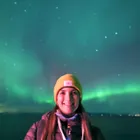
A trio of coronal mass ejections (CMEs) is currently hurtling toward Earth and space weather forecasters say we could experience up to three glancing blows over the coming days, potentially sparking northern lights displays across parts of the northern U.S.
While these solar storms are not expected to strike Earth head-on, they could still clip us and buffet Earth's magnetic field strongly enough to trigger minor (G1) and possibly moderate (G2) geomagnetic storm conditions, according to the U.K. Met Office.
Current NOAA forecast maps show the auroral oval dipping across parts of the northern U.S. overnight. If G1 conditions develop, skywatchers in Alaska, Washington, Montana, North Dakota, Minnesota, Michigan and Maine could have a chance of spotting the northern lights. If conditions strengthen to G2 levels, auroras may also become visible further south in states including Idaho and New York.
According to NOAA's Space Weather Prediction Center and the U.K. Met Office, the possible geomagnetic storms are linked to several CMEs launched from the sun in recent days. Modelling suggests that most of the solar material will miss us, passing north of Earth, but even a glancing blow from any one of these CMEs can be enough to stir geomagnetic activity and enhance aurora shows.

Further enhancement could also come from the lingering effects of the fast solar wind stream from a coronal hole that has been buffeting Earth in recent days. The residual high-speed stream could combine effects from possible CME impacts and boost geomagnetic conditions through May 20, according to the U.K. Met Office.
Northern Hemisphere aurora forecast courtesy of the U.K. Met Office
Best time to look
The best time to look for auroras is typically within a few hours of local midnight, when skies are darkest and geomagnetic activity often peaks. NOAA forecasts the highest chances for G1 geomagnetic storm conditions between 11 p.m. and 2 a.m. tonight (0300-0600 GMT).
But remember, auroras can be notoriously fickle. Even during geomagnetic storms, there is no guarantee that you'll see them. Clear skies, dark conditions and favorable magnetic field alignment all need to come together at the first moment.
How to find the northern lights
If you live in a northern U.S. state with a chance of seeing the northern lights tonight, head to a north-facing vantage point as far from light pollution as possible.
Use your mobile phone to scan the skies, as the camera is great at picking up faint auroras before your eyes spot them. This can help you pinpoint where in the sky you should be focusing your attention. But remember to keep an eye out elsewhere too, as auroras can pop up in front, behind or even above you! Happy aurora hunting.
If you want to make sure you're all clued up on when to look for auroras, download a space weather app that provides forecasts based on your location. One option I use is "My Aurora Forecast & Alerts," available for both iOS and Android. However, any similar app should work well. I also use the "Space Weather Live" app, which is available on iOS and Android, to get a deeper understanding of whether the current space weather conditions are favorable for aurora sightings.