





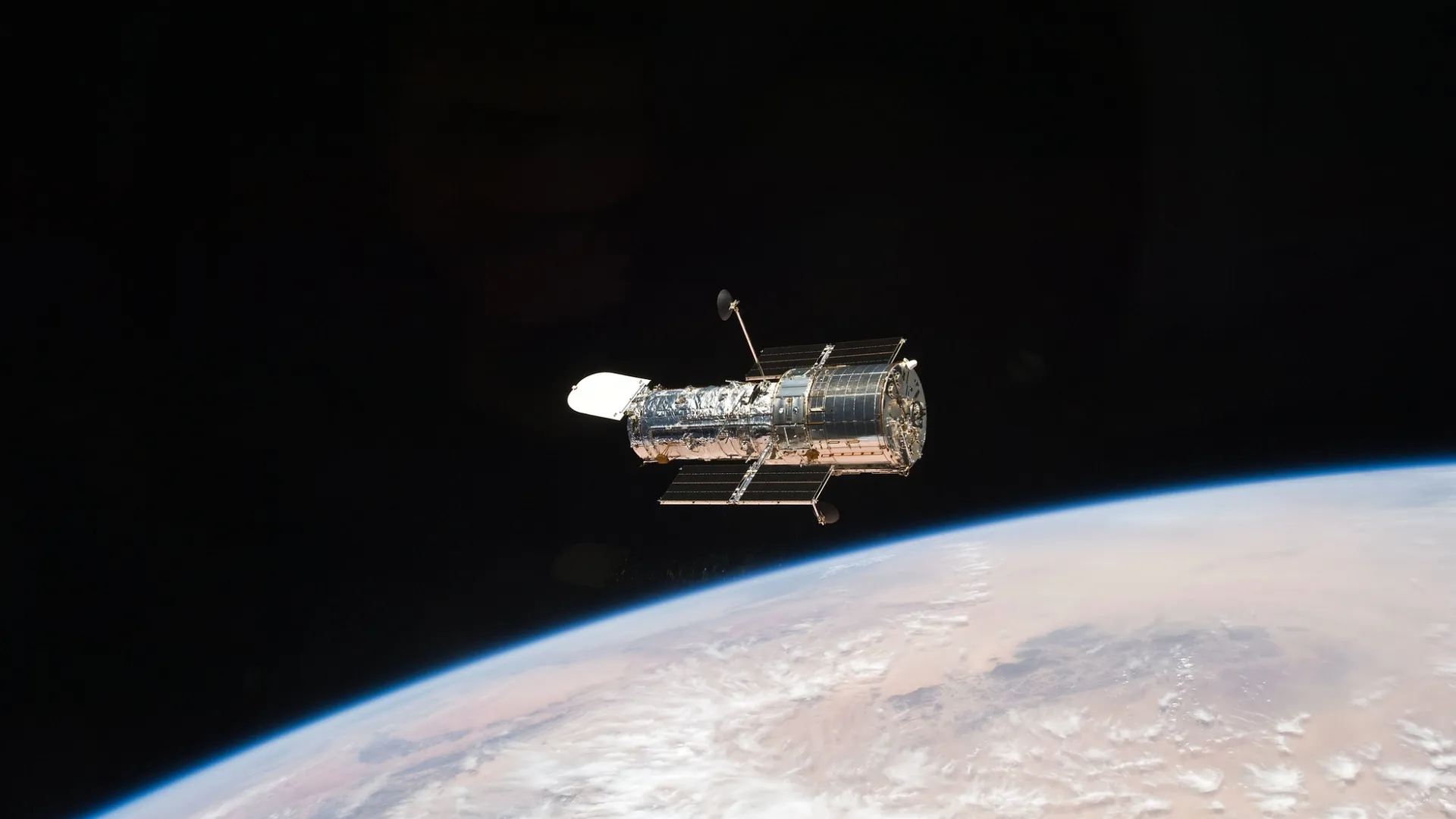
NASA is reviving discussions to rescue the Hubble Space Telescope, which is operating well but is on track to reenter Earth's atmosphere about six years from now.
The agency issued a request for information (RFI) on Oct. 29 for "in-space servicing" capabilities, which could include boosting Hubble's orbit (which is naturally degrading due to atmospheric drag), or even a mission to "enhance its capabilities" in some way.
Hubble, which launched in April 1990 in partnership with the European Space Agency, was serviced five times by astronauts on space shuttle missions, the most recent being in 2009. The observatory's groundbreaking achievements include helping to show that the expansion of the universe is accelerating — a discovery that won the Nobel Prize — as well as a swath of finds about planets, galaxies, stars and other parts of the universe.
Hubble also regularly teams up with other telescopes for science work, and its observations have led to the publication of at least 23,000 scientific papers, NASA figures suggest. And, despite its age, Hubble remains in high demand. "Astronomers request about seven times as much observing time as is available each year," the agency stated in September.
Hubble is also widely appreciated by the public. People have long enjoyed and celebrated its iconic images, such as the Eagle Nebula's "Pillars of Creation," a gorgeous shot that has been revisited several times over the decades. As such, this is not the first time in recent years that discussions have opened about keeping the famed observatory running for a while longer.
In 2022, for example, billionaire tech entrepreneur Jared Isaacman proposed using SpaceX hardware to mount a Hubble-servicing mission. (Isaacman also purchased and commanded two crewed SpaceX missions to Earth orbit, which flew in September 2021 and September 2024.) NASA declined, however, citing possible risks to the healthy observatory.
But things have changed, apparently. Isaacman, who in December 2025 became NASA administrator, said in an Oct. 30 agency statement that Hubble's science return means the agency should "be looking at every reasonable opportunity to keep it delivering for as long as possible" — especially if doing so would be a cost savings compared with launching another mission.
In an Oct. 30 post on X, Isaacman added that it's "still worth exploring the options" and noted that NASA had previously considered "a far lower-cost solution" to keep the observatory flying. "That was then. Still worth the effort — Hubble deserves it," he added.
The new RFI also allows for alternative scenarios, however, which could include a "safe, controlled reentry into Earth's atmosphere or orbital disposal at the end of Hubble's mission."
Hubble will naturally enter the atmosphere in 2033 or 2034 due to orbital drag, so any attempt to service it would have to be in 2032, the agency stated.
Earlier this year, NASA worked with Katalyst Space Technologies on a $30 million mission that aimed to boost the orbit of the Neil Gehrels Swift Observatory, which is also falling back to Earth due to orbital drag.
That long-shot rescue mission — which was developed quickly to race against accelerated solar activity, which ballooned Earth's atmosphere and increased drag — launched successfully this summer. But control issues prevented Katalyst's LINK spacecraft from meeting up with Swift. Swift is expected to reenter Earth's atmosphere tomorrow (Nov. 4) after 22 years of operations — far past its two-year design lifetime.