When we think about a black hole, we probably picture some vast cosmic titan, greedily consuming any matter unfortunate enough to fall within its gravitational influence. Thinking deeper, we probably imagine this ravenous cosmic beast forming from the explosive collapse of the core of a massive star. Maybe we even picture a supermassive black hole at the heart of a galaxy, formed from a multitude of mergers between smaller black holes and reaching masses millions or even billions of times that of the sun.
However, as accurate as this picture is, many scientists have long suspected that it is only the tip of the black hole iceberg, representing a single class of "astrophysical black holes" alone. These researchers theorize that black holes can also form at much more diminutive sizes that do not require the existence and death of massive stars or prior pairs of black holes. In particular, many scientists think that tiny black holes, with masses as small as that of a medium-sized asteroid, could have formed directly from density fluctuations in the hot and dense matter that filled the cosmos moments after the Big Bang. These objects have remained hypothetical as evidence of their existence has proved elusive. That hasn't stopped researchers thinking about non-astrophysical black holes and the routes to their formation, however.
One example is new research from scientists from Goethe University, Frankfurt, and the Vienna University of Technology (TU Wien), which suggests that minuscule black holes could form when the very fabric of space and time, united as a four-dimensional entity called "spacetime," undergoes critical collapse and organizes itself into a regular crystal-like arrangement. Though the idea isn't entirely new, the team has become the first to mathematically describe this transformation. And what is most staggering, they did it with nothing more than a pen and paper!
While astrophysical black holes form from some of the universe's most titanic and violent events, like core-collapse supernovas or black hole mergers, that set the very fabric of spacetime ringing with gravitational waves that can be "heard" from millions and even billions of light-years away, the team found these critical collapse black holes could be born with only a tiny nudge.
"Sometimes a tiny, seemingly insignificant cause is enough to trigger a huge and dramatic change," team member Daniel Grumiller of TU Wien told Space.com. "These microscopic black holes would form if you have a spacetime crystal and you inject an arbitrarily small amount of energy - a bit like what you get when you have undercooled water and you shake it so that it crystallizes."
Grumiller explained further that when liquid water is at its freezing point, only a small change is required to cause water molecules to spontaneously arrange themselves into a regular pattern and form an ice crystal. Even a tiny change in the structure of spacetime can allow a repeated pattern to develop, resulting in the emergence of a spacetime crystal, the team theorizes. This can kick-start the process of critical collapse.
"You can think of the critical spacetime crystal as water at freezing point; even though it is still water, it already 'knows' about ice, and small perturbations can convert water at 0 Celsius into ice, or vice versa," Grumiller said.
Enter stage left spacetime
Einstein suggested in his 1915 theory of gravity, general relativity, that particles of mass causethe very fabric of spacetime to curve. That means when particles move through spacetime, they affect the fabric of spacetime itself. That was the revolutionary thing about Einstein's rethink of gravity: to Newton, space and time were merely a stage upon which the actors of the universe, energy and matter, play their roles. To Einstein, spacetime was part of the production. It's that active role that allows for the formation of astrophysical black holes and their diminutive counterparts.
"We say that spacetime is curved by mass," Christian Ecker from the Institute for Theoretical Physics at Goethe University Frankfurt said in a statement. "Large objects such as stars curve spacetime strongly — for example, we can observe this when light rays are deflected by massive stars. But smaller masses also produce spacetime curvature, just to a lesser extent." However, because tiny black holes are hotter than their astrophysical counterparts, they rapidly "leak" thermal radiation called "Hawking radiation" to the cold of space; these spacetime crystal black holes would rapidly evaporate.
"This spacetime crystal is a very peculiar and fascinating object. It is a kind of intermediate state, an unstable point that can evolve in two different directions,” Grumiller continued. "After some time, the instability will kick in and either the spacetime crystals disperse into radiation or collapse into a small black hole. In case the crystal collapses to a black hole, it will be classically stable."
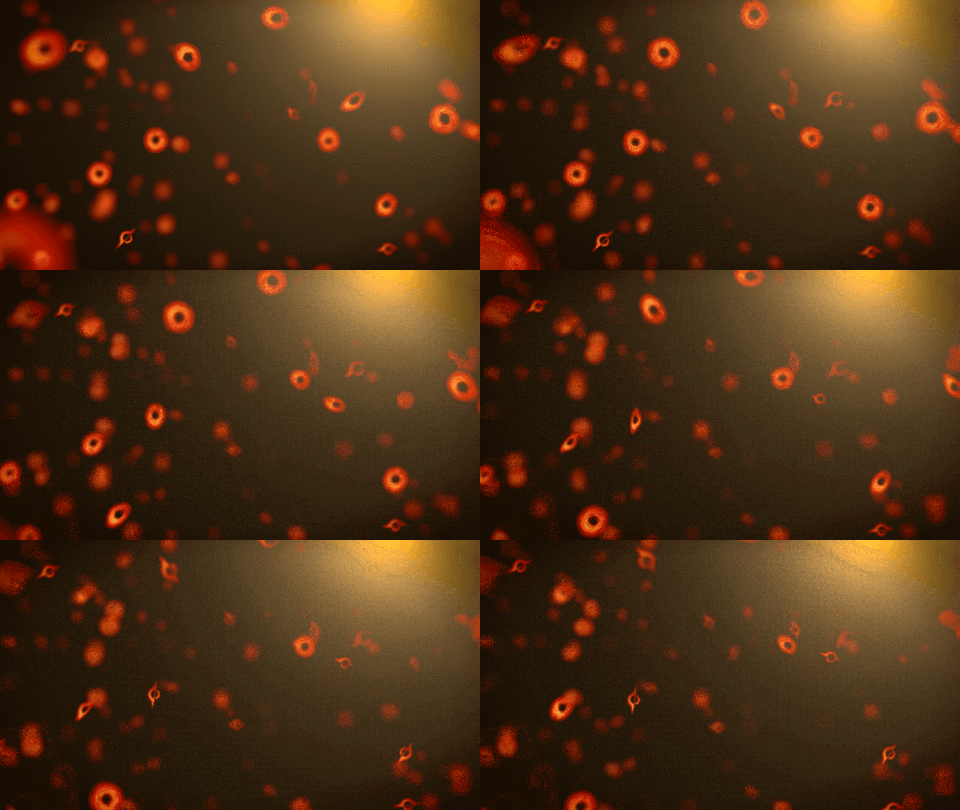
Grumiller explained that one surprise this research delivered was just how simple their mathematical descriptions of this process were while presenting solutions to the equations of general relativity.
"We provided the first paper-and-pencil solutions for spacetime crystals. Before our work, there were only numerical simulations but not exact solutions to the Einstein equations," Grumiller said. "We were astonished that the solutions were so simple that they fit into a few lines and only involved elementary functions - this was quite unexpected given the complexity of corresponding numerical simulations that take thousands of computer processing hours."
Of course, all this is great, but proving that critical collapse black holes could exist and that this route could have created primordial black holes in the dense particle-rich conditions shortly after the Big Bang doesn't actually prove primordial black holes exist.
"If we are lucky, our experimental colleagues will, at some point, discover primordial black holes. But even if this never happens, understanding critical collapse means understanding an important and conceptually rich part of general relativity, our currently best theory of gravity," Grumiller concluded. "Our next step is to find out if our various conjectures about the behavior of critical spacetime crystals are correct."
The team's research was published in the May edition of the journal Physical Review Letters.