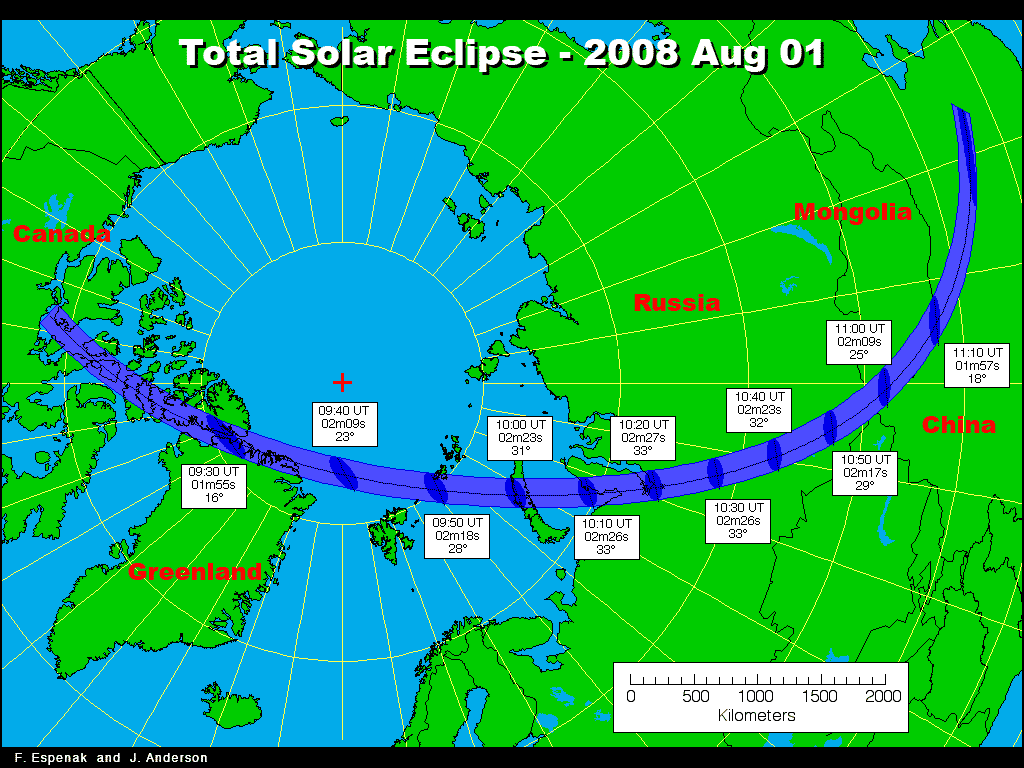
Friday, August 1 is a red-letter day for eclipseenthusiasts. On that date, the sun will be partially eclipsed over an immensearea that includes western and central Asia, parts of northern and centralEurope, all of Greenland and even a small slice of northeastern North America.
A totalsolar eclipse — the first in nearly two and a half years — will be visiblealong a narrow track that will start over the Northwest Passage of Canada,gives a glancing blow to northern Greenland, then shifts southeast throughSiberia and western Mongolia and before ending near the famed Silk Route ofChina.
The path of totality for this upcoming eclipse is never morethan 157 miles (252 km) wide.
Where it's visible
The totaleclipse begins at sunrise over Northern Canada's Queen Maud Gulf, where the moon's umbra will first touch down on the Earth, resulting in Canada's hosting its first total solar eclipse since February 26, 1979.
As the sun comes into view overthe north-northeast horizon its disk will become completely blockedby the moon. This is in the area of thefamous Northwest Passage, a sea route connecting theAtlantic and Pacific Oceans through the Arctic archipelago of Canada. Thevarious islands of the archipelago are separated from one another and theCanadian mainland by a series of Arctic waterways collectively known as theNorthwestern Passages. Politically, thisregion belongs to Nunavut, the largest and newest of the territories of Canada; it was separated officially from the vast Northwest Territories on April 1, 1999.
Although the umbral shadow narrowly misses thetowns of Cambridge Bay on Victoria Island, and Resolute on Cornwallis Island,its northern edge just clips the northernmost permanently inhabited place inthe world: Canada's remote outpost of Alert, which lies just 508 miles (817 km)from the North Pole and has a population of just 5. Here, totality will last 43seconds.
Crossing the open Arctic, the southern half ofthe totality path slides across the many fjords of northermost Greenland,coming to within 450 miles (720 km) of the North Pole at 9:38 UT over the Arctic Ocean before turning southeast. Totality sweeps over the Norwegian island group ofSvalbard, while the northern edge of the umbra's path just grazes Russia's Franz Josef Land island group, then cuts across the crescent-shaped island of Novaya Zemlya on its way to central Asia. The umbra first touches the Russian coast on the Yamal Peninsula. Not far inland, greatest eclipse, producing 2 minutes 27 seconds oftotality, is attained near the town of Nadym (pop. ~46,000), just inland fromthe boot-shaped Gulf of Obskaja.
Spending part of your summer in Siberia maysound a bit more appealing upon hearing that the central path passes almostdirectly over the city of Novosibirsk, Russia's third most populous city (pop.~1.4 million) where totality begins at 10:44 UT and will last 2 minutes 18seconds. The center of the path will then follow the Mongolia-China border forseveral hundred kilometers, with Olgij, Mongolia getting 1 min 36s of totality.Totality finally whisks into north-central China, crossing the west end of theGreat Wall before leaving the Earth at a point northeast of the major city of Xi'an (pop. 3.9 million).
The northern half of Maine as well as the Canadian MaritimeProvinces will experience a partial eclipse at sunrise.
Eclipse expedition
A most unusual attempt torendezvous with the moon's shadow will be made by an Airbus A330-200twin-engine long-range aircraft. Following a flight plan optimized specificallyfor the purpose of viewing this eclipse, all of the many unusual requirementsof this flight have been evaluated and satisfied with arrangements by the aircharter company Deutsche Polarflug (AirEvents) which has previously operatedsuccessful over-flights of the North Pole with this same aircraft.
Glenn Schneider, from the University of Arizona's Steward Observatory and a veteran of 26 total eclipses, has workedout the detailed formulation of the flight plan. He is targeting a point fromthe high polar north, at approximately +83-degrees latitude and about 440nautical miles from the North Pole at an altitude of 37,000 feet above the Arctic Ocean.
This will be a unique event in theannals of solar eclipse-chasing since there are no records of any total solareclipse observations as far north as this. While total solar eclipses in the polar regions are not rare, accessibility is very difficult. Until this juncture in time(and technology) very high-latitude (north or south) total solar eclipses havebeen elusive. The total solar eclipse of 23 November 2003 was the first inhistory to have been observed fromthe Antarctic.
Once again it needs repeating: to look at the sun without propereye protection is dangerous. Even if you are in the path of the total eclipseyou will need to protect your eyes during the partial phases.
- The Science Behind the Eclipse
- Galleries: Solar Eclipse in 2005 and 2006
- Local Viewing Circumstances
Joe Rao serves as an instructor and guest lecturer at New York's Hayden Planetarium. He writes about astronomy for The New York Times and other publications,and he is also an on-camera meteorologist for News 12 Westchester, New York.