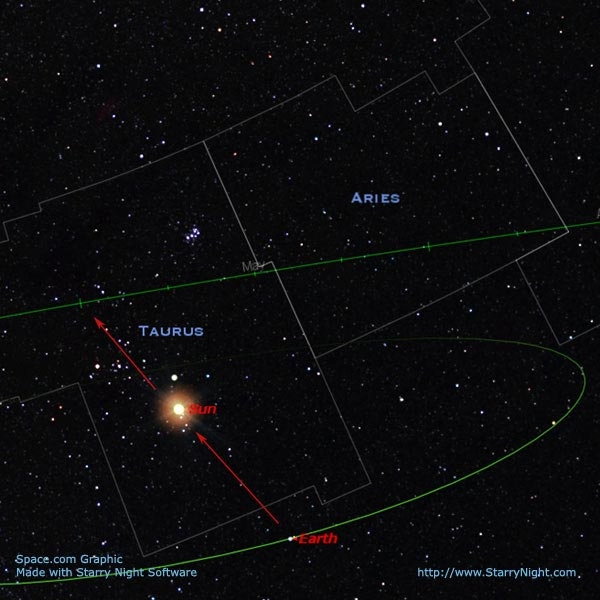
Of the imaginary coordinate lines that astronomers and navigators use in mapping the sky, perhaps the most important one is the ecliptic, the apparent path the sun appears to take through the sky as a result of the Earth's revolution around it.
Because of the Earth's yearly revolution around the sun, the sun appears to move in its annual journey through the heavens with the ecliptic as its path. Technically then, the ecliptic represents the extension or projection of the plane of the Earth's orbit out towards the sky.
But since the moon and planets also move in orbits, whose planes do not differ greatly from that of the Earth's orbit, these bodies, when visible in our sky, always stay relatively close to the ecliptic line. In other words, our solar system can be best defined as being somewhat flat, with the planets moving in very nearly the same plane.
It is for this reason that most sky charts plot the position of the ecliptic; it is something of a warning to sky watchers that strange "stars" (planets) often appear near and along this path through our heavens, as well as the moon.Usually the moon and planets are not positioned exactly on the ecliptic (because they're not located exactly in the same orbital plane as Earth), but lie within several degrees of it and form a sort of narrow strip encompassing the entire sky which we call the Zodiac.
The ecliptic runs exactly along the middle of the Zodiac.
The "Classic Twelve"
Twelve constellations through which the ecliptic passes form the Zodiac. The name is derived from the Greek, meaning "animal circle," and also is related to the word "zoo," coming from the fact that most of these constellations are named for animals, such as Leo, the Lion; Taurus, the Bull; and Cancer, the Crab, just to name a few.
These names which can be readily identified on sky charts are familiar to millions of horoscope users (who — ironically — would be hard pressed to find them in the actual sky!).
If we could see the stars in the daytime, we would see the sun slowly wander from one constellation of the Zodiac to the next, making one complete circle around the sky in one year.
Ancient astrologers were able to figure out where the sun was on the Zodiac by noting which was the last zodiacal constellation to rise ahead of the sun, or the first to set after it. Obviously, the sun had to be somewhere in between. As such, each month a specific constellation was conferred the title of "House of the sun," and in this manner each month-long period of the year was given its "sign of the Zodiac."
Some discrepancies
Interestingly, however, the "sign" which has been assigned for a given month in the horoscope that you'll find in your daily newspaper is not where the sun actually is for that particular month, but where it would have been several millennia ago!
This is due to the "wobble" of the Earth's axis(known as precession); yet today's astrologers, who believe that the sun, moon and planets mysteriously direct our lives, continue to adhere to star positions that for all intents and purposes are out of date by thousands of years!
In addition, the ecliptic crosses through the constellation of Ophiuchus, the Serpent Holder. In fact, the sun spends more time traversing through Ophiuchus than nearby Scorpius! It officially resides in Scorpius for less than a week: from Nov. 23 through 29. It then moves into Ophiuchus onNovember 30 and remains within its boundaries for more than two weeks — untilDec. 17. And yet the Serpent Holder is not considered a member of the Zodiac and so must defer to Scorpius!
In addition, because the Moon and planets are often positioned either just to the north or south of the ecliptic, it allows them to sometimes appear within the boundaries of a number of other non-zodiacal star patterns.In fact, as pointed out by the well-known astronomical calculator,Jean Meeus, along with Ophiuchus, there are nine other constellations that occasionally can be visited by the Moon and planets: Auriga, the Charioteer;Cetus, the Whale; Corvus, the Crow; Crater, the Cup; Hydra, the Water Snake;Orion, the Hunter; Pegasus, the Flying Horse; Scutum, the Shield; and Sextans, the Sextant.
So in truth, there really aren't twelve zodiacal constellations, but twenty-two!
Origin of "Ecliptic"
Although the moon's orbit is inclined 5.5 degrees to the Earth's orbital plane, periodically there will come times when it crosses over the ecliptic.
Should this happen when the moon is at new phase, it will end up crossing in front of the sun causing a solar eclipse. If the moon crosses over the ecliptic when the moon is at full phase, it will pass into the shadow of the Earth resulting in a lunar eclipse. Usually when the new moon is in the vicinity of the sun it appears to pass above or below it and no eclipse occurs. Similarly, the full moon usually misses the Earth's shadow by sweeping above or below it.
Only when all three bodies (sun, Earth and moon) are on a straight line occupying the plane of the ecliptic can an eclipse occur.
Hence the name "ecliptic": the place where eclipses occur.
- Your Astrological Sign May Not Be What You Think It Is
- Why the Night Sky Changes with the Seasons
- Image Gallery: Constellations
Joe Rao serves as an instructor and guest lecturer at New York's Hayden Planetarium. He writes about astronomy for The New York Times and otherpublications, and he is also an on-camera meteorologist for News 12 Westchester, New York.