High in the south-southwest part of the sky during the late evening hours is an easy-to-find tiny constellation called Delphinus, the Dolphin.
It's a star pattern that is composed only faint stars, yet the stars are so close to each other that they can easily be seen on clear, dark nights.
A variety of descriptions have been used in various astronomy guidebooks for Delphinus; everything from charming to just plain cute. Although it possesses no star brighter than 4th magnitude, its has several in that brightness range. (On this astronomer's scale, higher numbers represent dimmer objects, and magnitude 6.5 is about the limit visible under perfect, dark-sky conditions.)
What you'll see
Delphinus forms a distinctive diamond-with-a-tail pattern that gives this group a prominence greater than you might otherwise expect from so faint a constellation.
Some reference books refer to the diamond as "Job's Coffin," though the origin of this name is unknown.
Two stars in Delphinus have rather odd names: Sualocin and Rotanev. They first appeared in the Palermo Star Catalogue in 1814, but nobody seemed to have a clue as to their origin. The English Astronomer Thomas Webb finally solved the mystery by reversing their letters, revealing the name of Nicolaus Venator, the Latinized form of Niccolo Cacciatore, the valued assistant and eventual successor of Palermo Observatory's Director Giuseppe Piazzi. But to this day nobody knows whether it was Piazzi or Cacciatore himself who ultimately christened these two stars.
According to legend, Arion, a Greek musician, was sailing on board a ship to Corinth, carrying a substantial cache of money and jewels. Unfortunately, the ship's crew planned to throw Arion overboard and abscond with his treasure. When confronted by the pirates, Arion requested that he be allowed to play his harp one final time.
The music attracted Delphinus.
Upon seeing the Dolphin, Arion jumped overboard and was carried safely to shore. When the ship docked at Corinth, the crewmen were arrested and hanged. Arion recovered his treasure and the dolphin was given a place of honor in the sky.
Another whale
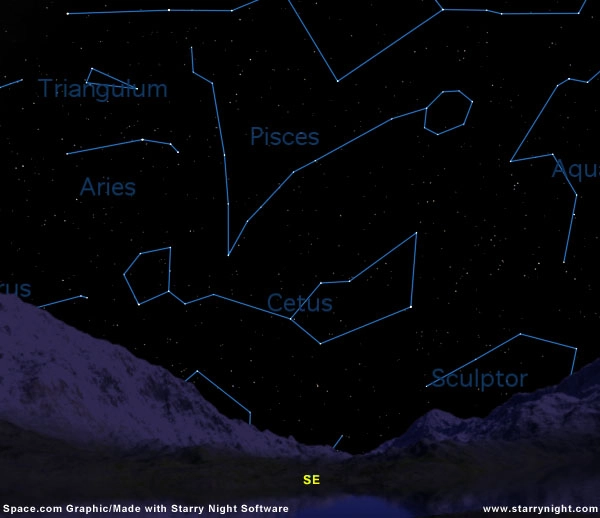
Dolphins are known today as being the smallest whales. Their family name, in fact, is Delphinidae. However, "dolphin" is also the name of a large tropical sport fish, though whales - including dolphins - are not fish but mammals. While Delphinus swims high in our south-southwest sky at around 11:30 p.m., local daylight time, the sky's "real" whale will have fully emerged into view, sprawling above the southeast horizon: Cetus.
Known by the ancient Greeks as the whale that was about to attack Andromeda when Perseus destroyed it, Cetus was later thought to represent the whale that consumed Jonah. However, if one were to look at some of the allegorical star atlases of the past few hundred years, the portrayals are hardly what we know whales to be.
In fact, not a few astronomy guides refer to Cetus as a sea monster even though, ironically, the scientific name for the whale order is Cetacea. Some star atlases depicted Cetus looking more like Godzilla with a fish tail.
Cetus consists chiefly of faint stars, but it occupies a relatively large part of the sky. His head is a group of stars not far from Taurus and Aries, and his body and tail lie toward Aquarius.
- Full Moon Fever
- Astrophotography 101
- Sky Calendar & Moon Phases
- 10 Steps to Rewarding Stargazing
- Understanding the Ecliptic and the Zodiac
- False Dawn: All about the Zodiacal Light
- Reading Weather in the Sun, Moon and Stars
- How and Why the Night Sky Changes with the Seasons
- Night Sky Main Page: More Skywatching News & Features

| DEFINITIONS |
Degrees measure apparent sizes of objects or distances in the sky, as seen from our vantage point. The Moon is one-half degree in width. The width of your fist held at arm's length is about 10 degrees. 1 AU, or astronomical unit, is the distance from the Sun to Earth, or about 93 million miles. Magnitude is the standard by which astronomers measure the apparent brightness of objects that appear in the sky. The lower the number, the brighter the object. The brightest stars in the sky are categorized as zero or first magnitude. Negative magnitudes are reserved for the most brilliant objects: the brightest star is Sirius (-1.4); the full Moon is -12.7; the Sun is -26.7. The faintest stars visible under dark skies are around +6. |