• TechMediaNetwork
  • LiveScience
  • SPACE.com
  • Newsarama
  • TopTenREVIEWS
advertisement
Monster Space Ear Unveiled: Largest Steerable Scope Ever
Baby Black Hole With Big Appetite Surprises Scientists
Supercomputers Foretell Cosmological Findings
The Grid: A Computer Web for Astrophysics and More
Dark Matter Solution: Annihilating Particles
By Jack Lucentini
Special to SPACE.com
posted: 08:00 am ET
06 October 2000

dark_matter_001003

The mysterious "dark matter" pervading the universe may be even darker than currently thought and the latest efforts to detect it directly may be useless, a group of scientists says.

The research suggests that, contrary to prevailing opinions in cosmology, none of the currently known or theorized particles of the physical world may be able to account for dark matter.

Another type of particle might, however, fit the bill, said University of Chicago astrophysicist Lloyd Knox, who worked on the problem. This particle would have the unusual ability to crash into others like it, causing mutual annihilation.

"We were surprised to find that [the annihilation idea] was perfectly consistent with the data," said Knox.

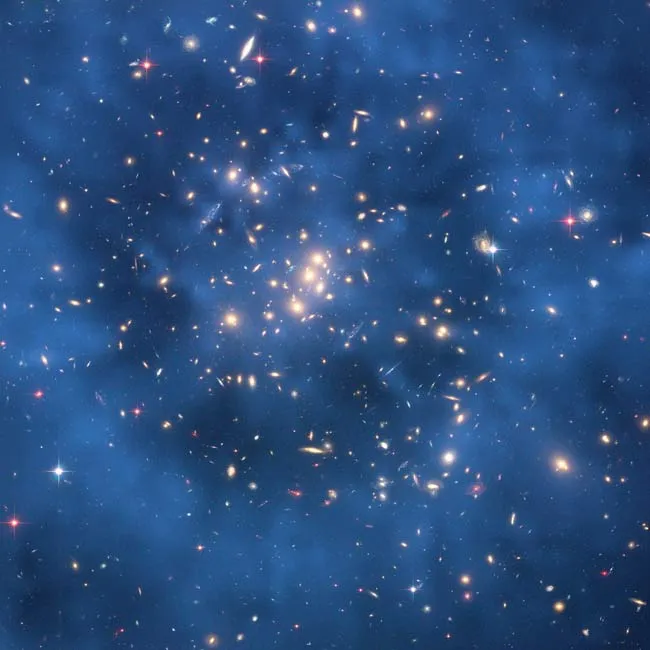
This image shows a simulation of the distribution of dark matter in a large volume of the universe. The box shown spans a distance of about 1 billion light-years. The structures are displayed so that the brighter regions have a higher density (that is, more dark matter) than the darker regions. The dark matter is concentrated into a web-like distribution of filaments that intersect at dense nodes where great clusters of galaxies are expected to form and become visible. At the rear of the cube (to the left), three blue disks represent three distant galaxies. The yellow lines that cross the box represent light rays from those galaxies propagating through the universe. In the absence of intervening matter, the light would travel on straight lines but in the presence of matter, the paths of the rays are evidently deflected by the gravitational effects of the clumpy matter (the breaks in the yellow lines illustrate the light passing behind a clump of dark matter).

According to the proposal, galactic centers are hotbeds of annihilating dark matter.

Knox described the idea as tentative, but if correct, he said, it could overthrow leading theories of physics, which depend on other types of particles serving as dark matter.

The approach could force scientists to develop a "new physics," Knox said. His research, done in cooperation with researchers at the University of Chicago and the Fermi National Accelerator Laboratory, is set for publication in the journal Physical Review Letters and was written in response to a puzzle that has stymied astrophysicists.

Scientists are certain that the universe is made up mostly of a mysterious, undetected substance. The way that galaxies rotate and move around each other gravitationally indicates there is much more mass than what is seen and currently identified as stars, galaxies, nebulae and dust clouds. By studying these motions, astronomers have inferred the quantity and distribution of dark matter. The obscure material is thought to float around in large blobs called halos, each of which is centered on a galaxy.

The trouble is that when scientists run computer simulations of how the hypothesized dark matter might behave, a sharp concentration, or "cusp," of the stuff always winds up near the galaxy center. But scientists can detect no such concentrations in the real sky using current methods, such as measuring galaxy rotation rates and studying how the gravity of dark matter might bend light from distant galaxies.

The explanation, the researchers think, might be that the dark matter destroys itself in annihilation interactions when it becomes too dense.

Matter with this property could be structured so as to exactly cancel out the anomalous "density cusps" in the simulations, he said. The simulations falsely assume that dark matter is "collisionless" and "non-interacting," that is, its particles do not slam into or influence each other, Knox says.

The research is still tentative because the "cusp" problem may not be a problem at all, Knox said. With constantly improving observations, he explained, astronomers may actually find the cusps that the computers insist are there.

However, if this latest research is correct, it would overturn a popular advance in physics, called string theory, which treats elementary particles as extended one-dimensional thread-like objects.

String theory puts forth its own candidates for dark matter -- particles such as axions, that have one-trillionth the mass of tiny electrons, and neutralinos, which are heavier than the protons that make up atoms. None of these bits of matter have the requisite self-annihilation properties, Knox said.

As a result, large laboratories currently trying to find the stuff could become useless, because the dark matter might have no effect on their detectors, and scientists would have to start seeking a particle outside their current models.

Future galaxy observations will demonstrate whether this view is correct by verifying whether the density concentrations exist, Knox said.

"We still don't have a smoking gun that there is a problem," he said. "Galaxy observations are going to improve. If they continue to indicate a problem with totally non-interacting, collisionless dark matter...then it will be very exciting indeed."

Knox's team wasn't the first to consider the possibility that dark matter might self-annihilate.

However, he said, other astronomers had rejected the idea because it appeared that such annihilation events would have wiped out all the dark matter a long time ago.

Knox's team described several scenarios under which that would not have happened. For instance, dark matter particles may arise from the decay of other types of matter. These decays could have happened after the danger of mass annihilations in the very compact, early universe passed.

The authors acknowledged that their scenario rests on assumptions that may or may not be right. Those requirements, they wrote, "are stringent, but by no means impossible."

Physicists are about to start closing in on what the dark matter is, and this latest research may be a key first step, said UC Davis physicist Andreas Albrecht.

"We're entering a phase where we have to know exactly what the dark matter is like," Albrecht said, "and we'll be able to tell which ideas are right or wrong, at a much higher level of precision than we've had so far. This is the age of precision in cosmology."


Orion StarBlast Astro Telescope
$179.95
Explore More


Site Map | News | SpaceFlight | Science | Technology | Entertainment | SpaceViews | NightSky | Ad Astra | SETI | Hot Topics
Image Galleries | Videos | Reader Favorites | Image of the Day | Amazing Images | Wallpapers | Games | Community | Reviews
about us | FREE Email Newsletter | message boards | register at SPACE.com | contact us | advertise with us | terms & conditions | privacy statement
DMCA/Copyright
  What is This?
<