


It's official: There's water ice on the moon, and lots of it. When melted, the water could potentially be used to drink or to extract hydrogen for rocket fuel.
NASA's LCROSS probe discovered beds of water ice at the lunar south pole when it impacted the moon last month, mission scientists announced today. The findings confirm suspicions announced previously, and in a big way.
"Indeed, yes, we found water. And we didn't find just a little bit, we found a significant amount," Anthony Colaprete, LCROSS project scientist and principal investigator from NASA's Ames Research Center at Moffett Field, Calif.
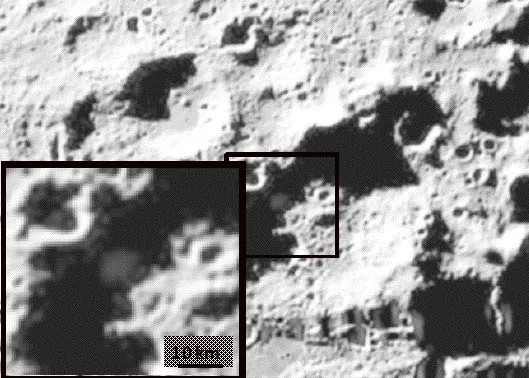
The LCROSS probe impacted the lunar south pole at a crater called Cabeus on Oct. 9. The $79 million spacecraft, preceded by its Centaur rocket stage, hit the lunar surface in an effort to create a debris plume that could be analyzed by scientists for signs of water ice.
Those signs were visible in the data from spectrographic measurements (which measure light absorbed at different wavelengths, revealing different compounds) of the Centaur stage crater and the two-part debris plume the impact created. The signature of water was seen in both infrared and ultraviolet spectroscopic measurements.
"We see evidence for the water in two instruments," Colaprete said. "And that's what makes us really confident in our findings right now."
How much?
Based on the measurements, the team estimated about 100 kilograms of water in the view of their instruments — the equivalent of about a dozen 2-gallon buckets — in the area of the impact crater (about 66 feet, or 20 meters across) and the ejecta blanket (about 60 to 80 meters across), Colaprete said.
"I'm pretty impressed by the amount of water we saw in our little 20-meter crater," Colaprete said.
"What's really exciting is we've only hit one spot. It's kind of like when you're drilling for oil. Once you find it one place, there's a greater chance you'll find more nearby," said Peter Schultz, professor of geological sciences at Brown University and a co-investigator on the LCROSS mission.
This water finding doesn't mean that the moon is wet by Earth's standards, but is likely wetter than some of the driest deserts on Earth, Colaprete said. And even this small amount is valuable to possible future missions, said Michael Wargo, chief lunar scientist for Exploration Systems at NASA Headquarters.
Scientists have suspected that permanently shadowed craters at the south pole of the moon could be cold enough to keep water frozen at the surface based on detections of hydrogen by previous moon missions. Water has already been detected on the moon by a NASA-built instrument on board India's now defunct Chandrayaan-1 probe and other spacecraft, though it was in very small amounts and bound to the dirt and dust of the lunar surface.
Water wasn't the only compound seen in the debris plumes of the LCROSS impact.
"There's a lot of stuff in there," Colaprete said. What exactly those other compounds are hasn't yet been determined, but could include organic materials that would hint at comet impacts in the past.
More questions
The findings show that "the lunar poles are sort of record keepers" of lunar history and solar system history because these permanently-shadowed regions are very cold "and that means that they tend to trap and keep things that encounter them," said Greg Delory, a senior fellow at the Space Sciences Laboratory and Center for Integrative Planetary Sciences at the University of California, Berkeley. "So they have a story to tell about the history of the moon and the solar system climate."
"This is ice that's potentially been there for billions of years," said Doug Cooke, associate administrator at Exploration Systems Mission Directorate at NASA Headquarters in Washington, D.C.
The confirmation that water exists on the moon isn't the end of the story though.One key question to answer is where the water came from. Several theories have been put forward to explain the origin of the water, including debris from comet impacts, interaction of the lunar surface with the solar wind, and even giant molecular clouds passing through the solar system, Delory said.
Scientists also want to examine the data further to figure out what state the water is in. Colaprete said that based on initial observations, it is likely water ice is interspersed between dirt particles on the lunar surface.
Some other questions scientists want to answer are what kinds of processes move, destroy and create the water on the surface and how long the water has been there, Delory said.
Link to Chandrayaan?
Scientists also are looking to see if there is any link between the water observed by LCROSS and that discovered by Chandrayaan-1.
"Their observation is entirely unique and complementary to what we did," Colaprete said. Scientists still need to work out whether the water observed by Chandrayaan-1 might be slowly migrating to the poles, or if it is unrelated.
Bottom line, the discovery completely changes scientists' view of the moon, Wargo said.
The discovery gives "a much bigger, potentially complicated picture for water on the moon" than what was thought even just a few months ago, he said."This is not your father's moon; this is not a dead planetary body."
Let's go?
NASA plans to return astronauts to the moon by 2020 for extended missions on the lunar surface. Finding usable amounts of ice on the moon would be a boon for that effort since it could be a vital local resource to support a lunar base.
"Water really is one of the constituents of one of the most powerful rocket fuels, oxygen and hydrogen," Wargo said.
The water LCROSS detected "would be water you could drink, water like any other water," Colaprete said. "If you could clean it, it would be drinkable water."
The impact was observed by LCROSS's sister spacecraft, the Lunar Reconnaissance Orbiter, as well as other space and ground-based telescopes.
The debris plume from the impacts was not seen right away and was only revealed a week after the impact, when mission scientists had had time to comb through the probe's data.
NASA launched LCROSS, short for Lunar Crater Observation and Sensing Satellite, and LRO in June.
