


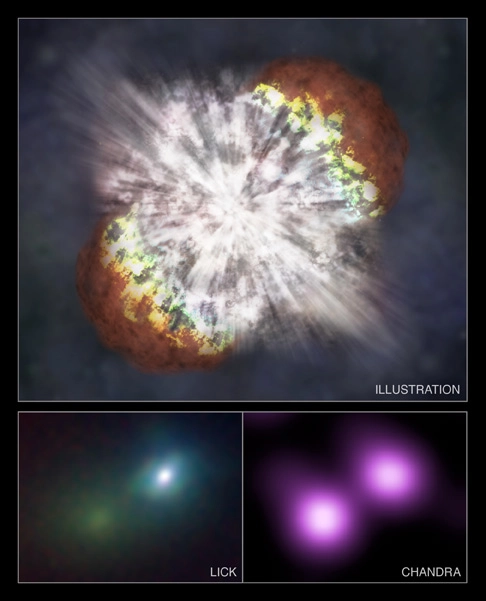
ST. LOUIS ? Quark stars, exotic objects thathave yet to be directly observed, are part of a new theory to explain some ofthe brightest stellar explosions recorded in the universe.
Super-luminoussupernovae, which produce more than 100 times more light energy than normal supernovaeand occur in about one out of every 1,000 supernovae explosions, have longbaffled astrophysicists. The problem has been finding a source for all of thatextra energy.
University of Calgary astrophysicists Denis Leahy andRachid Ouyed think they have a possible source ? the explosive conversion of aneutron star into a quarkstar.
A neutron staris a compact stellar corpse with a mass equal to about 1.5 suns packed into aspace no more than 16 miles (26 km) across. Though still just theoretical as nodirect evidence yet exists, a quark star is thought to be even denser, packinga similar mass into an object just 12 miles (19 km) across.
Leahy andOuyed's computer models suggest a quark-nova explosion would account for the extraenergy observed in super-luminous supernovae. The properties they found intheir simulations matched up with those of three of the most luminoussupernovae to date: SN2006gy, SN2005gj and SN2005ap.
"Intheory, when a neutron star converts into a quark star it releases a lot ofenergy and it produces something that looks like a supernova explosion in termsof energetics," Leahy said during a presentation of the results today,here at a meeting of the American Astronomical Society (AAS).
The low-down
Here's howthe scenario could work: The explosive collapse of a massive star generates a neutronstar. If that neutron star is massive enough, the neutron star will convertinto a quark star, which is packed with quarks.
"Ifyou make a neutron star massive enough, gravity compresses it so you get ahigher and higher density in the center," Leahy said. "If youcompress matter to a high enough density you'll get quark matter."
Sincequarks are a lower energy state than neutrons, the conversion should releaseloads of energy, enough to power a second explosion called a quark-nova.
In atypical supernova explosion, most of the released energy is used to push offthe cloud of gas as the star collapses. This so-called envelope of gas expandsoutward. Just a fraction of a percent of the energy goes into the spectacularlight shows of supernovae.
Leahy saidthat if a second explosion, the quark-nova, were to occur 10 to 20 days afterthe supernova, the energy wouldn't have to go into expanding the gas envelope.Instead, most of the energy would be in the form of light radiation. Thatradiation could explain the brightest supernova recorded, he said.
Oddmatter
The resultsare of special interest for two reasons: Astronomers previously did not have asatisfactory explanation for super-luminous supernovae; and the model providesindirect evidence for the existence of quark stars, Leahy said.?
"Noone has given a satisfactory explanation for these super-luminoussupernovae," Leahy told SPACE.com. "Until somebody does with anormal mechanism, I think it [this theory] does provide some evidence, becauseyou need to get that energy."
Quarks areconsidered to be the tiniestelementary particles that form the building blocks for protons andneutrons, which in turn form atoms. While protons and neutrons are thought to bemade of three quarks each, a short-lived particle called a pion is made up ofjust two quarks and eventually decays into photons, electrons and neutrinos.
So thefinding, albeit theoretical, brings astronomers a step closer to understandingand possibly finding more evidence for the existence of quarks.
Otherexplanations for the bright supernovae are possible, the researchers say, sofurther research is needed to confirm the new quark-nova model.
This workwas supported by the Natural Sciences and Engineering Research Council ofCanada.
- Video: Supernova ? Destroyer, Creator
- Top 10 Weirdest Things in Space
- Gallery: Spitzer's Infrared Views of the Universe
