


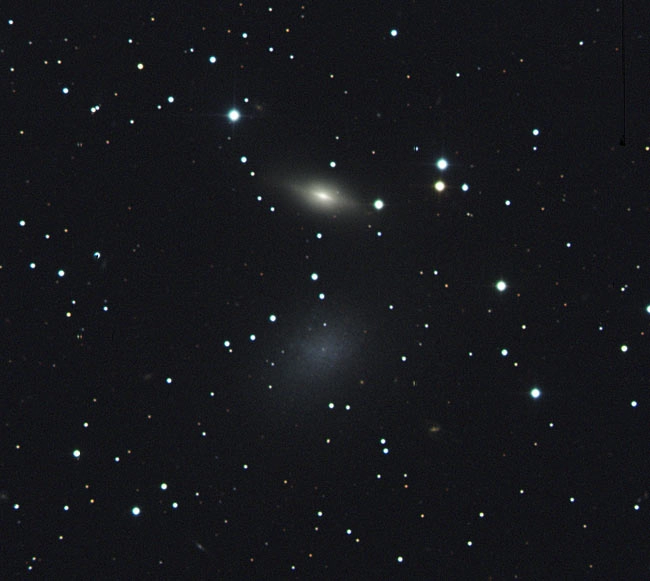
Astronomersare rubbing their eyes after discovering that a galaxy assumed to have been a giant forthe past 23 years is in fact a dwarf,according to new observations.
NGC 5011C,a galaxy in the vicinity of the MilkyWay is located towards the Centaurus constellation, one of the largest constellations of the southernhemisphere. Because of its low density of stars and absence of other features,astronomers would normally classify such a galaxy as a dwarf elliptical--a smallfaint galaxy with little gas and dust that mainly consists of old stars.
However,for years scientists thought that NGC 5011C was located in the more distant Centauruscluster--located some 155 million light years away--close to the NGC 5011B galaxy,its bright red companion. So they pinned it as a giant galaxy that was just faraway.
Mostgalaxies--the basic units of the universe which contain stars, gas,dust, and darkmatter bound together by one central gravitational force--are found ingravitationally joined binary pairs or in groups. So it was no surprise thatthe projection of NGC 5011C and NGC 5011B in the sky had astronomers believingthat they were cohorts at about the same distance from our own.
But newdata obtained with the 3.6-m ESO telescope,revealed that the two galaxies have very different red shifts and are notat the same distance as once believed. NGC 5011C is centered around the CentaurusA galaxy group which is estimated to be about 13 million light years away fromour galaxy, while the NGC 5011B galaxy--a member of the Centaurus cluster--is about12 times farther away.
The NGC5011C galaxy lies outside of the LocalGroup, a small group of around 30 galaxies that include our own Milky Way. Beingthat the Universe is about 14billion years old, observing NGC 5011C will giving us a small glimpse of theuniverse as it was just yesterday--more than 95 percent of its current age.
Theastronomers then determined that NGC 5011C contains only about 10 million timesthe mass of the Sun in stars. Therefore it's considered a dwarfgalaxy.
"Ournew observations with the 3.6-m ESO telescope thus confirm a new member ofthe nearby Centaurus A group whose true identity remained hidden becauseof coordinate confusion and wrong distance estimates in the literature forthe last 23 years," said Ivo Saviane, aresearcher from the European Southern Observatory.
- Milky Way Galaxy: The Best of Your Images
- VOTE NOW: Most Amazing Galactic Images Ever
- Video Player: Our Corner of the Cosmos
- Images: Hubble's New Views of the Universe
- All About Galaxies
