


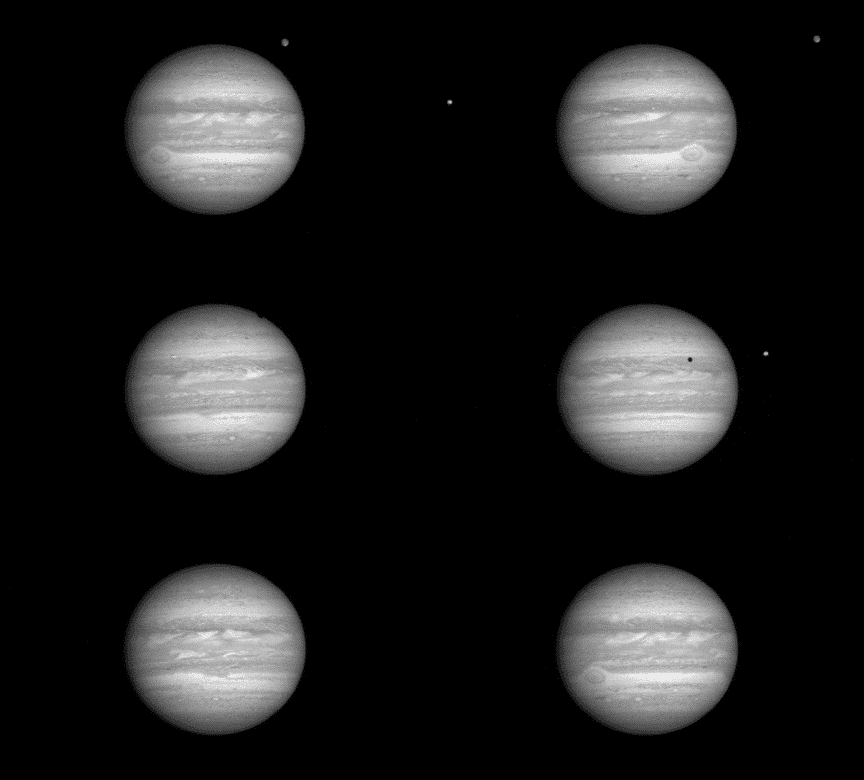
Jupiter, the largest planet in the solar system, is about to welcomea robotic visitor.
NASA's NewHorizons probe will make its closest pass by the gas giant at about 12:45a.m. EST (0545 GMT) Wednesday in a sort of cosmic stopover on its long trek to distantPluto and the KuiperBelt. The planetaryflyby comes just 13 months after NewHorizons' launch, with the probe hurtling through space at about 47,000miles per hour (75,639 kph) on what NASAis billing as its fastest mission to solar system's edge.
"We have avery narrow window in space that we have to hit," New Horizons principalinvestigator AlanStern, of the Southwest Research Institute (SwRI) in Boulder, Colorado, hassaid of the rendezvous. "It's about 500 miles (804 kilometers) across and wehave to hit it from 500 million miles (804 million kilometers) away, from the Earth."
It's theequivalent of shooting a skeet target in Baltimore, Maryland from a firingrange in Washington, said Stern [VIDEO:Follow the Jupiter flyby].
Atits closest approach, the New Horizons is expected to fly within 1.4 million miles (2.3 millionkilometers) of Jupiter. The first data from that pass is expected to arrive atEarth via the Deep Space Network at around 12:00 p.m. EST (1700 GMT) Wednesday,officials at the Johns Hopkins University's Applied Physics Laboratory (JHUAPL),which is overseeing the mission for NASA, told SPACE.com [VIDEO:Passport to Pluto].
NewHorizons is the first probe to visit Jupiter since NASA's Galileoorbiter plungedinto the gas giant's atmosphere to end its 14-yearmission in 2003. The Cassini orbiter,currently circling the planet Saturn,swungpast Jupiter in December 2000.
Newscience awaits
Already,the New Horizons probe has returned new views [image1, image2] and movies of Jupiter's moons [viewmovie], though the interaction of the Sun'ssolar wind with the planet's vastmagnetosphere takes center stage for some researchers.
Jupiter hasthe largest magnetosphere in the solarsystem, with its trailing non-Sunward direction - known as the magnetotail [image]- stretching out towards the orbit of Saturn. New Horizons instruments havealready detected a dense region of solarwind known as a shock, which develop as a fast layer of solar windparticles compress a slower layer ahead like a snow plow.
"I thinkthe most exciting part about the next few days is that we'll see our closestmeasurements to Jupiter," SwRI's David McComas, principal investigator for NewHorizon's Solar Wind Around at Pluto (SWAP) instrument, told SPACE.com.
New Horizons'observations of Jupiter's magnetic field will help researchers determine whichprocesses - such as solar wind or planetary rotation - spawn auroras and other phenomena. Theresults will be compared tandem studies by the Hubble Space Telescope andother space and ground-based observatories, McComas said.
ThePluto-bound probe will also be the first spacecraft ever to fly down Jupiter'smagnetotail, a journey that could take anywhere between 45 and 70 daysdepending on how the magnetic field "flaps" as it extends from the gas giantplanet, researchers said.
"It's sortof like a windsock...because the solar wind doesn't flow exactly radially outward,"McComas said of the magnetotail, which may extend anywhere between 1,000 and1,500 times the radius of Jupiter. The planet's radius spans about 43,495 miles(70,000 kilometers).
Spacecraftshakedown
NewHorizons' Jovian magnetosphere studies are part of no less than 700 separateobservations planned during the Jupiter flyby, which serves as a shakedownperiod for the spacecraft's seven instruments. The probe will also grab agravitational boost from the planetary pass, shaving three years off its journeyfor a July 2015 Pluto rendezvous [image].
"Hereon the ground we aren't yet seeing much science data, but the engineering datawe're getting shows the encounter is progressing nominally and the variousobservations are coming off right on schedule," Stern wrote in Monday statusupdate on the New Horizons mission website at JHUAPL.
NewHorizons began studying Jupiter and its moons in earnest on Feb. 24, and is conductingbetween 15 and 20 observations each day, Stern said. On Monday, the spacecraftwas due to map the surfaces of Jovian moons Ganymedeand Europa,study the atmospheres of satellites Ioand Callisto,as well as photograph Jupiter's"Little Red Spot," Io's volcanicplumes and the gas giant planet's faint rings, he added.
Ittakes about 45 minutes for a signal from New Horizons to reach Earth from Jupiter'sneighborhood, according to a mission description.
Muchof New Horizons' Jupiter flyby instructions have already been uploaded to the spacecraftsince the probe will be out of contact with Earth while it studies the Joviansystem.
Thoseinstructions include an auto shutdown of the SWAP instrument in case Jupiter'snear magnetosphere proves too strong for the tool, which was designed primarilyfor the Pluto environment, McComas said. If that occurs, SWAP should restartautomatically once New shortly after Horizons' closest swing past Jupiter, headded.
"You workon these things for many years, designing and developing, going through alaunch and getting the thing up in space," McComas said. "It's an extremelyexciting time for my team and me."
- VIDEO: Follow New Horizons on its Jupiter Flyby
- IMAGE MOVIE: View Jupiter's 10-Hour Day as Seen by New Horizons
- Pluto-Bound Spacecraft to Nab Speed Boost in Jupiter Flyby
- VIDEO: Passport to Pluto
- IMAGES: Bound for Pluto
- IMAGES: The New Solar System
- Reaching for the Edge: Complete Coverage of New Horizon's Pluto Mission
- All About Jupiter
