





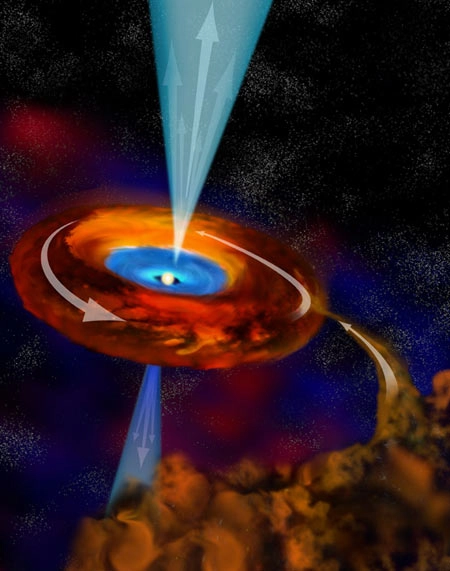
Observations confirmed a leading theory that adoughnut-shaped ring of material could be responsible for the formationof massivestars, scientists reported today.
Smaller starstypically form when clouds of dust and gas collapseinto a ball of compact material.
Stars that are 10 times more massive than the Sun, however, generate powerful stellarradiation, which can prevent the accumulation of material.
Doughnut disk
One model suggests that the radiation shoots out stronger atthe poles of the star and is much weaker in the equator regions. Mattertherefore forms a whirling disk, much like a doughnut, around the equator ofthe star. Most of the radiation escapes without hitting the disk so materialkeeps falling onto the star from the disk.
"If this model is correct, there should be materialfalling inward, rushing outward and rotating around the star all at the sametime," said leader Maria Teresa Beltran, of the University of Barcelona inSpain.
Beltran and colleagues found one such star, G24 A1, a youngobject some 25,000 light-years from Earth and up to 20 times more massive thanour Sun.
"For the first time, we have revealed the simultaneouspresence in the same massive object of material moving outward, material movinginward, and rotation," Beltran said. "These three elements, outflow,infall and rotation, are commonly found during the formation process of lowmass stars."
Tracing gas
Using the National Science Foundation's VeryLarge Array (VLA) radio telescope, the researchers traced the inward motionof the material.
"By studying the velocity field of the gas wedetected a Dopplershift toward positive velocities of the surrounding gas, which indicatesthat the gas is moving inward the star," Beltran told SPACE.com.
The Doppler shiftin the frequency of radio waves emitted by ammonia molecules present in thematerial gave scientist information on the motion of the gas.
Beltran says that the detection of gas falling inward towardthe star is an important milestone and supports one of several proposed waysfor massive stars to accumulate their great bulk. But she does not exclude thetheory of smaller star collision.
"Wethink that the coalescence mechanism to form massive stars could still berequired to form even more massive stars, or to form massive stars where thestellar densities are very large."
The study is detailed in the Sept. 28 issue of the journal Nature.
- Collapse or Collision: The Big Question in Star Formation
- Explosive Appetite: Star Caught Devouring Companion
- Forces of Creation: Black Holes Spark Star Formation
- Unknown Force Triggers Star Formation
- How Magnetic Fields Help Stars Form
