Far Out! New Deep Space Mission Ideas Draw NASA's Eye
This story was updated at 3 p.m. ET.
NASA is taking a close look at new concepts to send crews on deep space expeditions near the moon, as a promising next major "stepping stone" for human spaceflight.
The goal of the appraisal is to focus on what can be accomplished affordably in the near future, to showcase NASA’s ability to venture beyond low-Earth orbit (LEO).
The space agency’s last manned foray beyond LEO was 39 years ago — the Apollo 17 trek to the moon in 1972. It was the sixth and last moon landing mission by astronauts.
At the heart of current efforts to explore beyond Earth's orbit is extensive use of the International Space Station, which astronauts can use to prepare for human travel beyond LEO. Moreover, work is underway to find novel ways to reuse existing equipment at the space station.
For instance, leftover components from the station and the now-defunct space shuttle program could be used to house technology demonstration hardware. Indeed, a combo of shuttle/station gear could be re-tasked and put together into a spacecraft for operations beyond LEO, researchers said. [Gallery: NASA's Vision for Deep Space Missions]

Deep space scenarios
One ambitious human voyage on the table is long-duration crewed operations at libration points, gravitationally stable points in space that are also known as the Lagrangian points.
The Lagrange points are space places where the combined gravitational pull of two large masses roughly balance each other out, allowing spacecraft to essentially "park" there.
There are five Lagrange points in near-Earth space. The closest Earth-sun Lagrange points are L1 (between Earth and the sun) and L2 (behind Earth, as viewed from the sun), which are about 930,000 miles (1.5 million kilometers) from the planet. For comparison, the moon is typically about 238,000 miles (382,900 km) from Earth, and represents the farthest point from Earth humans have ever explored.
Space architects contend that Lagrange point travel could sharpen human skills and technologies for even more challenging manned space sojourns.
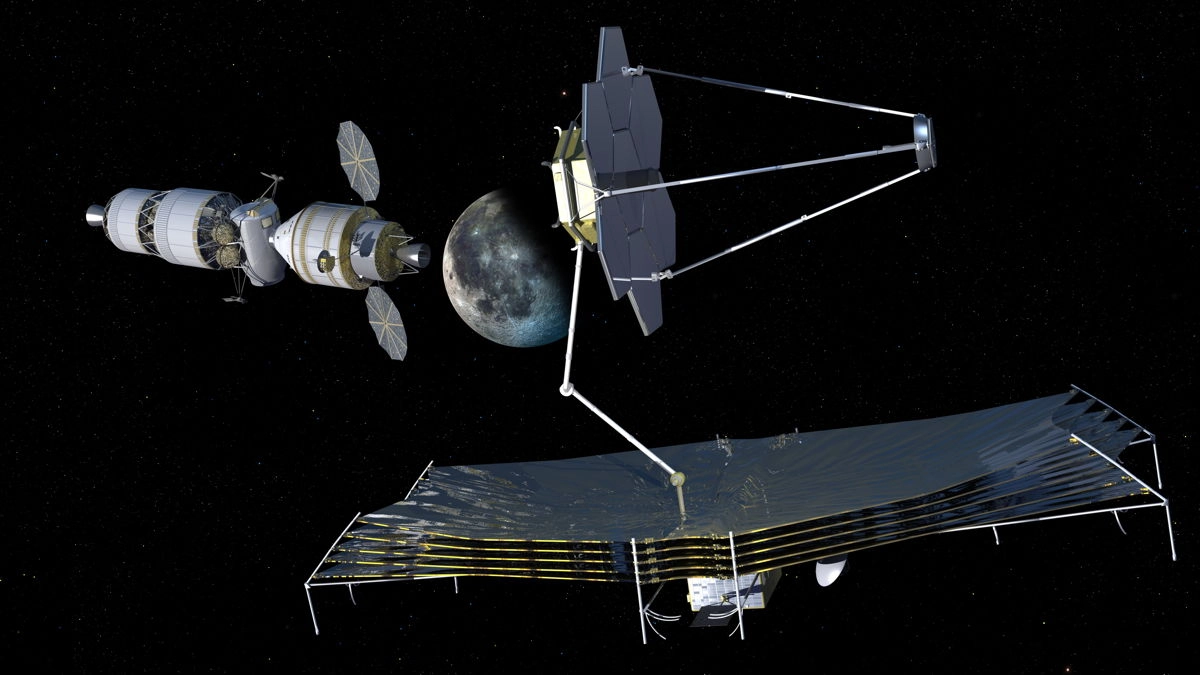
Other L-point scenarios involve support of lunar surface exploration, but done tele-robotically; creation of a refueling site; and/or assembly/upgrade of future very large optical systems.
"In the current budget environment, we are taking the view that we can resume human space exploration beyond LEO now … with the systems that we have … or continue to wait for the lengthy development of systems that we wish we had," said Harley Thronson, senior scientist for advanced concepts at the Astrophysics Science Division of NASA Goddard’s Science and Exploration Directorate.
Thronson also leads the Future In-Space Operations Working Group, which has served as a wellspring of beyond-ISS viewpoints.
"Libration points and other cis-lunar orbits offer operations sites within relatively easy return to Earth," Thronson told SPACE.com. Technologies and capabilities first deployed on ISS, he said, can be further developed at libration points to help prepare for very long human voyages.

Exploring "free space"
"Our recommendations have been to demonstrate the capabilities for safe, comfortable and productive human activities in free space. These would be in advance of the extremely long voyages proposed for beyond the Earth-moon system," Thronson said. "Once this was demonstrated, humans and robots could then descend into the deep lunar gravity well and explore the moon’s surface, perhaps supported by growing capabilities in free space near the moon."
Thronson pointed out that free space missions have long been discussed.
"The handful of us working on concepts and operations for human operations in free space beyond LEO felt for much of the past decade that we were consigned to the wilderness," Thronson said. Meanwhile, more mainstream planning for exploration concentrated on, for example, a mini-colony at the lunar south pole, he noted.

Far side of the moon
"Interest in a mission to the Earth-moon L2 region is growing at NASA and among international partners,” said Josh Hopkins, space exploration architect at Lockheed Martin Space Systems Co. near Denver. The firm is building the Orion Multi-Purpose Crew Vehicle, NASA's next-generation spacecraft for manned deep-space exploration. [Photos: NASA's Orion Space Capsule]
Hopkins said more people are recognizing that there are important lunar exploration objectives on the farside, and that Earth-moon L2 is easier to reach than L1 or low lunar orbit.
"Orion and some of the ISS supply vehicles would be capable of supporting missions in L2 halo orbits with straightforward modifications," Hopkins told SPACE.com.
Lockheed Martin is working on how best to navigate beyond the moon and how Orion’s communications system might be used to control rovers on the lunar farside, Hopkins added.
Astronauts at the L2 point could enhance via teleoperation a sample return mission from the moon’s South Pole-Aitken basin, Hopkins said. In the longer term, a low-frequency radio telescope array on the farside could be deployed to probe the "dark ages" of the universe, he said.
"Human-hostile" destinations
"We’re calling it on-orbit telerobotics or, in a more spin-worthy way, exploration telepresence," said Dan Lester, a scientist at the University of Texas in Austin.
"This is where astronauts control surface telerobots from close enough to the exploration site that they can have some cognitive coupling with the activities there," Lester told SPACE.com.
Modern telerobotics are becoming sophisticated enough that real avatarlike operations are getting increasingly realizable, Lester said. There is increasing interest within NASA circles to start looking seriously at this approach "to getting human cognition down to exploration sites before human flesh can actually get there," he said.
"We’re thinking that a hab at Earth-moon L1 could offer long-term control of near-side telerobotics across the hemisphere," Lester said. "What’s pretty cool is that such a hab could, with a minimum of propellant, be re-stationed at Earth-moon L2, offering long-term control on the far side."
Lester envisions doing on-orbit telerobotic control of lunar surface telerobots from the Earth-moon L1 as an important near-term activity.
In the longer term, astronauts could do this at Mars from orbit. In the long run, Lester pointed out, the strategy opens up very "human-hostile" destinations to exploration, like the steamy surface of Venus, or the methane lakes of Titan, for example.
"Again, it’s the extensibility of this strategy that is pretty slick. Once you learn how to do it at the moon, you can do it all over the solar system," Lester said. "It basically increases the number of possible exploration destinations for humans, because it's not about putting human flesh on a site, but about putting human cognition there."
Leonard David has been reporting on the space industry for more than five decades. He is last year’s winner of the National Space Club Press Award and a past editor-in-chief of the National Space Society's Ad Astra and Space World magazines. He has written for SPACE.com since 1999.