Moonwalker Jack Schmitt and the Future of US Space Exploration (Exclusive Interview)
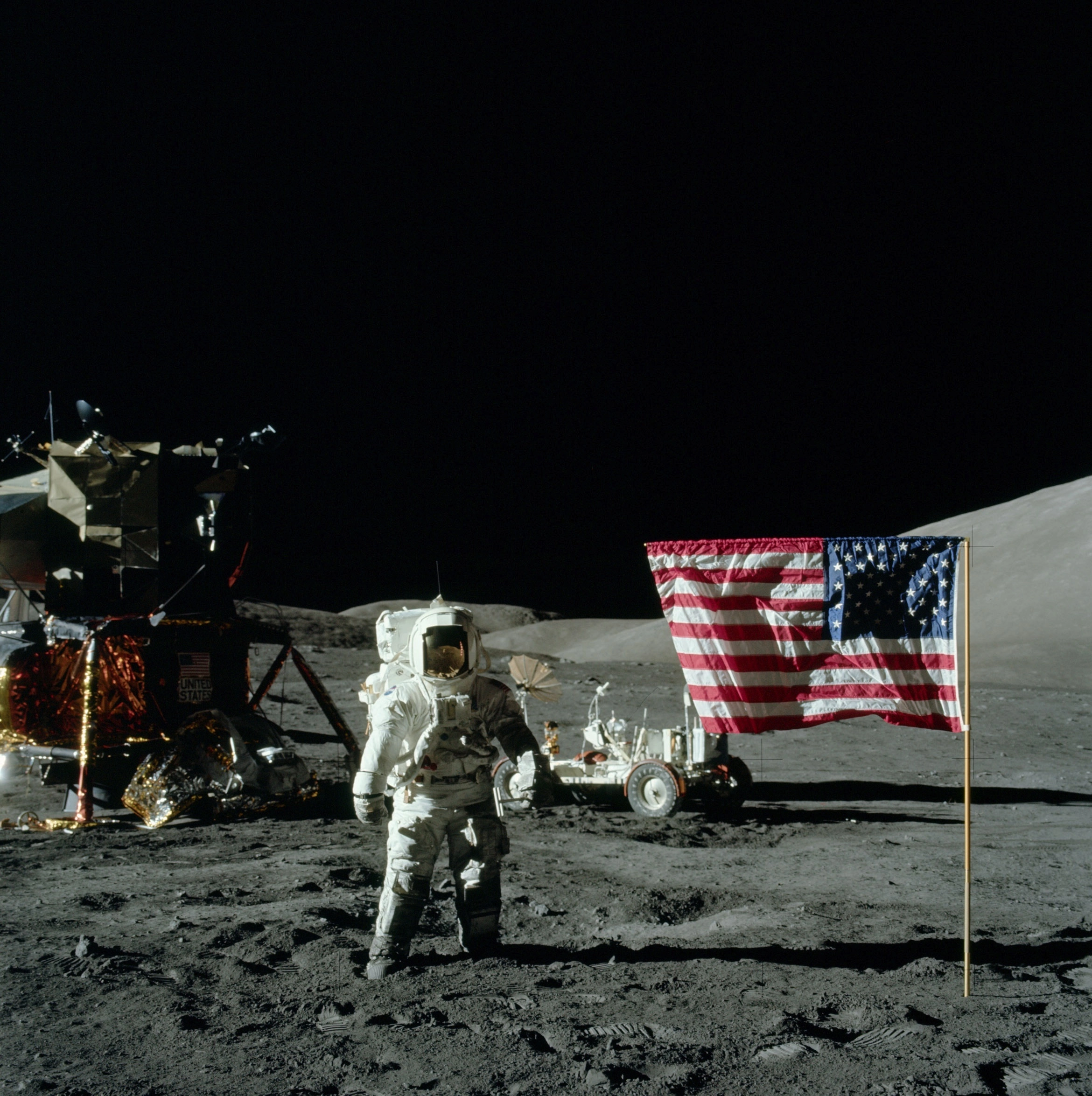
THE WOODLANDS, Texas — Harrison "Jack" Schmitt has already been to the moon and walked on its surface. But he is eager to see a rebirth of the zeal for United States human space exploration that boosted Schmitt and fellow astronaut, Eugene Cernan, onto the lunar surface back in December 1972, as Ronald Evans circled that airless world as Command Module Pilot.
The Apollo 17 mission — the sixth landing of astronauts on the moon — was America’s last human connection to that crater-pocked and dusty globe. Landing in the moon’s Taurus-Littrow valley, the expedition set several records, such as: the longest manned lunar landing flight; the most time spent by astronauts on the lunar surface; and hauling back the largest cache of moon samples to Earth.

Schmitt, a professional geologist, is a member of an elite club, one of the “dusty dozen” to have strolled across the lunar landscape. He was the last man to set foot on the moon. [NASA's 17 Apollo Moon Missions in Pictures]
Now heading toward age 79, Schmitt departed his NASA scientist-astronaut duties in August 1975 to run for the U.S. Senate, elected to that post and served a six-year term as one of New Mexico’s Senators in Washington, D.C.
Space.com sat down with Jack Schmitt for an exclusive interview during the 45th Lunar and Planetary Science Conference (LPSC) held here in March to discuss his moonwalking experience, space politics and the future trajectory of the U.S. space program.
Space.com: U.S. astronauts returning to the moon, how do you resurrect that prospect?
Jack Schmitt: There is one big difference between now and then with the Apollo program. Now, as then, a return rests on geopolitical considerations. That tact might be stimulated in the future, near-term or far-term. But there is another path that we didn’t think about in those days of Apollo and that is an investor-based path. That is quiescent right now, even though there are some small groups talking about this approach. It’s another path that may or may not move forward.
Space.com: Investing in the moon seems like a long-shot, both in distance and money back, no?
Schmitt: The amount of investment capital needed to really do something, say like helium-3 mining, is significant. It’s out of the range of the private sector that has invested in other things because space investment seems way out. Oil companies see that they can get a more guaranteed rate of return, in their mind, by increased investment in exploration for oil and gas.
I’m trying to be a little bit philosophical about this, which is tough to do. Keep in mind how long it took for the private sector to get interested in the Louisiana Purchase. It was comparable to what we’ve gone through after Apollo. It’s also similar in many ways with the transcontinental railroad and the establishment of private property in the west.
Settlement does go in pulses. And we’re in a lull right now. I can’t predict when the next pulse — private sector or investor-based or government-based — is going to take off. You just hope that history repeats itself.
Space.com: Your tenure as U.S. Senator surely gave you a front-row seat into the issue of funding a sustained space program?
Schmitt: NASA funding looks bigger than it is relative to the entire budget … and it isn’t very big, even relative to the non-entitlement, discretionary monies being spent. The Congress and Administration we have today are unwilling to cut other things in order to fund space, except to the level that it keeps jobs in their district or in their state. Today, basically, NASA is carrying the Apollo overhead. And in real numbers, it doesn’t have the same budget.

Space.com: So what needs to be fixed first to get the U.S. space program going in forward gear?
Schmitt: Political leadership of the country has to decide that, geopolitically, it’s important for the U.S. to be dominate in deep space, or at least competitive, but dominate would be better. Until the political leadership makes that decision there’s not much else we can do except try to make sure that the science community at least is prepared. Hopefully, the technology community is going to be prepared too. Both need to be ready, given a challenge by some new leadership of the country that recognizes the geopolitical significance of deep space.
Space.com: Any other concerns about NASA as an organization? You have advocated for a new space agency, replacing NASA with a National Space Exploration Administration.
Schmitt: If we ever decide to go into deep space again, doing it with a new agency may be the best way…that’s why I wrote that essay. NASA needs to be a younger agency. The average age needs to be back where it was in Apollo. The engineering population at the time, NASA and the contractors…they were in their 20s. That’s what you’ve got to have. What’s needed is having that stamina, the motivation, the courage and competence of young people. Some have said, most importantly, people that don’t know how to fail yet. [Lunar Legacy: 45 Apollo Moon Mission Photos]
First of all you need a big program to attract them. Then you have to make sure that you are managing it in a way that’s highly efficient. The Apollo program was highly efficient. You can’t launch a Saturn V every two months and not be efficient.

Space.com: What about the “China card” and their intent to send humans to the moon?
Schmitt: They have been saying that for a long time, as well as saying that lunar helium-3 is one of the primary drivers. I think they are interested because of the success of Apollo. They see the geopolitical significance of Apollo. They think that they will gain international prestige and influence and, in fact, dominance over nearby countries, if not the entire world, in deep space exploration.
Space.com: Do you see the moon as a private-sector opportunity where as NASA should be spending research and development dollars in technology to send humans to Mars?
Schmitt: Yes, I think right now it is fairly clear-cut. What it will be a 100 years from now, I can’t tell you. But if the private sector were successful in developing a supply of helium-3 from the moon, it would mean that a great deal of the technological capability to do Mars would have been developed.
Space.com: How so?
Schmitt: You would have the heavy lift rocket systems required to access lunar resources. You would have the moon as a test bed for working out all the operational issues that are still associated with Mars. In developing those rocket systems, there are many things that would be in place…to contract from the private sector.
Schmitt: But the space part won’t happen until you have the demonstration that the helium 3 fusion is a viable power plant technology. That would have to come first. But I think that this can be done, about a $5 billion investment to show that it is indeed a viable energy approach. Once you have helium-3 going, I have always thought of the so-called consumables – oxygen, water, you name it – those are a by-product of the helium 3 operation.
You’ve got to have a space infrastructure that creates a demand for the oxygen and water. But it’s not something that can support an investor-base business, unless the space facilities are there, and the infrastructure is in place to use those resources.
Space.com: You set foot on the moon in 1972, geology pick in hand. But even today there seems to be a quandary about how the moon formed. Why is this still being deliberated?
Schmitt: Even here at LPSC, there’s debate on the moons of Mars. Were they captured or not? Most of the evidence seems to be leaning toward capture. How the diverse set of moons around Jupiter formed, your guess is as good a mine. [Our Solar System: A Tour of the Planets]

As for Earth’s moon, there are a number of things that are bothering the giant impact community. And there is argument for the moon’s capture around Earth. But my view is that, when scientists get dogmatic, I tend to go the other way. I’m a skeptic at heart and always start looking for another explanation. I think this comes from my dad. In his mining world, he hated to see people getting dogmatic.
We have to remember that we’re testing hypotheses. Frankly, I like to see people squirm a bit when they become a little dogmatic. The giant impact hypothesis has gotten so wedded into the culture that students are being taught it as fact. It’s a model. It has to be hypothesis.
Space.com: What next for Jack Schmitt?
Schmitt: I have been busy trying to integrate the scientific output from my Apollo 17 experience with what came out of the work we did on Apollo 17, scientifically, with the actual mission sequence of what took place.
But I want to do more than that; tell not just what happened on the moon, but also something I call 30 days in counting – before our launch. This includes our training, how we interacted with mission control, the en route systems work that we had to do, plus getting all the scientific observations clearly distinguished from operations … even working on a broken fender on our moon rover. I’m writing something that is really a diary, but to also try to make it interesting and readable.
Space.com: That sounds like the most documented of all the Apollo landings on the moon?
Schmitt: If I finish it. It’s huge. It is probably five books, at least!
Leonard David has been reporting on the space industry for more than five decades. He is former director of research for the National Commission on Space and is co-author of Buzz Aldrin's new book "Mission to Mars – My Vision for Space Exploration" published by National Geographic. Follow us @Spacedotcom, Facebookand Google+. Original article on Space.com.