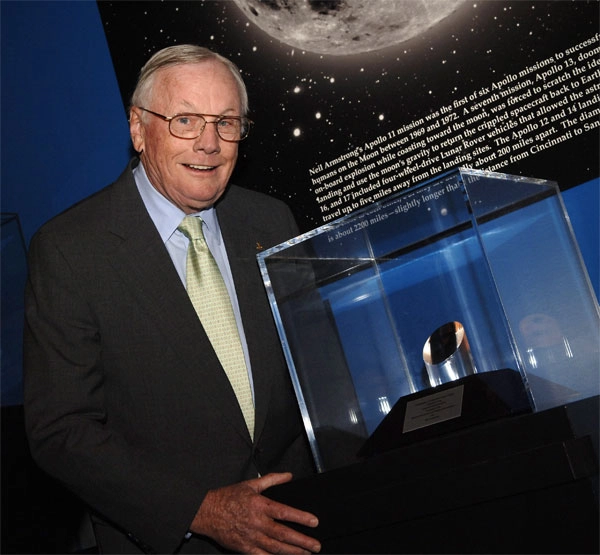
Apollo'sfirst moonwalker Neil Armstrong was honored today as NASA Ambassador ofExploration at an event hosted by the Cincinnati Museum Center at UnionTerminal in Ohio. During the televised ceremony, Armstrong was presented with asmall sample of a moon rock he returned from the lunar surface, which in turnhe donated to the center's Museum of Natural History and Science for publicdisplay.
NASAAdministrator Michael Griffin introduced Armstrong to the invited audience,which included members of the astronaut's family.
In additionto commanding the first moon landing in 1969, Armstrong was honored for hisX-15 rocket plane flights and for piloting Gemini 8, "by all accounts themost harrowing space mission that the United States has yet executed and fromwhich survival was possible," recounted Griffin. "Neil is, if nothingelse, an engineering test pilot, and in that milieu, is a test pilot's testpilot."
Acceptingthe award, Armstrong described the acrylic-encased moon rock as"impressive" while still acknowledging that it was only on loan fromNASA. "I get to keep it myself only so long as I speak today, so I amgoing to be talking longer than I otherwise would," quipped Armstrong.
Armstrongused his time to explain why he had chosen a natural science museum to exhibitthe award. "Many here would know that natural history is the history ofthings in nature--animal, vegetable or mineral--and excludes humans and theiractivities. So we might conclude that the recounting of human activities istherefore, by the process of elimination, unnatural history," explainedArmstrong. "Today, I'd like to recount some of the things we have learnedand talk just a bit about a specific, but very thin slice of naturalhistory."
"Manyeons ago, maybe half a star lifetime," began Armstrong, twisting a talethat encompassed the formation of the solar system and the Earth-Moon system tothe formation of "his" rock.
"A seaof molten basalt is slowly solidifying. As the crust cools, it cracks. Currentsof hot lava press upward, fracturing and sculpting the fresh rock above it. Apiece of this young basalt is completely separated from its mother. Hisbrothers and sisters lie nearby. Let's call him "Bok," suggestedArmstrong of the focus of his story. The moonwalker recounted the adventure ofthe small stone, breathing life into geological processes that governed itsaging.
"Duringthe next half-billion years, Bok changed as he grew into adulthood,"continued Armstrong. "Crystals of plagioclase which had somehow formedduring his solidification added a few plates of molecules. He felt this gnawingin his viscera, like a cancer.
Occasionally,he thought he felt the itch of a change of olivine in his vesicles. It was notorganic life, but in his universe and by his standards, it was life."
Summarizingbillions of years in only a few minutes, Armstrong told of Bok's journey fromthe Moon to Earth.
"Itstarted with a rude awakening one lunar morning. A peculiar white creature waslifting him with an unusual metal device. He was roughly thrown into a box withsome acquaintances he knew only slightly and then the lid was closed and it wasdark. There was a brief force, then a sense of lightness for a time. Thenanother brief force and then his weight somehow returned and changed. He feltat least six times heavier than the 190 grams he had weighed back at the Sea of Tranquility on Luna. Suddenly, the lid opened, there was light and more of thosestrange creatures, somehow different and peculiar mechanisms. There was astrange pressure of an atmosphere. And there was a number beside him: 10071.Clearly, they didn't know his name."
Armstrongconcluded while referencing the award that was sitting to his left on thestage. "If you want to see Bok and have him clarify any points that mayhave been obscure, you may do so. He is, or at least part of him is rightthere. The sample on the award is a chip of 2.039 grams, a chip off the old Bok,you might say," Armstrong said to laughter and applause.
"Thankyou Mr. Administrator," Armstrong said to Griffin, "for giving methis opportunity to receive and have possession, ever so briefly of Bok. And Iam now delighted to present him to this museum center and I hope I havepersuaded you that a place of natural history is a great place for Bok tobe."
MuseumPresident Doug McDonald accepted the rock, "Bok", on behalf of the Cincinnati Center where it will go on display along with a replica of Armstrong'sspacesuit.
NASA ispresenting the Ambassador of Exploration Award to the 38 astronauts and otherkey individuals who participated in the Mercury, Gemini, and Apollo spaceprograms. To date, 15 moon rocks have been awarded and placed on publicdisplay, including one to Mercury astronaut John Glenn, who was also present attoday's ceremony honoring Armstrong.
"I'vebeen lucky enough to have a lot of opportunities in my own life, so I am notusually given over too much to envy of other people. That just isn't part of mynature," said Senator Glenn, "but for Neil, I make a bigexception."
Copyright 2006 collectSPACE.com. All rights reserved.