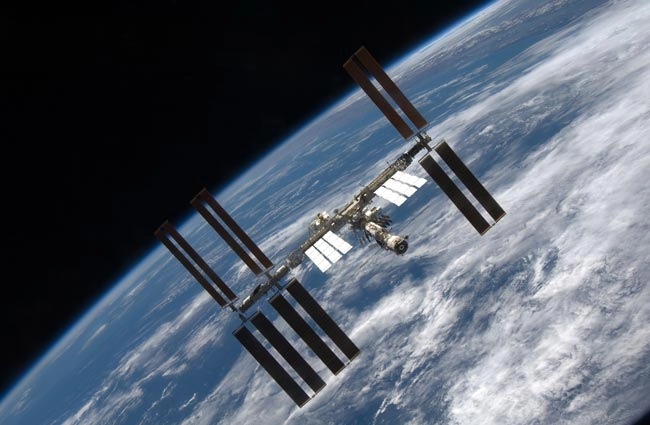
NASAengineers are studying the impact of excessive vibrations aboard theInternational Space Station to make surethe unexpected shaking did not damage the $100 billion orbital lab.
Engineersare checking the space station?s integrity after a Jan. 14 thruster firing aimed atboosting the outpost?s orbit to meet the expected arrival of two spacecraftlater this month. But the two-minute, 22-second rocket engine firing led to ?higher-than-usualstructural oscillations? on the 10-year-oldspace station, NASA officials said in a Jan. 24 update.
Reports ofthe space station?s vibrations were posted in NASA?s daily status updates onthe outpost and first reported by USA Today. Video of the move obtainedby MSNBC shows a wildly shaking camera inside the space station duringthe Jan. 14 maneuver.

NASAofficials have said an initial review of the space station?s subsystems ?havenot shown any off-nominal results,? according to a Jan. 29 update.
Earliertoday, mission managers at NASA?s Johnson Space Center in Houston cleared thespace station?s structure of any concerns for another planned thruster firing initially slated for Wednesday, NASAspokesperson Kelly Humphries said during the agency?s daily mission commentary.But that planned maneuver was cancelled by Russian flight controllers, who said it was no longer required, he added.
The spacestation is in an acceptable position to jettison an older Russian cargo ship,Progress 31, on Thursday, and link up with its Progress 32 replacement on Feb.13, Humphries said. The space station is also in position to meet NASA?s spaceshuttle Discovery, which is slatedto launch Feb. 12 and dock at the orbiting lab two days later to deliverthe final pair of U.S. solar arrays.
Humphriessaid the decision to cancel Wednesday?s space station maneuver did forcemission planners to reschedule the planned March 25 launch of a Russian Soyuzspacecraft carrying the outpost?s next crew and American space tourist CharlesSimonyi. That Soyuz TMA-14 spacecraft will now launch one day later in order tomeet the space station in the preferred position, he added.
TheInternational Space Station is currently home to Expedition18 commander Michael Fincke and flight engineer Sandra Magnus, both ofNASA, and Russian flight engineer Yury Lonchakov. Magnus is slated to returnhome later this month after her replacement, Japanese astronaut Koichi Wakata,arrives aboard the shuttle Discovery.
- Video - Space Station Acrobatics
- Video - Bloopers in Space
- Astronauts to Help Double Space Station Population
