


NASA has awarded a pair of contracts worth $3.5 billion through 2016 to two private aerospace firms seeking to haul vital supplies to and from the International Space Station, the space agency announced late Tuesday.
The Hawthorne, Calif.-based firm Space Exploration Technologies (SpaceX) and Orbital Sciences Corp., of Dulles, Va., beat a third competitor for NASA's Commercial Resupply Services contracts with their proposals to privately develop and launch spacecraft capable to delivering cargo to the space station and returning supplies back to Earth.
"This is a contract that we really need to keep space station flying, and to service space station," NASA's space operations chief Bill Gerstenmaier told reporters in a teleconference. "I think it's exciting we're doing this from a commercial side."
NASA's Commercial Resupply Services plan calls for SpaceX and Orbital Sciences to haul 20 tons of cargo to the space station through 2016. NASA has agreed to pay $1.6 billion for 12 flights of SpaceX's planned Dragon spacecraft and their Falcon 9 boosters. The agency has also doled out $1.9 billion to Orbital for eight flights of its Cygnus spacecraft.
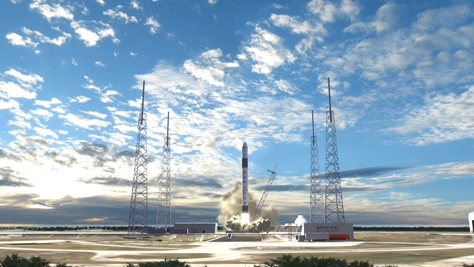
SpaceX plans to launch its Dragon spacecraft atop a Falcon 9 rocket from Florida's Cape Canaveral Air Force Station, while Orbital Sciences is developing its Cygnus vehicle to fly atop its Taurus 2 booster from NASA's Wallops Flight Facility on the eastern coast of Virginia.
Bridging the gap
NASA has been seeking commercial U.S. cargo delivery services to the space station to reduce reliance on its international partners during the anticipated five-year gap between the 2010 retirement of its aging space shuttles and the first operational flights of their successor, the Orion Crew Exploration Vehicle.
None of the rockets proposed under the Commercial Resupply Services program have yet flown. However, SpaceX announced Monday that it expects to have the first Falcon 9 erected on the launch pad at Cape Canaveral by the end of the year to support a spring launch for a U.S. government customer the company says it is not at liberty to name.
Orbital, meanwhile, recently reached an agreement with NASA's Stennis Space Center to begin testing the Taurus 2's AJ-26 engines at the Mississippi field center by late 2009 in preparation for the rocket's initial launch in 2010.
Russia's unmanned Progress cargo ships have long been the workhorse for automated station cargo deliveries, with Europe's Automated Transfer Vehicle making its successful debut last year. Japan's first H-2 Transfer Vehicle is slated to make its first test flight to the station in 2009.
Commercial cargo launches vital
Gerstenmaier said it is absolutely vital that SpaceX and Orbital come through with their cargo launch and return pledges to support the space station's full, six-person crews in the future. Ultimately, the companies are expected to provide between 40 percent and 70 percent of NASA's space station cargo each year.
"We don't have a backup per se in terms of cargo resupply," Gerstenmaier said. "The majority of our cargo is going to be coming from these cargo providers — we are looking for them to be successful."
Only one other company was in the final running for the pair of Commercial Resupply Services contracts just awarded: Chicago-based PlanetSpace, a start-up company that had teamed with Alliant Techsystems (ATK) and Boeing and Lockheed Martin on a solid-fueled rocket ATK proposed to design and build.
Gerstenmaier cited the likelihood of rocket availability and the superior management structures and technical abilities demonstrated by the SpaceX and Orbital proposals as the basis for selection.
Both SpaceX and Orbital were developing their spacecraft using seed money from NASA's separate Commercial Orbital Transportation System program, which awarded up to $278 million to SpaceX and $171 million to Orbital.
"We really need these guys to deliver," Gerstenmaier said. "We're committing to them to go deliver."
