





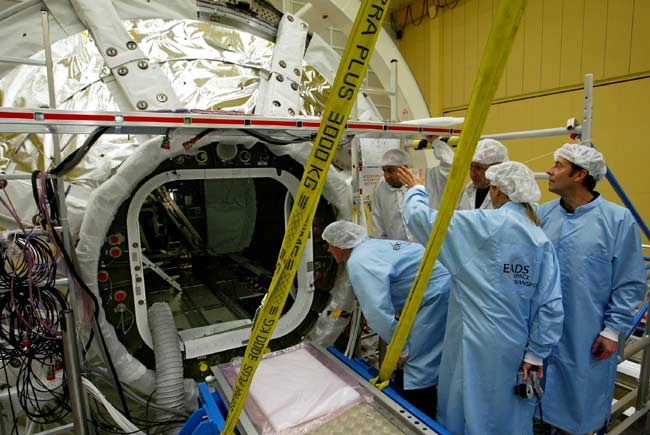
PARIS -- Thelaunch of Europe'sunmanned cargo vehicle to the International Space Stationaboard an Ariane 5rocket has slipped to November, with Europe's shuttle-launched Columbus crewlaboratory shifting to December, under the tentative station schedule beingrevised following the U.S. space shuttle's hail damage-relateddelay.
Thereshuffling of the station's traffic schedule caused by the shuttle's delay isonly one of the reasons Europe's AutomatedTransfer Vehicle (ATV) [image], to carry thousands of kilograms offood, water and fuel to the station, will not make its late-summer launch date,according to Europe's space station director, Daniel Sacotte.
The ATV'sprevious schedule, calling for a launchbetween July and September, was going to be difficult to maintainregardless of the shuttle schedule as the European Space Agency struggled tocomplete integration of Russian and European components on the vehicle andresolve outstanding performance issues.
"Icertainly am not going to say I am happy with a delay," Sacotte said in anMarch 16 interview. "But in this case, a July-September launch was going tobe difficult for us. Now we have more than enough breathing room."
The ATV isdesigned to perform many of the functions of a manned vehicle, including theability to approach the station, then stop and back off if necessary before afinal docking. Its arrival must coincide with the availability of a dockingport, and even with the Sun's positionrelative to the station so that ATV's laser-guided rendezvous sensors are notconfused by backlighting of the station on approach.
ESAofficials want ATV to be launched before the Columbus lab to avoid possiblecash payments to NASA for Columbus [image]overhead charges. ATV is considered as part of Europe's payment in kind forstation services paid by NASA.
- VIDEO: Space Station Building Blocks
- IMAGES: An Insider's View of the International Space Station
- IMAGES: The Spacewalks of NASA's STS-116 Mission
- Shuttle Flight Delays Complicate European ISS Plans
- All About the International Space Station
