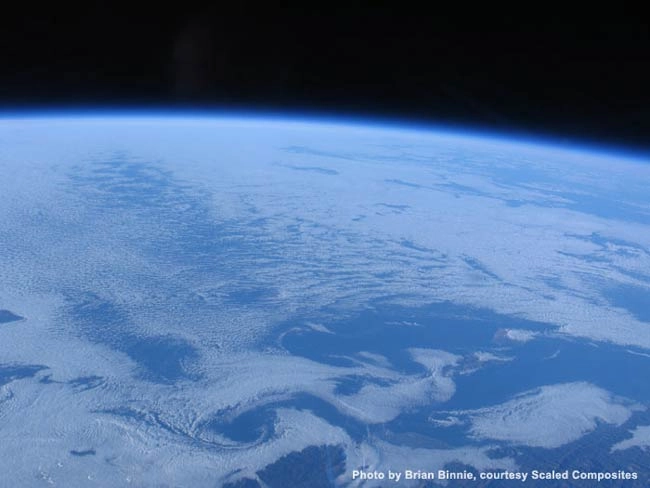
Ask
anybody that has blasted off Earth and shot into space...the view out the window is
tremendous.
Given
the promise of privately built spaceships routinely skyrocketing from spaceports
around the globe, rubbernecking customers will be afforded exceptional looks at
Mother Earth and deep space.
For
some, it's flat out thrill. There's also the magic of microgravity as keepsake
moments. And handheld photographs taken out windows can freeze-frame your
personal space trek for later show-and-tell parties.
But
by all accounts, face time with Earth from space is a bonding experience.
Author
Frank White coined it the "Overview Effect" in his 1987 book, The Overview
Effect - Space Exploration and Human Evolution. The book's pages capture
the comments from space travelers about how viewing Earth from space affected perceptions
of themselves, their planet of origin, and their own place in space and time.
In love with our world
The
scenery from Earth orbit stirs up many thoughts, observed space traveler, Tom
Jones, a veteran shuttle flyer and spacewalker, as well as author of the
acclaimed book, Sky Walking: An Astronaut's Memoir (Smithsonian Books -
Collins, February 2006).
"On
nearly every one of my 52 days in orbit, my most enjoyable time was spent
viewing and photographing Earth from space," Jones told SPACE.com.
Trained as a planetary scientist, he was most interested in the varied geologic
provinces of the globe.
"But
it was impossible not to be struck by the sheer beauty of the scene laid out
before me. The delicate appearance of the atmosphere, its clouds and storms,
and the incredible palette of colors exhibited by the landscape and vegetation
made me vividly aware of Earth's interrelated complexity, in a way that is
impossible to gain by mere classroom study," Jones explained.
Jones
said that he launched spaceward prepared to study the planet...and returned truly
in love with our world.
"My
overwhelming sense was of Earth's uniqueness as a harbor for life. As a
resident of this world, it's impossible not to see it now as a place both
graced and threatened by mankind," Jones said. "Becoming a space traveler
nearly inescapably makes one an advocate for careful stewardship of our
environment."
Universal demand for windows
The
role of space ecotourism as a marketing theme has not gone unnoticed by
spaceline operators.
"We
as a species couldn't survive on this planet now without space," said Will Whitehorn,
President of Virgin Galactic - the Sir Richard Branson group that's busy
selling seats on passenger-carrying suborbital SpaceShipTwo rocket planes.
Look
for a fleet of these spaceships to roll out the hangar doors at Scaled Composites
of Mojave, California. The work is led by aerospace designer, Burt Rutan, and his team. First toted to high altitude
for release by a huge carrier plane, a SpaceShipTwo will transport paying
passengers - at $200,000 a seat - up to the edge of space and back down to
terra firma.
"Space
is absolutely crucial to the survival of humankind given the level of
population we have got," Whitehorn told SPACE.com. From monitoring
Earth's weather and crop production to gauging climate change and helping to
move goods and services around the globe - satellites have proven of colossal
value, he added.
"We
wouldn't know about issues of the planet's safety if it wasn't for space,"
Whitehorn suggested. "From our point of view, the ecotourism fits well with
suborbital space tourism flights. Many of the people who want to fly with us
are very environmentally conscious."
Whitehorn
said there is a universal demand by customers for windows. "Being able to see
the Earth from a viewing port is absolutely crucial."
And
in true "keep the customer satisfied" fashion, SpaceShipTwo designs will have loads
of windows, even in the floor of the spacecraft, Whitehorn said. "You can view
forwards, backwards and outwards in every direction."
Environmentally friendly: air-launch
The
ecotourism theme also plays well when considering the role of air-launched
spaceships - for both suborbital and eventual orbital trips.
"Not
only have you got an economic breakthrough in launch costs, but also we have to
look at the environmental constraints that will be put upon the space industry,
long-term," Whitehorn said. Given the projected launch rates of people and
payloads, he added, ground-based rocketry and the effluents spewed into the air
by those liftoffs - especially by solid fuel motors - will likely not be environmentally
and politically acceptable within a generation, he predicted.
Air-launched
spaceships are "environmental breakthrough technology," said Stephen
Attenborough, head of Astronaut Relations for Virgin Galactic. "It's
environmentally thousands of times cleaner than any other system in the past,"
he told SPACE.com.
Attenborough
said that the tempo of the environmental debate can be enhanced by flying
passengers into space.
"In
reading the accounts of astronauts, it's evidently a life-changing experience,"
Attenborough said. "They do come back with very firm views about the
environment, the fragility of the atmosphere, our place in space, and ways of
better managing the planet."
The
technology of SpaceShipTwo and its derivates, Attenborough noted, "may well be
the key to actually exploiting space for the benefit of mankind...to a far
greater degree than we've been able to do in the past, but without destroying
the planet in the meantime."