


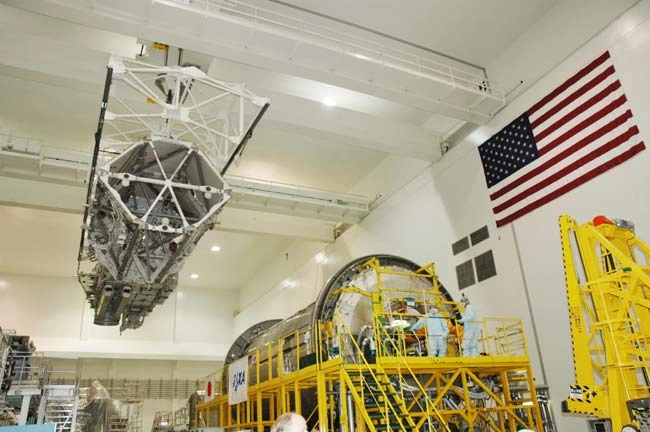
CAPE CANAVERAL - In a bigroom at Kennedy Space Center, cylindrical labs and plastic-draped trussessurround a 17-ton space girder whose time to fly has come.
It's not particularlypretty, with its hexagonal frame, bouquets of wires and squat batteries, butthis two-truss combo is the first big piece of the International Space Stationto be brought there in nearly four years.
This morning, a super-cranelifted the linked P3/P4 truss segments -- designated "P" for theirport or left-side location -- and placed them in their canister.
"I always love to seethat," said Boeing site manager Chuck Hardison of Merritt Island, who haswaited a long time to see it go. "It's like a ship going down the channel.It's so big, and it moves so gracefully."
In turn, the cargo willhead to the pad for a launch aboard Atlantis targeted for Aug. 28. The orbiteris set to roll to the Vehicle Assembly Building at Kennedy Space Center onMonday and to the launch pad July 31.
"The shuttle is flyingagain, and we're excited and anxiously awaiting our turn at the end ofAugust," said Robbie Ashley, NASA's manager for the cargo.
The last true stationconstruction mission was in late2002, before the 2003Columbia accident grounded the shuttles and prompted a round of designchanges.
In the interim, astronautshave taken several spacewalks, making repairs and performing other tasks on thestation, but no large equipment has been installed.
The truss will add anotherset of solar panel wings. Tests gave managers confidence that, after issueswith sticky panels in the past, these will unfold despite their long storage.
The batteries have beenreplaced because NASA feared they wouldn't be able to store and distributepower as expected.
"They were neverintended to be on the ground this long," Hardison said.
Perhaps one of the mostimpressive parts of the linked segments is the 10-foot-wide Solar Alpha RotaryJoint in the middle, which keeps the solar panels aimed at the sun.
"The entire spacestation outboard of that joint will be rotating 360 degrees every orbit,"Hardison said. "It'll be quite something to see, that's for sure."
He said his team was eagerto get the hardware into orbit as they waited for the shuttle schedule to pickup again. Among the many parts awaiting flight are the JapaneseExperiment Module, Europe's ColumbusLaboratory and a starboard truss that will mirror the port pieces about tofly.
"We worked on it forso long," Hardison said.
Published under license from FLORIDATODAY. Copyright ? 2006 FLORIDA TODAY. No portion of this materialmay be reproduced in any way without the written consent of FLORIDA TODAY.
- Return to Flight: NASA's Road to STS-121
