
The
crew of the International Space Station (ISS) flawlessly completed a
spacewalk Tuesday morning, preparing their orbital home for a new cargo ship and retrieving
experiments attached to its hull.
ISS Expedition 9
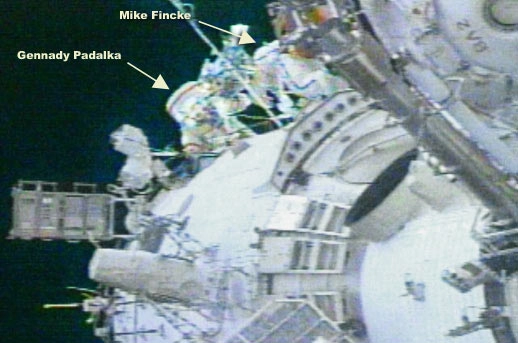
commander Gennady Padalka and NASA ISS Science Officer Michael Fincke are safely
back inside the space station after a 4.5-hour spacewalk that found them
consistently ahead of schedule and so eager to work that ground controllers
repeatedly urged them to take breaks and enjoys the scenery.
"It's a great view," Fincke said during a rest early in the
activity as he watched
the sun rise during one of the spacecraft's 90-minute orbit of the
planet.
The spacewalk was the third extravehicular activity (EVA) for the Expedition 9
crew and began when Padalka and Fincke opened the outer hatch of the station's
Pirs Docking Compartment at 2:58 a.m. EDT (0658 GMT) Tuesday morning. By the spacewalk's
end at 7:28 a.m. EDT (1128 GMT), the astronauts had completed all of their EVA
tasks.
Preparing for 'Jules Verne'
Expedition 9's
primary task during the spacewalk was to prepare a docking port on the aft end
of the station's Zvezda Service Module to receive an unpiloted European supply
vehicle expected to make its first delivery in the fall of 2005.
The
cargo-carrying Autonomous Transfer Vehicle (ATV), named Jules Verne by its
builders, is an unmanned spacecraft developed by the European Space Agency
(ESA). It carries three times the cargo capacity of Russia's unmanned Progress
ships, and may also be used to move the ISS if needed.
It took the
Expedition 9 crew about 30 minutes from exiting the space station to reach their
Zvezda worksite, but once the astronauts arrived, they were all
business.
Padalka and
Fincke removed six obsolete laser reflectors used for docking, replacing four of
them with more modern versions. The crew also installed two antennas - to allow
the Jules Verne ATV to communicate with the space station - and removed a cable
from a faulty television camera that will be retrieved in a later
spacewalk.
The astronauts
also replaced a series of space exposure experiments, including a folding
replaceable cassette container filled with materials and a Kromka experiment
that measured contamination caused by the station's thrusters.
"I did not work much," said an energetic Padalka during the
spacewalk. "I'm not tired."
Drifting in
space
Despite their
busy schedule, Padalka and Fincke snagged some 40 minutes of down time while
outside the space station when mission controllers reoriented the station using
its Russian thrusters.
The reorientation
was required primarily to counteract the effect of the Expedition 9 crew, NASA
spacewalk commentators said.
When the
Expedition 9 crew first ventured out to the aft of Zvezda, U.S. station handlers
put the ISS under U.S. momentum gyroscope control to prevent Russian thrusters
on the module from firing while crewmembers were near.
But the heavy
work activity on Zvezda's aft by Padalka and Fincke increased the momentum load
on the gyroscopes and the station began to drift slightly off course. The drift
led ground controllers to institute power conservation procedures that
temporarily cut off primary S-band communications with the Expedition 9 crew,
though a backup system reestablished contact.
NASA officials
said Russian and U.S. station controllers had anticipated the drift, but
concluded it posed no danger to the crew or station. It was easily cancelled out
at about 5:15 a.m. EDT (0915 GMT), when Russian thrusters were fired while
Padalka and Fincke were at a safe distance from Zvezda's aft.
By 6:00 a.m. EDT (1000 GMT),the spacewalkers resumed their
work.
One more to go
Padalka and
Fincke still have one last spacewalk to perform before they turn the ISS over to
new tenants in October. Some of those activities will also be ATV-related, NASA
officials said. Tuesday's spacewalk was the 55th EVA made to
support space station and the 12th staged from the Pirs compartment. The spacewalk
marks Padalka's fifth career spacewalk and the third for Fincke. The three
Expedition 9 spacewalks to date total of more than 10 hours of EVA work for the
astronauts.