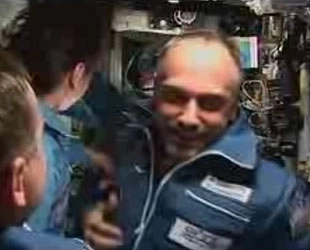
RichardGarriott's approach to the International Space Station (ISS) this morning mayhave seemed familiar to him, even though this was his first flight in space.That feeling could be attributed in part to the six months of training heunderwent for the mission, but it might also have been what happened when hewas twelve, or more appropriately, what his father did then.
Consider itgenerational d?j? vu.
Thirty-fiveyears ago, seated in the right seat of a three man capsule, OwenGarriott docked with a space station. This morning, RichardGarriott did more or less thesame thing. It wasn't the same spacecraft, nor the same space station, butthe father's and son's missions share a lot in common.
Spaceruns in the family
OwenGarriott was selected to be one of NASA's first six scientist-astronauts whenRichard was four years old.
"He'sgrown up in this program," shared the elder Garriott in an interview with collectSPACE.com."He's known about space since he was old enough to talk, almost."
Richard'spath to space however, was not to be through NASA. Told that his eyesight wouldpreclude his being eligible, he never applied for the astronaut corps. Instead,he made a name -- and fortune -- for himself developing computer games,including the very popular Ultima series and most recently, TabulaRasa.
Still,growing up in Houston the son of an astronaut had a way of catching up withhim.
"JuneScobee, the wife of Challenger commander Dick Scobee, was actually my highschool science teacher," explained Richard. "After the Challengeraccident, which was intended to be the first Teacher in Space flight, thefamilies of the Challenger astronauts got together and wanted to build a livingeducational memorial. Knowing I was very active in things like science fairsand already starting in the business of computer games, June came to me and Ihelped work on the designs that eventually became what are now the so far, 50Challenger Center educational facilities that are now spread out around theworld."
Then in themid-1990s, Richard became involved with the X Prize and Space Adventures, aimedat kick-starting the commercial space travel market. He personally financed theRussian study that would open ISS flights to privately funded individuals withthe intention of being the first. The dotcom bubble burst delayed, but did notcancel his plans. In Sept. 2007, Space Adventures announced that Richard wouldpay a reported $30 million to fly to the ISS in 2008.
Fatherand flight manager
From thestart, Richard planned to dedicate his time in space to advancing science, andwho better to turn to for guidance then his scientist-astronaut dad?
"I'vebeen playing a substantial role for quite some time," said Owen."I've been trying to help with his experimental program all the waythrough the flight."
Richard'sfirst commercial research partner for the flight, ExtremoZyme, is abiotechnology company co-founded by his father. During his nine days on-boardthe station, Richard's primary experiment will be focused on protein crystalgrowth for the company, which is looking to apply the results to betterstructure-guided drug design.
Duringtoday's docking and throughout the mission, Owen has been and will be in Russia's mission control, the TsUP, where he's serving as Richard's science manager.
"Thatinvolves not only protein crystal growth ... but also a great deal associatedwith visual observations with the photography that can be done from spacelooking down at the ground, working with a variety of educational outreachprograms such as the Challenger Center, and amateur radio operations,"said Owen. "I have been involved in all of these activities for almost ayear now and will continue working with Richard during the flight."
The viewfrom space, 35 years later
"As itturns out, Skylab was one of the first times we had an extended human presencein space looking back at the Earth," Richard told collectSPACE.comof the United States' first space station, and the outpost on which his fatherlived for 59 days in 1973. "I thought it would be an interesting story togo back to the Skylab photo archive, identify scientifically interesting placeson the Earth that may have changed -- through either natural processes or humanintervention -- in those 35 years, and try to retake some fraction ofthose."
Workingwith The Nature Conservancy to locate potential targets, Richard was intriguedby one set of observations.
"Thenegative story sites are actually, unfortunately, relatively easy to find andwhether that's the recession of glaciers or the expansion of urbanization ordesertification or the clear cutting of places like the Amazon rainforest,those stories are very easy to find," said Richard. "But I think itis just as important to showcase the places where land management and/or humanpractices have actually either sustained or improved the situation."
To improvehis chances of photographing the targets as they pass below, Richard willemploy new software as a test for future astronauts and cosmonauts.
"Thesoftware is called Windows on Earth and it was actually developed by theAssociation of Space Explorers, and hypothetically, or the hope is, is that itwill ultimately become a common tool for crew use in space. I'll be the firsttest subject for this piece of software," said Richard of the applicationthat runs in a web browser.
"Youcan select which window you are at on the ISS and it will give you countdowntimers to all the targets you've inputted into the system. So you can set thatright by the window you are looking at and hopefully get a good chance to catchsome of those targets photographically."
Click here to readthe conclusion of Astronaut's Son Reboots Dad'sWork in Orbit only at collectSPACE.com.
- New Video - The Garriotts: An American Space Legacy Part 1, Part 2
- Video - Dangerous Spacewalk: Handling Explosives in Orbit
- Soyuz - The Russian Space Workhorse
Copyright 2008 collectSPACE.com. All rights reserved.