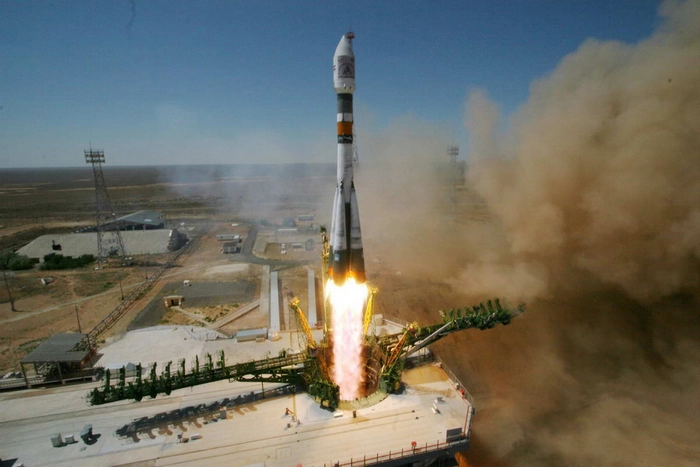
Baikonur Cosmodrome in Kazakhstan has been the launch site for Soviet and Russian space missions since the beginning of space exploration in 1957. The first satellite and the first human flew into space from there. Today, the site is heavily used for Soyuz astronaut launches to the International Space Station.
The site has mostly been used to launch Soviet Union and Russian cosmonauts, but after the Cold War cooled, some American and European astronauts started to launch there as well. After the space shuttle program retired in 2011, NASA shifted to having all of its astronauts fly from Baikonur until the new Commercial Crew Program is ready to launch astronauts. Test flights for the program are currently expected in 2018 or 2019, so around the 2020s fewer American launches are expected from Baikonur. Russia has also built a new launch site, Vostochny, which is eventually expected to take over many of the launches of Baikonur.
Baikonur, although it is located in Kazakhstan, is an enclave of Russian territory. The Kazakh and Russian governments work together on the maintenance and operations of Baikonur, with Russia paying at least $115 million annually to lease the land. While operations continue at Baikonur, the two countries have had some disputes over how to manage the space complex over the decades.
Location and early history
To this day, Baikonur remains somewhat remote. It is 1,300 miles (2,100 kilometers) from Moscow. The launch complex is on a desert steppe east of the Aral Sea. The region is known for its harsh climate, and was mainly chosen because of its advantage for radio communications — as well as its remoteness, according to Russian journalist and space historian Anatoly Zak. While its average temperature is 55 degrees Fahrenheit (13 degrees Celsius), NASA says its temperatures can range from minus 40 F (minus 40 C) in winter to 113 F (45 C) in summer.
"The name Baikonur is misleading," NASA wrote of the complex. "The former Soviet Union used the name and coordinates of a small mining town, Baikonur, to describe the location of its rocket complex. In fact, the launch complex is about 322 kilometers (200 miles) southwest of the mining town near Tyuratam in Kazakhstan. This misrepresentation was done intentionally to hide the actual location of the launch complex. Although the true location is now known, the launch complex is still referred to as Baikonur."
Baikonur's origins came with the Soviet desire to launch intercontinental ballistic missiles; the extended range and tracking system required did not fit existing Soviet facilities at the time. A site search was conducted in high secrecy and has only been revealed in recent decades to people such as Zak, who pieced together the area's early history through reading documents and doing interviews.
The reasons for choosing what is now known as Baikonur are complex, but one major factor (according to Zak) appears to be the existence of a rail spur connected with what was then called the Kazakhstanskaya Railroad. This allowed for building materials, and later the rockets themselves, to be transported to the site. Construction started in 1955 in high secrecy; by 1957, the United States was aware of an ICBM site in the area and had U-2 aircraft scanning the zone, Zak says.

Space-age pad
The first successful space launch from Baikonur is also the first successful space launch of a satellite —Sputnik-1, which left Earth on Oct. 4, 1957. The cosmodrome only officially received the name "Baikonur," however, after cosmonaut Yuri Gagarin went into space on April 12, 1961 — also a world first. Rather than reveal the location of the facility, the Soviet Union achieved its world record by telling the International Aviation Federation that it had launched from the town of Baikonur, Zak says.
Prior to Gagarin's flight, Baikonur was host to the worst launch pad failure in history, known informally as the Nedelin Catastrophe after a high-ranking Soviet official who was killed in the disaster. It happened when an R-16 missile detonated on the pad due to various factors (including skipped safety checks and a rushed launch schedule) and killed an estimated 150 people on Oct. 24, 1960. The incident was kept secret for decades, even from the families of disaster victims.
Baikonur was the site for all major Soviet launches, and remains so for most Russian launches today. Some of its notable early missions include the first spacecraft to go close to the moon (Luna 1, 1959); the first flight of a female in space (Valentina Tereshkova, 1963); the first flight to carry two people (Voskhod 1, 1964) and the first crewed launch to a space station (Soyuz 11, 1971). Baikonur also was the launch site for two fatal missions; Soyuz 11's three cosmonauts (Georgy Dobrovolsky, Vladislav Volkov and Viktor Patsayev) died during re-entry, and the parachute failed to deploy during the first re-entry of the Soyuz spacecraft (Soyuz 1) in 1967, killing Vladimir Komarov, the single cosmonaut on board.
On July 3, 1969, the Soviets made a test attempt to launch a heavy rocket — capable of sending humans to the moon — known as the N-1. At the time, NASA was only three weeks away from making the first moon landing. A rocket failure caused part of the N-1's fuel to detonate, heavily damaging the launch pad and surrounding area. No fatalities were reported in the incident, Zak says, which was kept secret for some time. The N-1 program underwent four test launches between 1969 and 1972, all of which ended in failure.
The Soviets have launched missions to many space stations over the decades, starting with the fatal Soyuz 11 flight to Salyut 1 (the first space station) in 1967. Notably, the Soviet Union began opening its flights to other nations in 1978 under the Interkosmos program, which saw participating Soyuz astronauts from more than a dozen other nations through the late 1980s. The Soyuz program continues to this day, continuing to launch astronauts after more than four decades of operating different versions of the spacecraft.
The Soviets created their own space shuttle, called Buran, which flew autonomously from Baikonur in 1988 on top of an Energia rocket. Buran only flew once, in part because the Soviet Union was running short on funds ahead of its collapse in 1991. The flown Buran prototype was stored in a hangar at Baikonur, where it remained until a roof collapse at the aging facility in 2002. The prototype was reportedly destroyed in the collapse.
Americans launch from Baikonur
After the Soviet Union fell in 1991, Kazakhstan and Russia underwent a negotiation process to determine what to do with Baikonur. (Some of the effects are outlined in the next section below.) The handover at Baikonur took some time to accomplish, and Russia was also unclear on the future of the Mir space station. This led to a delay for when Sergei Krikalev — a cosmonaut on space station Mir during the Soviet collapse — could come home, despite the health risks to having him in stay in microgravity for longer, according to Discover magazine.
The Americans also stepped in with a financial agreement to help stabilize Russia's finances. NASA and Russia began joint missions to the Mir space station (including launching American astronauts from Baikonur) so that NASA could start learning from the Russians' long-duration stays in space on their various space stations. NASA docked at Mir using the space shuttle, a vehicle it used for spaceflight between 1981 and 2011.
Shuttle-Mir (as the joint program was called) was a precursor to learning to work together for the International Space Station program, which began construction in 1998. Some observers say the Shuttle-Mir program also allowed the U.S. government to financially stabilize the Russian space program during a difficult time, ensuring the two sides would stay allies. The first American to fly into space on a Soyuz spacecraft was Norman Thagard, in 1995.
The United States retired its aging space shuttle program in 2011, by which time several Americans had flown into space on Soyuz. To fill the gap until commercial flights began, the United States paid for seats on the Soyuz for all astronauts going to the International Space Station for the U.S. segment. The Commercial Crew Program is expected to run test flights in 2018 and 2019 and as it moves into operations, this will greatly reduce U.S. demand for Soyuz seats.
The date for commercial crew operations has been pushed back several years; when the space shuttle first retired in 2011, NASA expected that SpaceX and Boeing could start launching astronauts from U.S. soil again in 2015. Now it likely won't be until 2019, at the earliest. NASA's Office of the Inspector General issued a 2016 report noting the additional costs the commercial crew delays incurred.
Business Insider reported in an article about the OIG's work that Roscosmos used to charge NASA as little as $21.8 million per seat in 2008. In 2018, that price was expected to go up 372 percent to $81 million per astronaut. "Had the agency met its original goal of securing commercial crew transportation by calendar year 2015, NASA could have avoided paying Russia close to $1 billion for Soyuz seats in 2017 and 2018, even factoring in the purchase of some seats in 2016 to cover the expected transition period," the OIG report stated.
Some of the major locations at Baikonur today, according to Zak, include:
- Site 1 (launches Soyuz, Soyuz-U and U2 boosters)
- Site 10 (the main residential area)
- Site 15 (Krainy airfield)
- Site 17 (the hotel and VIP cottage zone)
- Site 31 (the launch and processing complex for R-7 ICBM)
- Site 81 (where the Proton rocket launches)
- Site 112 (where a flight version of the Buran space shuttle was destroyed during a roof collapse in 2002)
- Site 254 (where Soyuz and Progress spacecraft are refurbished
Tensions with local population
Unrest at Baikonur in 1992 and 1993 in the wake of the Soviet Union collapse, including reports of problems in food, heating and social facilities, led a U.S. congressional delegation to visit the area in December 1993. However, the situation stabilized approximately a year later when Kazakhstan and Russian decided on a leasing deal, and the Russian government also made direct interventions, according to GlobalSecurity.org.
The countries have had some disputes over Baikonur maintenance and operations in the decades since, according to Zak. In September 2007, a Proton rocket crashed in Kazakhstan, causing the country's government to ban all Proton rockets for two months — as well as to ask Russia for $61 million in compensation.
Since Baikonur has no large body of water nearby, rocket stages fall in the desert surrounding it in a designated drop zone. In 2011, Vladimir Popkovin (the head of the Russian space agency) told Russia's parliament that Kazakhstan had removed its ban on launching Russian ballistic missiles, Zak noted. A year later, however, Kazakhstan and Russia briefly butted heads over creating a new drop zone in the northwest of Kazakhstan, which is populated, to accommodate launches such as for the satellites Meteor-2 and Kanopus.
In 2013, the New York Times reported that about 70 percent of Baikonur's residents were actually Kazakh citizens. But when the Soviet Union broke up, only about one-third of the population was Kazakh. The Times reported that Baikonur's city is behind on maintenance because the lease is seen as temporary, and there are ethnic tensions as well as issues with labor and drugs.
In June 2017, a worker from Russia's NPO Mashinostroyenia rocket and space company died while attempting to stop a brush fire in the desert. The fire started after a stage of a Russian Soyuz-2.1a rocket fell nearby, according to Russian news agency TASS.
In May 2018, Russia transferred to Kazakhstan 44.8 square miles of the Baikonur Cosmodrome's territory — as well as two platforms for a rocket known as Zenit-M, the Eurasia Daily Monitor reported. But as the news outlet pointed out, Kazakhstan — even though it owns these platforms — will only be able to operate them through joint projects with Russia, since Russia has the actual rockets. Further, Kazakhstan will have to spend about $245 million to upgrade the infrastructure of the launch pads. The two countries are attempting to pursue partnerships in regard to the upcoming Soyuz 5 and Phoenix rockets, which are reportedly scheduled to start launches for 2022 and 2035, respectively.
Russia and Kazakhstan have had other disputes concerning Baikonur over the years, the Monitor continued. This included disputes that eventually derailed a joint space launch complex for the Angara rocket, as well as issues surrounding taxes, health and the environment. Still, the Monitor said, Russia and Kazakhstan will likely work together at least until the lease is complete. "Russia's upcoming transfer of certain Baikonur launch facilities to Kazakhstan will make the two countries' space programs even more dependent on each other," it wrote.

Russia builds a new launch complex
Russia has wanted to return rocket launches to its own soil for decades; the country previously considered a cosmodrome called Svobodny, but the project failed due to a lack of funds, according to Zak. Talk of building a new complex only resumed after soaring oil prices buoyed the Russian economy.
In 2011, Russia began construction on a new launch complex in eastern Russia, called Vostochny. It is located in eastern Siberia near the Chinese border. Observers said that the Russians wanted a launch pad on its own soil for both financial and political reasons (because the Russians wanted to have more autonomy over launch decisions.) The complex was expected to cost $7.5 billion when construction started in 2011, according to NBC News. That's four times higher than the original projected cost of $1.9 billion.
In 2013, Russian Prime Minister Vladimir Putin pledged Vostochny would host crewed launches within five years, but there have been difficulties with meeting that deadline. Construction workers on the site went on strike in 2015 after several weeks without salary, according to Radio Svododa. Putin pledged personal oversight of construction, which was taking place amid a decline in the Russian economy, CNN reported. In 2018, a high-ranking official overseeing Vostochny's construction was sentenced to 12 years in prison amid corruption allegations.
The first launch at Vostochny took place in April 2016, when three satellites were launched aboard a Russian Soyuz rocket. The second launch occurred in November 2017 and saw a $45 million weather satellite lost due to human error; the mission was accidentally programmed as though it was launching from Baikonur.
In late 2017, an article in Ars Technica pointed out that Russia's dominating position in space is changing and companies may soon go elsewhere for launches. Commercial competitor SpaceX had 16 launches in 2017, including 11 for customers. Russia had more launches than SpaceX (17) but only one-third of them for customers outside of the Russian government. Russia is developing a Soyuz-5 booster that is expected to be ready in 2021. SpaceX, however, will also evolve in the coming years, providing stiff competition.