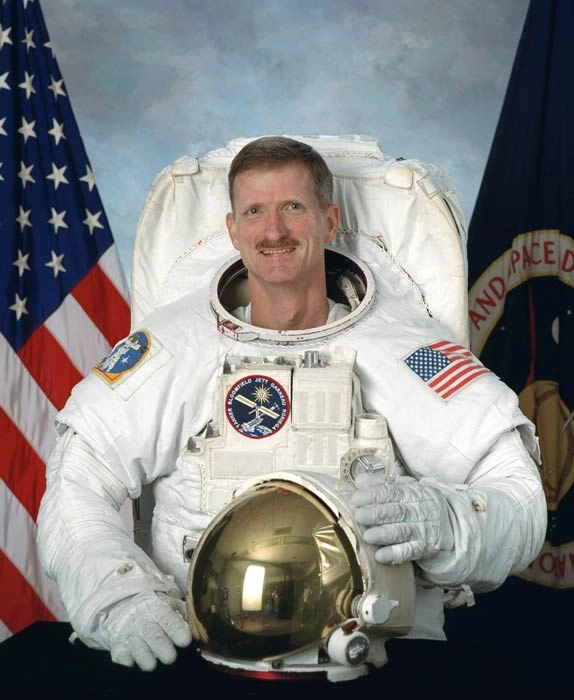
NAME: Joseph R. "Joe"Tanner
NASA Astronaut
PERSONAL DATA: Born in Illinois in 1950. Married.Two children. Joe enjoys swimming, camping, mountaineering, and spending timewith his family.
EDUCATION: Graduated from Danville HighSchool, Danville, Illinois, in 1968; received a bachelor of science degree inmechanical engineering from the University of Illinois in 1973.
SPECIAL HONORS: NASAExceptional Service Medal. NASA Space Flight Medals. NASA Stuart M. PresentFlight Achievement Award. JSC Superior Achievement Award. Outstanding Alumnusof the Department of Mechanical and Industrial Engineering, University ofIllinois. Distinguished graduate from Navy Flight Training. Captain of theSwimming Team and "Top 100 Seniors" Award at University of Illinois.Eagle Scout.
EXPERIENCE: Tanner joined the Navy aftergraduating from the University of Illinois in 1973. He earned his Navy pilotwings in 1975 before serving as an A-7E pilot with Light Attack Squadron 94(VA-94) aboard the U.S.S. Coral Sea. He finished his active service as anadvanced jet instructor pilot with Training Squadron 4 (VT-4) in Pensacola,Florida.
NASA EXPERIENCE: Tanner started working for NASAJohnson Space Center in 1984 as an aerospace engineer and research pilot.
His primary flying responsibilities involved teachingthe astronaut pilots SpaceShuttle landing techniques in the Shuttle Training Aircraft and instructingthe pilots and mission specialists in the T-38. In addition to his flyingduties, Tanner held positions as the aviation safety officer, the head of thepilot section, and the Deputy Chief of the Aircraft Operations Division (AOD).He has accumulated more than 8,862 hours in military and NASA aircraft.
Selected as an astronaut candidate by NASA in March1992, Tanner reported to the Astronaut Office in August 1992. He completed oneyear of initial training and worked in the Shuttle Avionics IntegrationLaboratory before being assigned to his first mission.
Tanner also served as part of the Astronaut SupportPersonnel team at the Kennedy Space Center, supporting Space Shuttle launchesand landings, and as EVA Branch Chief. A veteran of three space flights Tannerhas logged over 742 hours in space, including over 33 EVA hours in 5 spacewalks. He flew on STS-66 in 1994, STS-82 in 1997 and STS-97 in 2000. Tanner isassigned to the crewof STS-115. The mission is targeted to launch in 2006.
SPACE FLIGHT EXPERIENCE: Tanner flew aboard the SpaceShuttle Atlantis on the STS-66,November 3-14, 1994, performing the Atmospheric Laboratory for Applications andScience-3 (ATLAS-3) mission. ATLAS-3 was the third in a series of flights tostudy the Earth's atmosphere composition and solar effects at several pointsduring the Sun's11-year cycle.
The mission also carried the CRISTA-SPAS satellitethat was deployed to study the chemical composition of the middle atmosphereand retrieved later in the mission. Tanner logged 262 hours and 34 minutes inspace and 175 orbits of the Earth.
Tanner performed two space walks as a member of theSTS-82 crew to service the HubbleSpace Telescope (HST) in February, 1997. The STS-82 crew of 7 launchedaboard Space Shuttle Discovery on February 11 and returned to a night landingat Kennedy Space Center on February 21.
During the flight, the crew completed a total of 5space walks to improve the science capability of the telescope and replaceaging support equipment, restoring HST to near perfect working condition. Thecrew boosted HST's orbit by 8 nautical miles before releasing it to once againstudy the universe. Tanner's two space walks totaled 14 hours and 01 minutes.The flight orbited the earth 150 times covering 4.1 million miles in 9 days, 23hours, 37 minutes.
Tanner's third mission was STS-97aboard Endeavour (November 30to December 11, 2000), the fifth Space Shuttle mission dedicated to theassembly of the InternationalSpace Station. While docked to the Station, the crew installed the firstset of U.S.solar arrays, in addition to delivering supplies and equipment to thestation's first resident crew. Tanner performed threespacewalks totaling 19 hours 20 minutes. Mission duration was 10 days, 19hours, 57 minutes, and covered 4.47 million miles.
Last updated: January 2006
- VIDEO: STS-97 Spacewalker Joseph Tanner
- Complete Space Shuttle Mission Coverage
- NASA's STS-115: Shuttle Atlantis to Jump Start ISS Construction
- STS-97 Collection of SPACE.com stories