





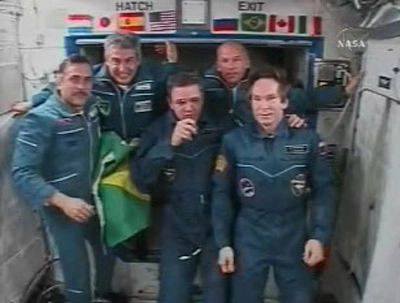
RIO DE JANEIRO, Brazil (AP)- Brazil's first astronaut, MarcosPontes, has won the global attention that he feels his country deserved acentury ago.
docked with Russian Cosmonaut Pavel Vinogradov and U.S. astronautJeffrey Williams atthe International Space Station on Saturday, dedicated his flight to the memoryof Brazilian inventor and aviator Alberto Santos Dumont.
Pontes planned to take withhim a Panama hat used by Santos Dumont, the Brazilian who - as allschoolchildren here learn - was said to have invented the airplane but didn'tget credit for it.
"At the moment of takeoff,I want to recall that 100 years ago another Brazilian took off, also outsideBrazil, in France, for another important mission,'' Pontes told local media inan interview before his Soyuz TMA-8 took off Thursday from Baikonur Cosmodrome inKazakhstan.
Santos Dumont flew abamboo-and-silk biplane in Paris on Nov. 12, 1906, and was hailed across Europeas the inventor of the airplane. Brazilians say the Wright brothers cheated byusing a takeoff ramp and were helped by a tail wind in their 1903 flight.
But today, Pontes hasbecome the face of Brazilian aeronautics.
The 43-year-old is featureddaily on Brazilian TV news broadcasts and in newspaper pages. The Brazilianflag he waved in the capsule is a symbol of pride for Brazil's 185 millionpeople.
"Doing loops around theEarth,'' read a headline in Rio's O Globo newspaper Saturday.
"This is the beginning of anew era for the people of Brazil, we have opened new frontiers with thismission,'' Pontes told Globo TV from the space station. "This is not only apersonal dream, it's a realization that can positively impact the Brazilianyouth.''
He compared the Earth'sview from space to his mother's eyes, which are blue.
"She always said I couldachieve anything that I dreamed of,'' Pontes said. "That's the message I wantto leave to everybody.''
Born into a poor family inthe southeastern city of Bauru, 700 kilometers (425 miles) west of Rio, Ponteshelped pay for his studies by working as an electrician's assistant at age 14.
A cadet at the BrazilianAir Force Academy in Pirassununga, Pontes became a fighter pilot in 1984. Hedid graduate studies in Brazil and at the Johnson Space Center and the NavalPostgraduate School in Pasadena, California.
In 1997, Brazil joined the15 nations involved in the International Space Station Project. A year later,Pontes was picked for the flight by NASA and the Brazilian Space Agency.
For seven years, Pontestrained for the mission - with some unexpected setbacks.
He was scheduled to fly tothe space station aboard a U.S. space shuttle, but NASA suspended shuttleflights after the 2003 Columbia[accident]. Brazil and Russia then discussed whether Pontes could flyaboard a Russian rocket.
In 2003, Brazil's own spaceprogram - the only one in Latin America - had an enormous setback when theVLS-1 VO3 rocket carrying two research satellites explodedin a ball of fire three days before its scheduled launch in Alcantara, a basein northeastern Brazil.
Pontes knows the value ofpersistence.
"When someone gives you amission, you go to the end,'' he said from the launch site.
He is due to return toEarth on April 8, along with ValeryTokarev of Russia and William McArthur of the United States.
- Orbital Rendezvous: Fresh Crew, Brazilian Astronaut Arrive at ISS
- Brazil's First Astronaut, Fresh ISS Crew Reach Orbit
- Complete Coverage: ISS Expedition 12
- Complete Coverage: ISS Expedition 13