


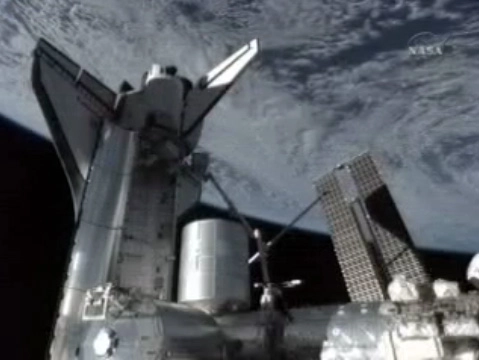
NASA istracking a piece of leftover space junk from a 2007 Chinese anti-satellite test thatis expected to fly near the International Space Station twice on Wednesday, a day afterthe shuttle Discovery leaves the orbiting lab.
The satellitedebris is expected to come within 31 miles (50 km) of the spacestation at about 4:30 a.m. EDT (0830 GMT) Wednesday morning, then zip aroundagain two hours later to pass within 15 miles (25 km), NASA officials said.
Shuttle flightdirector Tony Ceccacci said NASA engineers are tracking theorbital debris to determine whether it could pose a threat to the space station.If so, the space station would have to fire its thrusters to in order to dodgethe satellite remnant after Discovery undocks Tuesday afternoon.
?The latestand greatest confidence is that it probably won?t be a concern,?Ceccacci told reporters late Monday. ?We won?t really know until we get thelatest tracking this evening and determine what the probability of collisionis.?
Thepotential space junk threat comes on the heels of another pieceof orbital trash that buzzed the linked station and space shuttle lastweek.
That debris,a massive chunk of a 3-year-old European rocket body, came within a mile (1.3km) of the space station, but it never posed an impact risk to the spacecraft,mission managers said. Trajectory analysts found that despite the near miss,the rocket trash had zero chance of hitting either Discovery or the space station.
Unlike thatlarge debris, which was part of an Ariane 5 rocket, the current piece of spacetrash under NASA scrutiny is small. It is from the Chinese weather satelliteFengyun 1C, which the Chinese military intentionally destroyed with a missileduring a 2007 anti-satellite test.
?It is justbig enough to be tracked,? Ceccacci said.
Theresulting debris from the satellite?s destruction has come nearspacecraft before, most recently in May when a piece flew near the shuttleAtlantis while it was linked to the Hubble Space Telescope.
NASAtypically moves the space station if the potential for a space debris impact iswithin a 1-in-10,000 chance. The agency likes to maintain a safety perimeter thatextends out 15 miles (25 km) around the space station, as well as about ahalf-mile (0.75 km) above and below it.
WhileMission Control tracked the space debris late Monday, the 13 astronauts aboardthe linked shuttle and space station held a brief farewell ceremony tomark the end of more than a week of joint work to upgrade the orbitinglaboratory.
?All goodthings come to an end,? Discovery commander Rick Sturckow told the station crew.
Discovery astronautslaunched to the station Aug. 28 and delivered nearly eight tons of new supplies,science gear and a treadmill named after TVcomedian Stephen Colbert. On Monday, the astronauts plucked their portablecargo pod from its parking spot on the station and packed it away in Discovery?spayload bay for the return trip to Earth
The shuttle is due to undock from the space station Tuesday at 3:26 p.m. EDT(1936 GMT) and land Thursday at NASA?s Kennedy Space Center in Florida.
- Easy to Spot: Space Station and Shuttle Together
- Video - Stephen Colbert to NASA: 'No Chubby Astronauts'
- New Image Gallery - Shuttle Discovery's Midnight Launch
SPACE.comis providing complete coverage of Discovery's STS-128 mission to theInternational Space Station with Managing Editor Tariq Malik and Staff WriterClara Moskowitz in New York. Clickhere for shuttle mission updates and a link to NASA TV.
