





Thisstory was updated at 9:45 p.m. EDT.
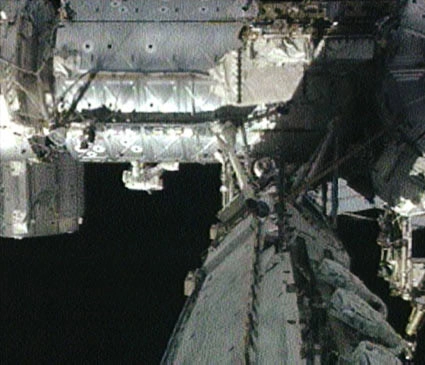
Twospacewalking astronauts ventured outside the International Space StationSaturday to set the stage for future construction and prime the outpost forJapan?s first space freighter.
Discoveryshuttle astronauts Steven Swanson and Joseph Acaba pushed through a packed listof maintenance chores to ease the workload for futurespacewalkers. They started with a trek to the very edge of the station?sport side to loosen bolts the outpost?s oldest solar array batteries.
An alarmrang out as the spacewalkers completed the battery work, but flight controllerssaid it meant the orbiting lab?s attitude-controlling gyroscopes wereoverwhelmed by the work on the end of the station?s backbone-like truss, whichis longerthan a football field. Mission Control turned control of the station overto the shuttle Discovery?s thrusters.
?Nothing toworry about,? Mission Control told the spacewalkers.
Later,an incorrectly stowed metal pin blocked the spacewalkers efforts to set up aspare parts platform on the station?s main truss. The swing-out cargo carrierwas one of two the astronauts hoped to prepare during the spacewalk, butMission Control told the spacewalkers to abandon both tasks and tie down thehalf-deployed platform for the time being as time ran short.
?Greatjob today,? said astronaut Richard Arnold II, who choreographed the spacewalkfrom inside Discovery. ?Sorry for all the changes we threw at you.?
Spacestation flight director Kwatsi Alibaruho told reporters late Saturday that, despite the platformglitch, the spacewalkers accomplished the critical chores on their excursion.
Saturday?s6 1/2-hour spacewalk began at 12:51 p.m. EDT (1651 GMT) as the linked spacestation and shuttle Discovery flew 220 miles (354 km) above the South Pacific.The excursion came one day after the astronauts unfurled the space station?s lastpair of gleaming solar wings, with Mission Control lauding the work in the Discoverycrew?s morning mail.
?[The station] now looks like the artist renderings thatwe've been seeing for years,? Mission Control wrote. ?A day to celebrate!?
It was alsoa big day for Acaba, aformer Florida schoolteacher, who made his spacewalking debut.
?Joe,great seeing you outside,? said Arnold, who is also a fellowteacher-turned-astronaut.
?Thankyou,? Acaba called back.
Upgrading space station
Duringtheir orbital work, Swanson and Acaba installed a new global positioningantenna on the outer hull of the station?s Japanese-built Kibo laboratory. Theantenna is one of two that will aid the docking of Japan?s first spacefreighter when it arrives at the station later this year.
Theyalso performed the bulk of their planned maintenance on a cable panel, as wellas an infrared camera survey of the space station?s radiators, one of which hasbeen damaged. But they ran out time to finish some of those tasks.
Whileworking on the station?s portside solar array batteries, the spacewalkersroutinely checked to make sure no metal from their spacesuits was exposed as asafeguard against the remote chance of electrical shocks. Mission managers saidthe risk was small and within safety limits, but the extra measure were just aprecaution.
Thespacewalk was the second of three planned during Discovery?s mission, with someof the chores pulled from a planned fourth spacewalk that was later cut fromthe flight due to launch delays.
?Wesure appreciate the work you did for our beautiful space station,? stationskipper Michael Fincke told the spacewalkers. ?You guys provedflexibility is definitely key.?
Missionmanagers are now working to replan the third spacewalk on Monday and determinewhether the reattempt the spare parts platform set up work.
NASAtrimmed the spacewalk and a day from Discovery?s now 13-day flight in order tocomplete the shuttle flight before the arrival of a Russian Soyuz spacecraftnext week carrying new station crewmembers and an American space tourist.
Space urine recycler fix
Whilethe spacewalkers worked outside, astronauts inside the station tested repairsto the outpost?s urine processer. Astronauts replaced a brokendistillation assembly, which spins like a centrifuge to begin filteringurine back into drinking water, on Friday.
"Youcan see the same good spinning," Fincke told Mission Control during a dryrun of the device. "We could barely hear any change in noise, which ismuch different than the last time we did this."
Theurine processor is part of a larger recycling system designed to convertastronaut urine, sweat and condensation into pure drinking water that can beused for drinking, food preparation, bathing and oxygen generation.
Saturday?sorbital work marked the 122nd spacewalk dedicated to space station constructionand maintenance. It was the fourth career spacewalk for Swanson, who now has 26hours and 22 minutes of spacewalking time, and the first for Acaba. Swanson andArnold will perform the mission?s third spacewalk on for Monday
Discoveryis due to leave the space station on Wednesday after eight days docked at thespace station. The shuttle is due to land on March 28.
SPACE.comis providing continuous coverage of STS-119 with reporter Clara Moskowitz andsenior editor Tariq Malik in New York. Click here for missionupdates and SPACE.com's live NASA TV video feed.
- Video - Discovery's Mission: Space Station Power Up!
- New Video - Discovery?s STS-119 Night Launch
- New Show - Inside the International Space Station
