Thisstory was updated at 6:33 p.m. EDT.
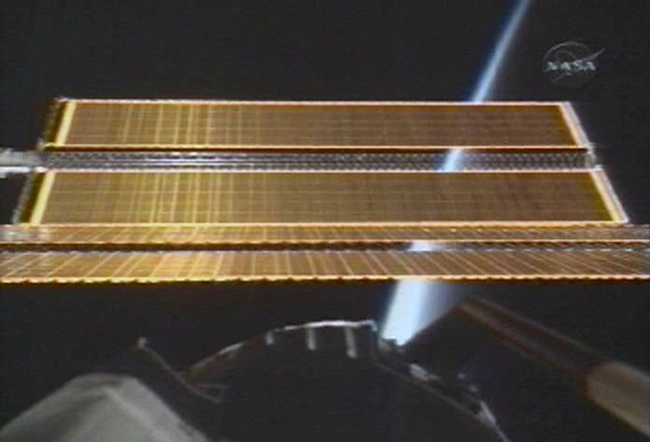
The InternationalSpace Station unfurled its last set of solar wings Friday, boosting theorbiting laboratory up to full power after more than 10 years of construction.
Astronautsaboard the station and docked shuttle Discovery kept all eyes on thetwo expansive solar arrays as they were remotely deployed from a consoleinside the orbiting lab. After just over two hours of work, Discovery skipperLee Archambault radioed Mission Control that both wings were fully extended andlooking good.
?Tremendousnews! Great work guys,? Mission Control called back. ?You?ve got a whole bunchof happy people down here as well.?
?We?revery happy as well,? Archambault said. ?Full power!?
Each of thenew 115-foot (35-meter) wings unfolded gracefully, with none of the potentiallydamaging glitches that have plagued past array deployments. Astronautsunfolded new arrays in stages, allowing them to warm in the sun to reduce thestickiness.
As thewings hit full extension, the tense mood of Mission Control eased considerablyas flight controllers erupted into applause, station flight director KwatsiAlibaruho told reporters late Friday. He received messages that some engineersshed tears of joy.
?We wereliterally on pins and needles,? Alibaruho said. ?It was just really like agreat weight lifted.? ?
The new$298 million solar arrays during a Thursday spacewalk, when astronauts mooredthe massive 16-ton girder supporting the new wings to the starboard-most sideof the orbiting laboratory. By the end of today?s deployment, all eight of thespace station?s solar wings - four on each side - were unfurled, completingconstruction on the outpost?s 335-foot (102-meter) backbone. They representthe last major U.S.-built piece of the space station. The first piece of thespace station launched in 1998, with its first backbone segment lifting off twoyears later.
?It wasabsolutely beautiful,? station commander Michael Fincke said in a televisedinterview, adding that there was a ?shout of triumph? as the wings unfurled.
Theastronauts aboard Discovery and the station are now preparing for the secondspacewalk of their mission, set for Saturday, to upgrade systems outside theoutpost.
Spacestation power play
The newsolar arrays are vital since they will completethe station's power grid, boosting the current system by 25 percent. Inall, the station is designed use all four sets of solar wings to produce enoughelectricity to power 42 houses on Earth, NASA has said.
Astronautsand scientists are counting on that power supply so they can ramp up scienceoperations and double the station's crew size up to six people in late May.This last set of solar wings should generate about 36 kilowatts total, 15kilowatts of which is reserved for science. It should double the currentscience power supply, mission managers said.
Astronautsalso made repairs to the outpost's urine recycling system inside the orbitallab. The spaceflyers will install a new centrifuge to distill urine back intodrinking water. The system is part of a larger water recycler that convertsurine, astronaut sweat and condensation back into pure water for drinking, foodpreparation and bathing.
Discoverylaunched toward the station late Sunday on a 13-day mission to swap out amember of the outpost's crew and deliver the new solar arrays truss. Two of themission's three spacewalks remain. Four were originally planned, but NASAtrimmed the flight due to launch delays in order to complete the constructionwork and depart the station before the launch of a previously scheduled RussianSoyuz spacecraft next week.
Discovery isset to undock from the station on Wednesday and land on March 28.
SPACE.comis providing continuous coverage of STS-119 with reporter Clara Moskowitz andsenior editor Tariq Malik in New York. Click here for missionupdates and SPACE.com's live NASA TV video feed.
- New Video - Discovery's STS-119 Night Launch
- Video - Discovery's Mission: Space Station Power Up!
- New Show - Inside the International Space Station
