


This story was updated at 8:15 p.m. EDT.
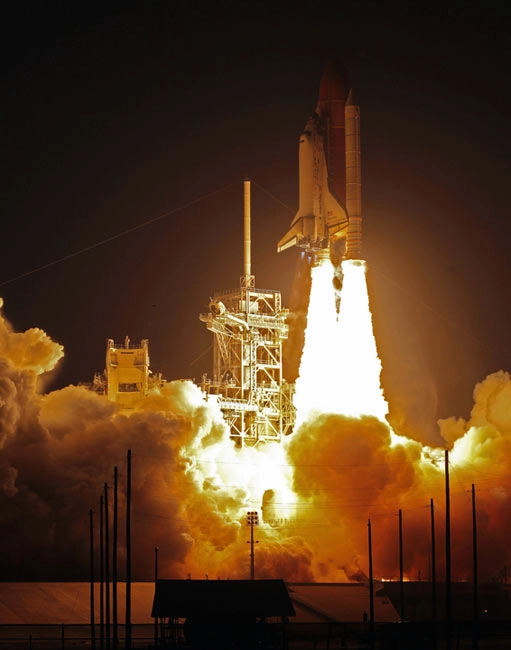
CAPE CANAVERAL, Fla. - The space shuttle Discoverysuccessfully launched into the clear evening sky above Florida late Sundayafter a series of delays held it on the ground for more than a month.
The shuttlelifted off without a hitch at 7:43 p.m. EDT (2343 GMT) from Launch Pad 39Ahere at NASA?s seaside Kennedy Space Center. A hydrogen gas leak that foiledDiscovery's first launch attempt last Wednesday did not pester the shuttleagain and the weather was 100 percent perfect for the liftoff.
?Well, you had a little bit of a wait, but well it?llmake the payoff that much sweeter,? NASA?s shuttle launch director MikeLeinbach told Discovery commander Lee Archambault. ?Good luck and Godspeed.?
"Thanks for the work Mike, we?ll see you in a coupleof weeks, take care and let?s go ahead and fire up the sound of freedom,"Archambault responded.
Discovery is carrying a seven-astronaut crew and the finalpair of solar arrays and the last big American-made piece of theInternational Space Station (ISS) into space for a planned 13-day mission.
Discovery's STS-119 mission will deliver the Starboard-6truss (S6), a 45-foot-long, 31,000-pound girder that will complete thestation's 11-piece main truss, which serves as the outpost?s metallic backbone.The truss also carries the fourth set of U.S. solar wings to generate power forthe orbiting lab.
"We're very excited to be bringing the S6 truss upto the space station to give it its final complement of power,"Archambault said when he and the crew arrived at the spaceport last week.
About the only glitch during Discovery?s launch aroseearly, when flight controllers picked up a low pressure in a valve that pumpsgaseous helium to part of the orbiter to prevent ice from forming. A repaircrew quickly fixed the glitch at the pad.
Ground crews also spotted asnoozing fruit bat on the shuttle's external tank during fueling. Since thesmall bat was perched on the side of the tank facing away from the orbiter, anda part of the tank that wasn't cold enough to freeze it in place, NASA decidedthe winged mammal was unlikely to pose a safety or debris risk to Discovery.
A first for Japan
Discovery is also carrying up Japaneseastronaut Koichi Wakata, a veteran spaceflyer who will serve as hisnation's first long-duration astronaut. Wakata is due to relieve NASA astronautSandra Magnus as a station Expedition 18 flight engineer for a roughly three-monthstay. Magnus will fly back home aboard Discovery.
"Long-duration flight is almost like a permanentassignment to a foreign country," Wakata said in a NASA interview."So I am very much looking forward to this. For me it is a new challengeto live and work in the space station."
Pilot Tony Antonelli and mission specialists JosephAcaba, Steve Swanson, Richard Arnold, and John Phillips fill out Discovery'sSTS-119 crew. Arnold and Acaba, both teacher-astronauts, are set to be thefirst educators to perform spacewalks when they help install the new elementson the space station.
"I think it?s just going to be an excitingfeeling," Acaba said of the spacewalks in a preflight interview. "Ihear the views are incredible, so I?m looking forward to that and trying to fita little bit of work in there."
While four spacewalks were originally planned forDiscovery's flight, one had to be cut from the mission for time when managersdecided to launch on March 15. NASA wants the space shuttle to return before apreviously scheduled Russian Soyuz craft ferries a new crew to the spacestation to avoid crew workload issues and spacecraft interference.
Discovery's flight was cut down by one day to make wayfor the Soyuz flight. Mission managers say the STS-119 crew should still beable to accomplish its main objectives, and whatever doesn't get done can becompleted by the station's Expedition 18 crewmembers later.
The shuttle is also set to carry up a spare part for thestation's urine recycling system, which filters astronaut urine back intodrinking water. The system has been malfunctioning since it was installed lastNovember.
Getting over glitches
Discovery was originally scheduled to launch Feb. 12, butwas delayed for weeks over concerns with suspect fuel control valves in theorbiter's main engines. The valves were replaced twice after a damaged valvewas found aboard the shuttle Endeavour after its successful November 2008flight.
NASA mission managers then cleared Discovery for a March11 launch attempt, but ground crews discovered the leak in hydrogen gas ventline attached to the shuttle's external fuel tank. The line carries away theflammable gas that is created as super-chilled liquid hydrogen propellant boilsoff in the tank, in order to keep the tank appropriately pressurized. Missionmanagers called off that launch attempt to study the glitch.
While they still haven't determined the root cause of thefailure, engineers replaced the connector between the vent line and the fueltank, which apparently fixed the problem.
Discovery is due to dock at the space station on Tuesdayat 5:13 p.m. EDT (2113 GMT) and land on March 28.
Today's flight is NASA's 125th shuttle flight and the36th for Discovery.
SPACE.com is providing continuous coverage of STS-119with reporter Clara Moskowitz in Cape Canaveral and senior editor Tariq Malikin New York. Click herefor mission updates and SPACE.com's live NASA TV video feed.
- New Video - Meet Discovery's STS-119 Shuttle Astronauts
- New Video - Discovery's Mission: Space Station Power Up!
- New Show - NewSpace: The Orbital Industrial Revolution
