


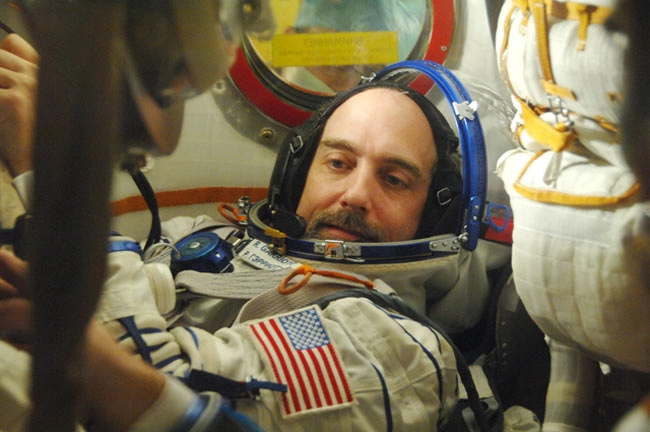
Former NASAastronaut Owen Garriott is proud of his son Richard and with good reason. Afterall, it’s not every day a child follows his father’s footsteps allthe way to space.
Richard Garriott,a computer game developer from Austin, Texas, is just days away from rocketinginto space aboard a Russian Soyuz spacecraft to become the world’ssixth space tourist. He will be the first American second-generationastronaut to reach space once he blasts off from the Central Asian spaceport ofBaikonur Cosmodrome in Kazakhstan on Oct. 12.
“I’mjust very pleased that he has made, for himself, this opportunity,” saidOwen Garriott, 77, of his son in an interview. “He’s been sopersonally interested in the opportunities of spaceflight, that I’m justextremely pleased that he has managed to find this channel.”
RichardGarriott, 47, is paying about $30 million, which he’s said is the bulk ofhis wealth, to launch into orbit under a deal between Russia’s FederalSpace Agency and the U.S. firm Space Adventures. The Vienna, Va.-based SpaceAdventures has brokered orbital spaceflights for five space tourists since2001.
For theyounger Garriott, reaching space has been a lifelong dream though he admitsthat it does feel more real now that he has his custom-built Russian Sokolspacesuit for launch.
“Anyday that you get to put on your own spacesuit is a great day,” theyounger Garriott told SPACE.com. “It definitely has that new carsmell … or that new spacesuit one.”
Set tolaunch spaceward with Garriott on Sunday are twoprofessional astronauts: Expedition 18 commander Michael Fincke of NASA andflight engineer Yury Lonchakov of Russia’s Federal Space Agency. Theywill replace the station’s current core crew - Expedition 17 commanderSergei Volkov and flight engineer Oleg Kononenko - who are due to return homewith Garriott on Oct. 23 after six months in space.
Bycoincidence, Volkov is also a second-generation cosmonaut. His father is famed Russiancosmonaut Alexander Volkov, a veteran of long-duration spaceflights to theSalyut 7 and Mir space stations.
“I’mlooking forward to getting a little more time to talk with Sergei,”Garriott said. “Obviously, I’ll have plenty more time to talk tohim on orbit.”
Likefather, like son … in space
Spaceflightwas an everyday phenomenon for the younger Garriott, who remembers his fatherbringing tools and equipment to their Houston home from NASA’s JohnsonSpace Center while training for his two spaceflights.
OwenGarriott joined NASA’s spaceflyer ranks as one of the agency’sfirst scientist-astronauts in 1965. He spent 59 in space during NASA’sSkylab 3 mission to the American space station in 1973, then another 10 days aspart of the shuttle Columbia’s STS-9 crew in 1983.
“Whenyou’re growing up in the middle of it, it seems quite normal,” saidthe younger Garriott, adding that all of his Houston neighbors where eitherastronauts or NASA engineers and scientists. “Everyone I knew was eithergoing to space or getting involved in getting those others into space.”
But theyounger Garriott’s own dream of reaching space was dashed by an eye examthat found his eyesight too poor to qualify for NASA’s astronaut corps.
“Ithought everyone was going to space and so being told I wasn’t going tobe a part of this great group of people and just have this opportunitywasn’t something I was going to take lightly,” he said, adding thatit spurred him to invest in Space Adventures and other private space companies.“Literally, throughout my entire career I’ve been investing in theprivatization of space.”
Garriottdeveloped the popular Ultima online computer game and co-founded the Origins Systemscomputer game company with his brother Robert, as well as the North Americanbranch of the online game developer NCsoft. "Tabula Rasa," hislatest release, is an online science fiction game chronicling humanity's exodusfrom Earth after a major catastrophe.
He’staking medallions made from the remains of Skylab, which fell to Earth in 1979,artwork and a so-called “immortality drive” - a flash drive archiveof mankind's greatest achievements, copies of the avatars in one of his gamesand digital versions of the DNA from some computer gamers, including that of comedianStephen Colbert, host of "The Colbert Report.”
Heavy onscience
WhileGarriott expects to enjoy his orbital flight, he also expects to work.
The privatespaceflyer has packed his 10-day mission to the brim with science experiments,Earth observations and education events to make the most of his time in space.He has a series of experiments on tap for commercial partners Seiko and DHL,NASA, the European Space Agency, as well as protein growth experiments for thefirm ExtremoZyme, a company founded by his father.
Oneexperiment is aimed at measuring visual acuity to see the effects of hiscorrective Photorefractive Keratectomy eye surgery in microgravity, which NASArecently approved for use by astronauts, though none have had the procedure todate.
Garriottalso plans to record weightless exercises as part of a so-called SpaceSportalization effort with former NFL player Ken Harvey to promote fitness inyouth. Other educational efforts include events with the space education-themedChallenger Center in the U.S. and a student experiment competition with by theBritish National Space Center.
His Earthobservation schedule includes snapping photos of areas previous observed by hisfather from Skylab in 1973 to measure environmental and climate change usingthe “Windows on Earth” software to find his targets.
“Idefinitely don’t need anymore!” Garriott said with a laugh. “Ifanything, I’m overbooked.”
If all goesas planned, he’ll even hold off on sending letters or photos home duringthe trip to squeeze in more science.
“Whenyou only have 10 days in space, taking an hour or two to organize data and sendit down when its going to come down with you anyway doesn’t make muchsense,” Garriott said, adding that he’ll record his feelings on adigital voice recorder instead. He’ll also talk to students on Earth viaham radio much like how his father called him from Skylab when he was young.
Meanwhile,the Russian-built Soyuz rocket that will launch Garriott and his Expedition 18crewmates into space is due to roll out today to the historic same launch padthat lofted cosmonaut Yuri Gagarin on the first-ever human spaceflight fromBaikonur Cosmodrome in 1961.
SpaceAdventures’ next space touristCharles Simonyi - who is paying $35 million for his second privatespaceflight - has said he plans to be on hand to see Garriott off. OwenGarriott is also at the Baikonur Cosmodrome to watch his son launch into space,and will follow the mission from the Federal Space Agency’s MissionControl Center outside Moscow as the flight’s chief scientist.
“Ifyou’ve asked anyone who’s flown what was the most enjoyable part,they’ll tell you to a person it was looking out the window,” theolder Garriott said, adding that seeing the Earth from space with one’sown eyes is indescribable. “That’s one of Richard’s mainexperiments in flight, Earth photography … I envy him the opportunity ofspending some hours looking out the window.”
TheExpedition 18 crew is set to launch into space on Sunday, Oct. 12 at 3:01 a.m.EDT (0701 GMT). NASA will broadcast the launch live via NASA TV. Click here for SPACE.com's NASA TV feedand space station mission updates.
RichardGarriott is chronicling his spaceflight training and mission at his personalWeb site: www.richardinspace.com.
- Video - Space Tourist Charles Simonyi Launches to Orbit
- Future of Flight: Space Tourism, Investment and Technology
- Video - Space Station Acrobatics
