





HOUSTON —Astronauts are preparing to venture outside of the International Space Station(ISS) later today to install its new Japanese laboratory and attempt to cleangrit out of a gummed up solar wing joint.
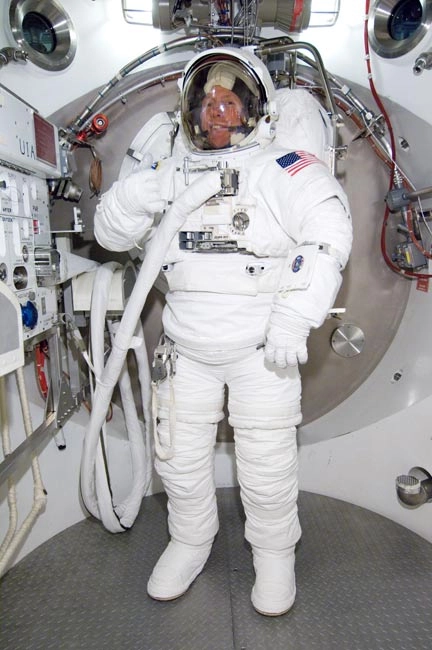
SpacewalkersMike Fossum and Ron Garan are preparing to suit up and head outside at 11:32a.m. EDT (1532 GMT) today, or earlier, if they get ahead of schedule. They havebeen camping out since Monday night in the station’s Quest airlock to preparetoday’s excursion, the first of three planned during their STS-124construction flight to the ISS.
“It’s onebig happy spaceship now,” said Matt Abbott, lead flight director forDiscovery’s mission Monday shortly after the shuttle arrivedat the station. “It’s great to have the Kibo pressurized module part of theInternational Space Station. All we have to do now is to install it tomorrow.”
Discovery’sseven astronauts are delivering a new crewmember to the station along with its thenewest and largest addition — the tour bus-sized main room of theJapanese-built Kibo laboratory.
The twospacewalkers - Fossum a veteran spacewalker and Garan a first-timer in space —plan to spend about seven hours outside the station. Fossum, the leadspacewalker, will be identifiable as the one wearing a spacesuit with redstripes.
“Ourbiggest task on EVA 1, our first spacewalk, is really preparing the spacestation to receive the Japanese module,” Fossum said in a preflight NASAinterview. “There’s some covers and launch locks we have to pull off... Allthese things have to be done manually and so really we’re the blue collarhelp.”
By the endof the spacewalk the new room should be moved out of Discovery’s payload bayand attached to its new perch on the station.
Busy day
But beforeFossum and Garan can deliver Kibo, the spacewalkers must first retrieve a vitalsensor-tipped heat shield inspection boom, which was left for them by aprevious shuttle crew because Discovery’s payload bay was too full with themassive Kibo lab to fit the extra 50-foot (15-meter) pole.
Theastronauts also plan to inspect the damage on the station’s cloggedsolar wing joint, and test tools and techniques for cleaning out the debrislodged inside it.
Known as aSolar Alpha Array Rotary Joint (SARJ), the massive gear is designed to rotatethe station’s outboard solar wings like a paddlewheel to keep them facing thesun to maximize power generation. But the starboard gear has been hobbled bymetallic grit, which has damaged its rotating ring and caused odd power spikesand vibrations that were first detected last October.
From insidethe space station, STS-124 pilot Ken Ham will serve as the spacewalkchoreographer, instructing the two men outside and making sure they stay ontrack.
“My role inthat team is to be the person on the inside of the shuttle that helps conductthe spacewalk in a real time sense,” Ham said before the flight. “That, I’velearned over the last few months, is a really fun, rewarding job. It’s a chanceto be flexible and use the assets you have in real time to try to coordinategetting a maximum amount of efficiency out of Mike and Ron.”
Missionspecialists Karen Nyberg, Akihiko Hoshide and Greg Chamitoff will also behelping out from inside the ISS by operating the space station and shuttlerobotic arms. Later in the mission after Kibo’s arm is deployed, Nyberg isexpected to become the first person to operate three different robotic arms inspace.
Firstspacewalk
Thisspacewalk will also be a trial run for a new fix on the gloves spacewalkerswear, designed to prevent the tearing near the thumbs seen on recent missions.Both spacewalkers will wear gloves with reinforced patches of a fabric calledTurtleSkin on the thumb and index finger. Tests show this material resistingcuts four times better than the normal fabric.
All in all,it should be a busy day forthe whole crew.
“We’ve gota lot of work to do,” Garan said before the launch. “It’s a very, verychallenging set of spacewalks that we’re doing.”
Though itmay be tough, Garan said he is excited for his first taste of space outside theprotective walls of the station.
“Ianticipate that it will be very overwhelming,” he said. “The view, just thefact that this whole massive station is out there in front of you. We’vetrained it in the pool but it’s just not the same.”
Today’sspacewalk will also mark the 43rd anniversary of the first U.S.spacewalk, performed by NASA astronaut Ed White during the Gemini 4 mission onJune 3, 1965.
- New Video: Liftoff! Discovery's STS-124 Mission Launches Into Space
- Video: STS-124 Mission Preview ? Delivering Kibo
- Complete Space Shuttle Mission Coverage
