


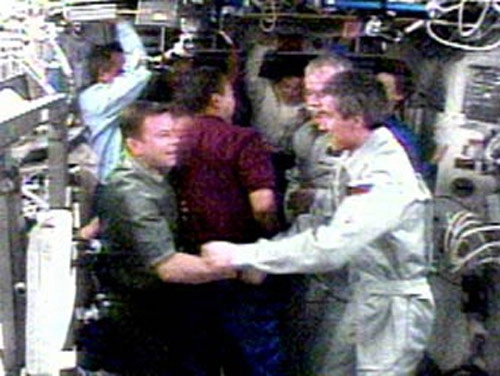
HOUSTON - Aftereight days docked at the International Space Station (ISS), the shuttleDiscovery cast off from the orbital laboratory Saturday and began the trip backto Earth.
Discovery'sseven STS-114 astronauts exchanged hugs and handshakes with the space station'stwo-man Expedition 11 crew then closed the hatches between their spacecraft atabout 1:14 a.m. EDT (0514 GMT).
"We thankthem for being such great hosts and we're so happy to have spent time up herewith them," STS-114 commander Eileen Collins told the station's Expedition 11crew before closing the hatches. "These are memories that we will have forever."
Discovery isscheduled to land Monday at 4:46 a.m. EDT (0746 GMT) at Kennedy Space Center (KSC)in Cape Canaveral, Florida.
Shuttlepilot James Kelly flew Discovery during today's undocking, which occurred ontime at 3:24 EDT (0724 GMT), then guided the orbiter on a fly-around maneuverthat circled the space station at a distance of about 400 feet. His fellowSTS-114 crewmembers photographed the station during the maneuver.
"We havephysical separation," Collins said, as the two spacecraft undocked.
Collins andher six fellow STS-114 astronauts are the first shuttle astronauts to visit theISS since the Endeavour orbiter left the station in December2002. Their mission, NASA's first shuttle flight since the 2003 Columbiatragedy, delivered tons of fresh suppliesto the station and is carrying tons more trash and broken or unneededequipment back to Earth.
The STS-114crew spent eight days, 19 hours and 54 minutes at the ISS after dockingat the station on July 28.
"We're notglad to see you go," Expedition 11 flight engineer John Phillips told theSTS-114 crew. "Great flight, soft landing, and we look forward to seeing youback in Houston in a few months."
WhileDiscovery will land Monday, the Expedition11 astronauts must wait until October - and the end of their six-month stayaboard the ISS - to return to Earth.
Duringtheir flight, Collins and her crew staged three spacewalks and tested out heatshield repair techniques and an orbital inspection boom tipped with laser andcamera sensors to scan for cracks and other damage. Those measures were part ofNASA's effort to enhance shuttle flight safety in response to the loss of sevenSTS-107astronauts aboard the Columbia orbiter, which suffered foam debris damageto its heat shield during launch and subsequently broke apart over Texas duringreentry on Feb. 1, 2003.
In additionto replacing a vital gyroscopeused to maintain the station's attitude control, STS-114 astronauts swapped outexperiment packages and installed a spareparts platform - with spare parts included - to ISS' exterior.
STS-114spacewalker Stephen Robinson also performed the first-ever in-flight repairof a shuttle's heat shield when used the fingers on his right hand to removetwo strips of space-filling material from between the tiles lining Discovery'sbelly.
"It'sreally been such a fantastic experience," Collins told Sen. Kay Bailey Hutchinson(R-Texas) Friday during an Earth-to-space phone call. "I'm looking forward toseeing my family again."
There maybe an extended gap between Discovery's ISS mission and the next shuttle mission.NASA officials said Friday that the agency's second return-to-flight mission,Atlantis' STS-121 spaceflight, will launch no earlier than Sept. 22- pushed back from Sept. 9 - to allow engineers to study and fix an externaltank foam insulation shedding problem seen during Discovery's launch.
AsDiscovery shot into space, a nearly 1-pound piece of foam fell from itsexternal tank - it did not hit the orbiter - in a similar manner to the foamloss that crippled Columbia's heat shield. NASA officials said they will notlaunch another shuttle until the foam debris issue is resolved.
"Spaceexploration isn't easy," Collins said told Congressman Tom DeLay (R-Texas) inthe Friday phone call. "Not everything is going to be 100 percent successful,but the important thing is we're learning."
- Fixing NASA: Complete Coverage of Space Shuttle Return to Flight
