





Thisstory was updated 11:25 p.m. EDT.
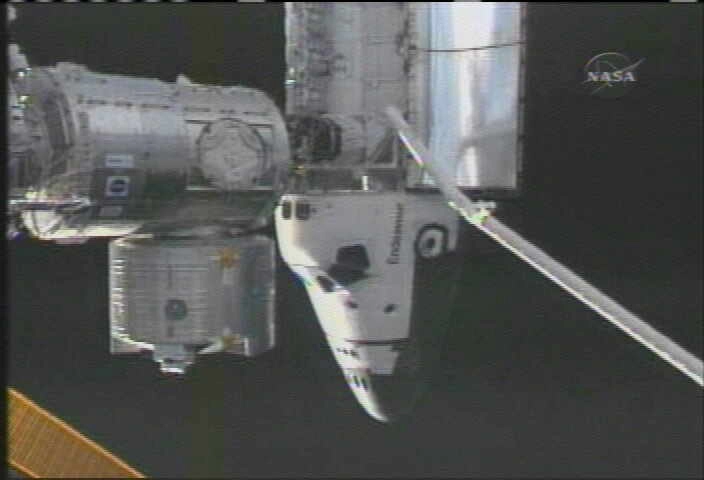
HOUSTON -Astronauts aboard NASA?s shuttle Endeavour scanned their spacecraft?s vitalheat shield for dings again Friday as they prepared for their fifth spacewalkoutside the International Space Station (ISS).
The lateheat shield inspection is a now standard task for astronauts to ensure their orbiter?ssensitive heat shield panels are free of damage from micrometeorites or otherorbital debris. But the laborious scan is typically performed after a shuttlehas undocked from the ISS and has room to move its laser sensor-tippedinspection boom - a 50-foot (15-meter) extension of the shuttle?s robotic arm.
?From what wesaw, there was no obvious report of anything funny,? shuttle flight directorMike Moses said late Friday. Engineers will spend the next 24 hours siftingthrough the survey?s detailed laser imagery and data to be sure Endeavour?sheat shield is pristine, Moses added.
NASA haskept a close eye on the integrity of its shuttle heat shields since the 2003 Columbia accident, inwhich wing damage led to the loss of the orbiter and its crew during landing.Astronauts now inspect the shuttle for damage just after launch, photograph itstile-covered belly before docking at the station, then survey the heat shieldagain before reentry to be sure it is safe to land.
Missionmanagers have already cleared Endeavour?s heat shield of any concerns from its March11 launch. But they also decided before liftoff to move up today?s lateinspection of the heat resistant carbon-composite panels lining the shuttle?swing edges and nose cap - which experience the hottest temperatures duringreentry - in order to leave Endeavour?s inspection boom at the station for itssister ship Discovery.
Set tolaunch on May 25, Discovery will be hauling Japan?s primaryKibo laboratory module, a massive, tour bus-sized cylinder that leaves noroom in the cargo bay for its own starboard sill-mounted boom, mission managerssaid. Endeavour?s crew will stow their shuttle?s inspection boom at a berth onthe space station?s backbone-like main truss during a Saturday spacewalk, thefifth of their record 16-day mission to the ISS.
?TheJapanese module was built long before the requirement to have the [boom]existed, so there?s a clearance problem in the payload bay,? Moses has said.
Similarclearance problems existed for Europe?s Columbus lab delivered last month andthe Japanesestorage room installed by Endeavour?s current STS-123 astronaut crew lastweek. While engineers were able to remove some fixtures to make room for thosemodules, they can?t for Kibo?s main segment because the laboratory is simplytoo big.
Instead,Endeavour commander Dominic Gorie, pilot Gregory H. Johnson and Japaneseastronaut Takao Doi will spend a few more hours conducting their late surveythan normal, and be extra careful that the shuttle?s 100-foot (30-meter)robotic arm-boom combo does not strike the space station?s outer hull.
?We haven?tdone a full what we call a late inspection while we?re docked,? said ISS flightdirector Dana Weigel in a morning status briefing, adding that some stationstructure is in the way. ?It?s really a geometry challenge.?
Moses hassaid today?s survey, which began just after 4:00 p.m. EDT 2000 GMT), would taketwice as long to scan Endeavour?s starboard wing because the need to workaround the station?s European-built Columbus lab, which juts out above theshuttle?s docking port. The shuttle boom also could not get as close to theheat shield as normal, so some regions on the bottom of the orbiter?s starboardwing will not be scanned as clearly as they would be in an undocked inspection,he added.
ButEndeavour astronauts said that it was debris from their shuttle?s launch thatwould pose the greatest risk to the spacecraft. Losing some image resolutionand a day or two on the late inspection to aid a future shuttle flight was nota major concern, they added.
?I?m veryconfident in our inspection,? Gorie said of today?s survey before launch.
Gorie and hiscrew are currently in the midst of a packed 12-day stay at the space station,where they have delivered a new crewmember, Japanese module and giant,Canadian-built robot to the ISS. The astronauts are slated to undock fromthe station late Monday and land Wednesday evening.
NASA isbroadcasting Endeavour's STS-123 mission live on NASA TV. Click here for SPACE.com'sshuttle mission coverage and NASA TV feed.
- NEW VIDEO: Space Station's Dextre Robot, AKA 'Gigantor'
- NEW GALLERY: Launch Day for Shuttle Endeavour
- NEW VIDEO: Japan's First Space Station Module
