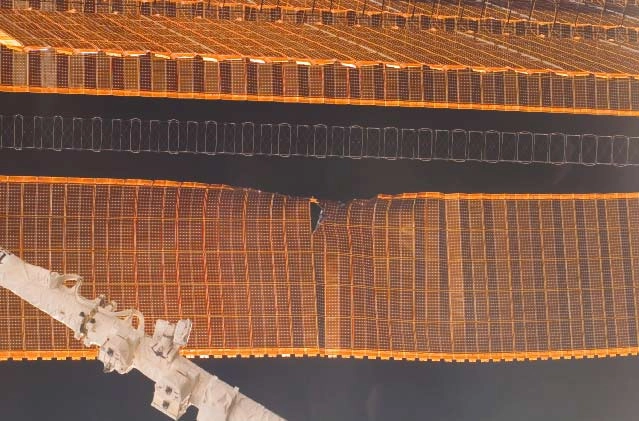
HOUSTON - NASA lauded its astronaut crewstoday for an unprecedented spacewalk outside the International Space Station(ISS) to stitch up a torn solar array wing.
Missionmanagers said thespacewalk performed by astronauts Scott Parazynski and Doug Wheelock brokethe record for robotic arm reach and duration and was one of the most excitingthey have ever experienced.
"Thisis a pretty big one," said Dina Contella, the STS-120mission's lead spacewalk officer, of the spacewalk's rank in history."I've been working in the spacewalk business for about 12 years, and I'llput it as number one."

ISS leadflight director Derek Hassmann commended astronauts and planning teams on theground for putting the spacewalk together in a matter of days--a process thattypically takes months to do.
"Today'sa huge day and just an unbelievable success," Hassmann said.
Quickfix
To repairthe maimed solar array, Parazynski snipped off wires thought to be the cause ofthe damage, then enforced the weakened accordion-like blanket with five handcrafted"cuff links" made by astronauts in space.
Oncepatched together, Parazynski looked on as Mission Control here in Houston fully deployed the scarred solar array.
"Yay!"Parazynski shouted in his spacesuit after the solar blanket deployed.
ISS programmanager Mike Suffredini said the space station's solar arrays were not intendedto be stitched-up, but are now functioning as expected.
"Itdidn't look like we quite expected it," Suffredini said, "but ? youhave your baby, your baby's beautiful to you, and our baby is still beautifulto us."
Schedulepressure
The solararray tore on Oct. 30, only two days after spacewalkers found troublingmetallic grit in solar-array-rotating gears.
Underpressure to pick one to fix before the space shuttle Discovery and its crewleave, Suffredini said he had no regrets going after the damaged solar blanket.
"Idon't look back on that decision and question it," Suffredini said, notingthat it was the most important problem to resolve before adding additionalpieces to the orbital laboratory. "Fixing this array let us get on withassembly."
Suffredinisaid adding the Columbus laboratory module with December's STS-122 missionwould not be an issue.
But afterFebruary's planned launch of Japan's module and a new robotic arm system, theNASA official hinted that the remaining problem--a gritty solaralpha rotary joint (SARJ)--might delay space station construction.
"Thisis the day in the life of a space station," Suffredini said, noting thathe will have astronauts repair the potentially damaged component as soon aspossible.
The spaceshuttle Discovery is set to depart the space station on Monday, Nov. 5 andtouch down at NASA's Kennedy Space Center (KSC) around 4:11 p.m. EDT (2011GMT). ISS astronaut Clay Anderson will ride Discovery home, leaving STS-120spacewalker and robotic arm operator Dan Tani to help outfit the space stationfor the arrival of new laboratories.
- SPACE.com Video Interplayer: STS-120 Mission Profile
- NASA: Shuttle Launch Paves Way to Larger Space Station
- Complete Space Shuttle Mission Coverage