





HOUSTON - There's trouble brewing in space,but NASA officials said today that they are confident astronaut crews aboardthe International Space Station (ISS) will work through the difficulties aheadwith mission control's help.
A worrisomejoint on the space station first complicated space shuttle Discovery's STS-120 mission,which launched a week ago, but today a torn solar array has added to theheadaches of NASA mission managers.
AlthoughISS program manager Mike Suffredini said the problems will be challenging totackle, he thinks together they are not as serious as now-fixed computerfailures that plagued space station this year.
"Ihave in my mind a path through the wilderness on both of these problems. It willtake time, but I have a path through the wilderness," Suffredini said ofthe double trouble. "We'll prioritize the work and decide which is theright thing to work on first."
Rippedwing
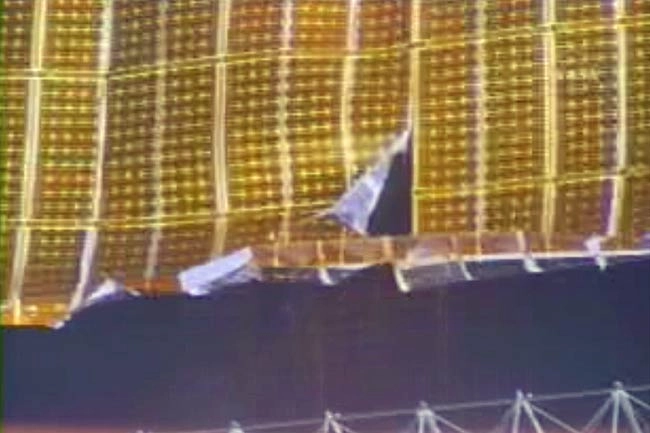
Suffredini saidengineers and mission managers are still heavily discussing a plan of action,but thinks repairing the solar wing will become priority number-one in the followingdays. He said the 2.5-foot (0.76-meter) rip in the 115-foot (35-meter) wing hasnot stopped the array's energy-gathering ability, as it is generating 97percent of its fully deployed power.
"We'rein a very good configuration in terms of being able to sort this problemout," Suffredini said of the situation. "It doesn't have to lookgood, it just have to give us power. We need it out, and need about as muchpower as it provides today."
He notedthat mission managers' concerns regard the solar array's fragile state, which dockingsand undockings of space shuttle and Soyuz spacecraft might aggravate.
"Everythingwe do has an effect on every other part of the space station," Suffredinisaid, noting that only a fully-deployed array is known to be stable. Becausethe array fabric is electrically sensitive and difficult to reach with eitherthe space shuttle or space station robotic arms, a fix would be extremelychallenging, Suffredini noted.
Astronautsaboard the orbital laboratory monitored the unfurling process following aseven-hour spacewalk today. The first pair of solar wings, known as 2B,deployed without incident from the freshly reattached Port 6 (P6) solar arraytruss. One of the 4B solar wings opposite of the 2B pair, however, ripped afterunfurling 80 percent of the way along a mast-like post.
Worrisomejoint
The ripped arraycame after spacewalker Dan Tani discovered metallic grit in starboard-side jointearly Sunday morning. The mechanism, called the solar alpha rotary joint(SARJ), is used to gently orient the space station's solar panels toward theSun.
Astronautsaboard the space station determined the metallic grit was iron-containing,which Suffredini thinks is coming from steel in the mechanism—a likely sign ofdamage.
"Thesteel components are the bearings ... and gears," Suffredini said of devicesin the SARJ, a motor-driven gear that looks similar to a Ferris wheel. He saidtwelve sliding clamps used to hold the 10-foot (3-meter) diameter wheel intoplace, called trundle bearing assemblies (TBAs), are suspect and would like to seeastronauts inspect them during Thursday's 6.5-hour spacewalk.
But Suffredinisaid the solar array rip will probably divert attention from such a focusedinspection during the fourth of five STS-120 spacewalks.
"Idon't want to do any more damage to the array than has already been done,"Suffredini said, and preventing it might mean delaying the launch of spaceshuttle Atlantis in early December, known as the STS-122 or 1E assembly mission."Right this instant ? I wouldn't want to plan a 1E flight until I knowwhat's better going on."
NASAlaunched Discovery and its crew, commanded by Pamela Melroy, on Oct. 23. Astronautsdelivered a new room to the space station and relocated a massive solar arraytruss during the now-extended mission, and expect to land at Kennedy Space Center in Cape Canaveral, Fla. on Nov. 7.
- SPACE.com Video Interplayer: Delivering 'Harmony' with NASA's STS-120 Mission
- NASA: Shuttle Launch Paves Way to Larger Space Station
- Complete Space Shuttle Mission Coverage