





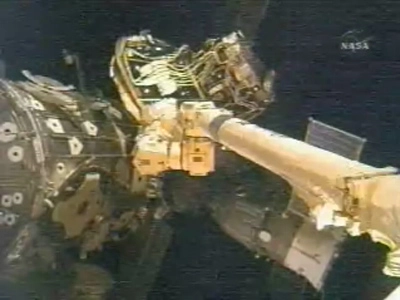
Despitesome finicky bolts, astronauts aboard the International Space Station (ISS) movedan old docking port to a new parking spot Thursday, clearing a berth for thearrival of a brand new module later this year.
Workingfrom inside the space station, Expedition 15 commander Fyodor Yurchikhin andflight engineers Oleg Kotov and Clayton Anderson successfully movedthe docking port from its port-side perch on NASA's Unity module toan Earth-facing berth. The relocation frees up space for the new Harmony connectingnode due at the ISS in October.
"Lucia, you and everyone else might want to go out and grablunch while this is going on," Anderson told spacecraft communicator LuciaMcCullough in Mission Control during the slow, delicate move of the dockingport known as Pressurized Mating Adapter-3 (PMA-3).
A series ofintermittent fault messages delayed PMA-3's relocation by about an hour whenthree of the 16 bolts securing the docking port in place returned errors. ButMission Control determined that the glitch would not impact the relocation orthe Harmony node's installation later this year.
"There'ssome speculation that the length of time PMA-3 spent at that left side locationmay have played a role in those fault indications," NASA commentator JohnIra Petty said of the docking port, which sat unmoved for more than six years beforetoday.
The short tripfor PMA-3 cleared a critical hurdle for the space station's construction.
NASA plansto launch the shuttle Discovery's STS-120 mission on Oct. 23 to deliver the new Harmony node,which will serve as the foundation for future international laboratories at theISS. But Harmony must be temporarily installed at Unity's port side berth sincethe station's 57-foot (17-meter) robotic arm would not have enough reach to attacha docking port at the tip of new node if it were stationed at an Earth-facinglocation, NASA said.
The threeExpedition 15 astronauts donned brightyellow hard hats emblazoned with their mission emblem for Thursday'sorbital work. The gag construction helmets were delivered to the ISS earlierthis month by the STS-118astronaut crew of NASA's space shuttle Endeavour.
"Welike the hats," McCullough told the Expedition 15 crew.
Anderson,assisted by Kotov, wielded the station's robotic arm during PMA-3's move andkept the massive docking port within a few feet of the ISS. Yurchikhin,meanwhile, oversaw the bolt latching systems to alternately free and secure themodule during its relocation. The astronauts plucked PMA-3 free of Unity at8:23 a.m. EDT (1223 GMT) and successfully reattached the port to its new berthat 9:07 a.m. EDT (1307 GMT).
Readyfor Harmony
The spacestation's three conical Pressurized Mating Adapters serve as either connectingtunnels between ISS modules or docking ports for NASA shuttles and the agency'sfutureOrion Crew Exploration Vehicles.
PMA-1connects the Unity node with the Russian Federal Space Agency's Zarya controlmodule, while PMA-2 sits at the front of the station's U.S. Destiny laboratoryas a shuttle docking port. PMA-3 weighs 2,607 pounds (1,183 kilograms) with adiameter that tapers from 6.2 feet (1.9 meters) at its widest down to 4.5 feet(1.8 meters) at the narrow point.
The dockingports are attached to the ISS by way of a Common Berthing Mechanism equipped with16 remote controlled bolts that Yurchikhin loosened in sequence to free PMA-3.
"It'sa bit like changing the lug nuts on a tire," NASA's lead Expedition 15flight director Bob Dempsey told SPACE.com of the ISS bolts. "Youkind of do them in groups to make sure the forces are equal."
Thursday'sPMA-3 relocation marked a return home of sorts for the seven-year-old dockingport.
Astronautsfirst installed the module to Unity's Earth-facing berth in October 2000 duringNASA's STS-92 mission, after which it served shuttle docking port. But in March2001, astronauts moved PMA-3 to Unity's port side berth where it most recentlyserved as a storage closet.
The module wasalso not completely empty during its short trip. Mission managers opted toleave a large spare part for the space station's robotic arm inside simplybecause there wasn't enough room inside the outpost to store it.
"Wedecided to leave it in there with straps, so we had to make sure that the itemwas secured very tightly," said Dempsey, adding that the astronauts wouldtake extra care to avoid exposing PMA-3 to high temperatures that would loosenthe glue on the straps and send the massive piece of hardware drifting out intospace. "That would be very bad."
Dempseypraised the cooperation between Expedition 15's Russian and Americanastronauts. Their mission has marked the first time NASA-controlled componentslike the station's Canadian-built robotic arm have been wielded by Russiancosmonauts. In the past, only NASA astronauts oversaw operating the station'sCommon Berthing Mechanisms and Canadian-built robotic arm, Dempsey said.
"Thisis one of the first crews I've seen that's been truly integrated," Dempseysaid. "There're really no boundaries here and it's great to see them meldtogether."
- SPACE.com Video Interplayer: NASA's STS-118 Shuttle Mission
- IMAGES: Endeavour's STS-118 Launch to the ISS
- Complete Space Station Mission Coverage
