





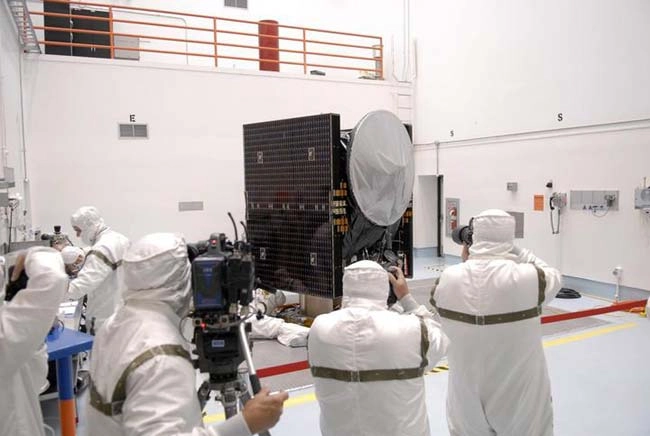
The launchof NASA?s Dawn spacecraft has met a new delay, with liftoff set for noearlier than July 15, the space agency said late Friday.
NASAspokesperson George Diller said that Dawn mission managers opted to delay Dawn?slaunch towards the asteroidsVesta and Ceres nearly a week from its planned Monday launch. Bad weatherand mechanical glitches with a tracking aircraft prevented Friday andSunday launch attempts.
By July 15,a tracking ship should be in place to observe Dawn?s launch atop a Delta 2rocket, Kurt Lindstrom, NASA?s Dawn program executive, told SPACE.comFriday. The ship, he added, is already en route towards its position on theAtlantic Ocean.
NASA?s Dawnspacecraft is the agency?s first to orbittwo planetary bodies and will study a pair of very different asteroids. The$449 mission is an eight-year trek that will send Dawn first to bright, denseVesta in October 2011 and then on to the dimmer, spherical Ceres in February2015. The two space rocks are the largest in the solar system, with Ceres -which is also considereda dwarf planet - containing up to half of the total mass of material in theAsteroid Belt running between the orbits of Mars and Jupiter, mission managerssaid.
Researchershope that studying the two asteroids and comparing their differences will shednew light on the origins of the solar system and its planets.
NASA hasuntil July 19 to launch Dawn before standing down to allow preparations for theplanned Aug. 3 liftoff of the agency?s MarsPhoenix lander. Should the mission miss its July window, NASA couldreattempt the space shot between September and October for an added cost of $25million for new rocket components.
But by lateOctober, Vesta and Ceres will be moving away from one another, making arendezvous with both asteroids difficult for Dawn for any later launch attempts,Chris Russell, Dawn?s principal investigator, said Friday. They won?t near eachother again for about 15 years, he added.
- ? VIDEO:The Asteroid Paradox
- ? GALLERY:Asteroids
- ? HowNASA's Dawn Spacecraft Will Explore Solar System's Origin
