


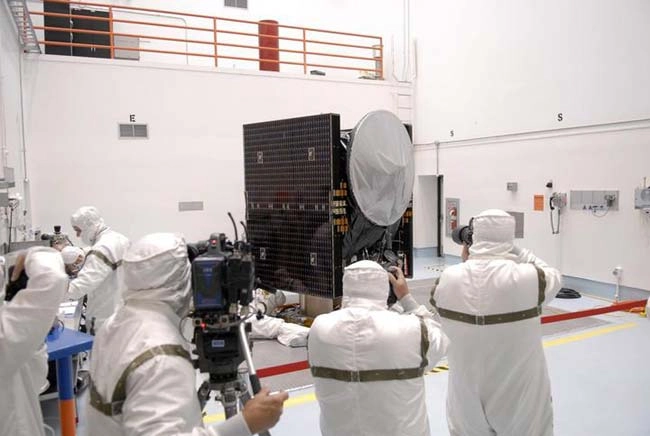
NASA ishoping for a Monday liftoff for the Dawn spacecraft, a probe bound to visit thetwo largest asteroids in the solar system.
Dawn is nowset to ride a United Launch Alliance Delta 2 rocket into space July 9 at 3:56p.m. EDT (1956 GMT) afternew issues scrapped plansfor a Sunday liftoff.
Mechanicaldifficulties with a telemetry relay aircraft, combined with the unavailability ofa tracking ship and an unfavorable weather forecast for rocket fueling, delayedplans for a Sunday launch, NASA officials said. Weather forecasts for Monday improveto a 60 percent chance of favorable liftoff conditions, they added.
Dawn'splanned Monday launch will kick off an eight-year trip to Vestaand Ceres, the two largest space rocks in the Asteroid Belt that rings theSun between the planets Mars and Jupiter. The $449 million mission will markNASA's first to orbit two different planetary bodies, and will study spacerocks that formed about 4.6 billion years ago while the solar system was stillyoung.
"What'sexciting to me is that this is comparative planetology at its best," said DavidLindstrom, NASA's Dawn program scientist, during a Friday briefing. "Wetruly are going back in time; back to the dawn of the solar system."
Powered byan ion drive, Dawn is due to enter orbit around Vesta in October 2011 and usethree onboard instruments to study the space rock's surface before heading offtowards a February2015 orbital rendezvous with Ceres.
Vesta is adense body scarred by an ancient impact that, researchers believe, sent amyriad of small meteorites falling to Earth. Ceres, with its spherical shape and a diameter about 600miles (almost 1,000 kilometers) wide, is so large it is consideredto be a dwarf planet and may sport a subterranean cache of ice or water,mission scientists added.
Examiningthe differences between dense, bright Vesta and the dimmer, less-dense Ceresmay yield new answers for researchers studying the formation of planets, NASAofficials said.
Dawn's abilityto shift from one target to another hinges on its three xenon ion-driven thrusters,which allow the probe to maneuver with less propellant than that required for chemical-basedrockets.
"Wecouldn't do this mission without the ion drive," said Mark Sykes, a Dawnmission co-investigator from the Planetary Science Institute at the Universityof Arizona. "It's an extremely flexible way of moving around the solarsystem."
NASA nowhas until July 19,? a window eight days longer than first announced, to launchDawn before standing down to allow preparations for the planned Aug. 3 liftoffof Phoenix, the space agency's next Marslander mission.
"We'rekind of just threading the needle with these two launches," KurtLindstrom, NASA's Dawn program executive, told SPACE.com.
The nextopportunity to launch the mission arises this fall. By the end of October thedistance between Vesta and Ceres - which are currently relatively close to oneanother - will begin increasing, mission managers said, adding that the twospace rocks will near each other again in 15 years.
- VIDEO: The Asteroid Paradox
- GALLERY: Asteroids
- How NASA's Dawn Spacecraft Will Explore Solar System's Origin
