





HOUSTON --Efforts to fully recover critical Russian computer systems aboard theInternational Space Station (ISS) will likely continue through the rest of theweek, with no quick fix at hand, a top NASA official said Thursday.
BillGerstenmaier, NASA?s associate administrator for space operations, said theRussian systems are down again after a briefseven-minute period earlier today. But during that time, Russian engineersuploaded commands to put the station in a more stable configuration as workcontinues to trace the glitch, he added.
?It?s goingto take time. It will not be quick,? Gerstenmaier told reporters during abriefing here at NASA?s Johnson Space Center. ?Unless we get lucky right awayand find the problem, it?ll be a couple days [that] we?ll probably be in thisconfiguration.?
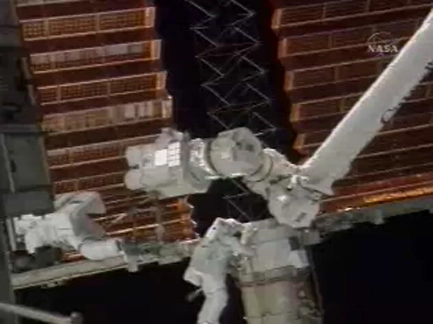
Possiblesources for the glitch may be power quality issues associated with thestation?s new starboard solar arrays, whichunfurled Tuesday, NASA said. Software anomalies, a mismatch in thestation?s U.S.-to-Russian power transfer system and electromagnetic interferencemay also be candidates for the computer crash, the space agency has said.
The spateof recent false fire alarms aboard the ISS, meanwhile, has been found to beassociated with the ongoing computer issue, Gerstenmaier added.
Computercrash
Two vitalcomputers, one governing navigation and attitude control and the other commandand control systems, wentoffline inexplicably early Wednesday, leaving some of the station?s Russiansystems unavailable to its three-person crew and seven visiting shuttleastronauts. Those systems include Russian thrusters used to orient the ISS whenits U.S.-built gyroscopes are unavailable, as well as the Elektron oxygengenerator and other systems.
TheElektron, and some others aside from the thrusters, can be operated manuallywithout computer control, said Gerstenmaier, who stressed the current computerissue is not serious enough to warrant abandoning the space station.
?I thinkwe?re a long way from that scenario,? he said.
But sinceThursday?s computer crash, the ISS has depended solely on its control momentgyroscopes for attitude control, with the thrusters on NASA?s visiting Atlantis shuttle servingas backup. Astronauts aboard Atlantis have powered down unnecessary lighting,laptops and other systems in order to conserve power for the possibility of aone day or so extension to their alreadyextra-long mission to continue serving as the station?s attitude controlsystem backup, NASA said.
Spacestation managers hope to fix the computer issue before Atlantis undocks, sincethe Russian thrusters are preferred to be functioning in case the station?sgyroscopes are overwhelmed - or ?saturated? - just after the orbiter?s plannedJune 21 departure.
?Ideally,we?d would like to have the Russian computer systems up and operating when theshuttle undocks,? Gerstenmaier said. ?The concern is really attitude control,and can we find ways of providing attitude control without using thesecomputers.?
Thrusters aboardunmanned Russian Progress cargo ships, two of which are docked at the ISS, areamong several alternatives to control the station?s orientation, he added.
Russianflight controllers woke the station?s Expedition 15 crew, commanded bycosmonaut Fyodor Yurchikhin, much earlier than planned this morning so theastronauts could help in the troubleshooting process. Russian communicationswith the ISS are handled through ground stations, which are within range of theorbital laboratory earlier in the day, NASA said.
?We won?task how you?re doing because we can imagine,? Russian flight controllers saidlater, adding that a crewmember will again have to stay up overnight. ?Are yourunning out of steam yet??
?No we?reokay,? Yurchikhin replied. ?And we?re ready to work.?
NASA isbroadcasting the space shuttle Atlantis' STS-117 mission live on NASA TV. Click here for mission updates andSPACE.com's video feed.
- SPACE.com Video Interplayer: Space Station Power Up with STS-117
- STS-117 Power Play: Atlantis Shuttle Crew to Deliver ISS Solar Wings
- Complete Shuttle Mission Coverage
