


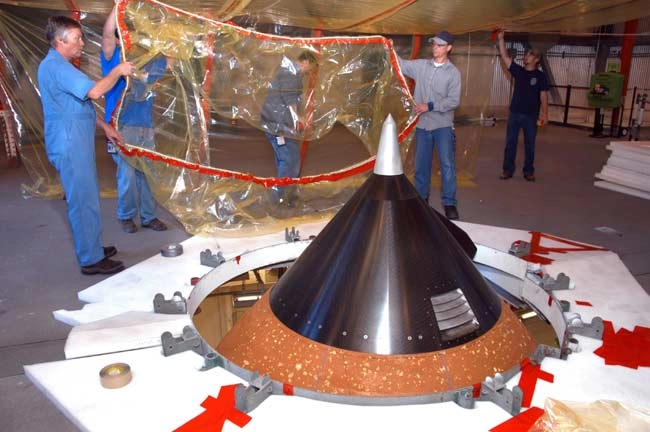
A team ofengineers is taking a meticulous look at the hail-damagedfuel tank of NASA's shuttleAtlantis to determine how best to repair its weather-beaten surface for a plannedApril launch to the InternationalSpace Station (ISS).
"We're kindof working our way down the tank to assess it," Harry Wadsworth, a spokespersonfor shuttle fueltank manufacturer Lockheed Martin, told SPACE.com Thursday. "Weshould have a go-forward plan early next week to take to the space shuttleprogram."
A freakthunderstorm centered right over NASA's Pad 39 launch complex at theKennedy Space Center (KSC) in Cape Canaveral, Florida peppered Atlantis' fueltank with golf ball-sized hail on Feb. 26, gouging thousands of dings in thevessel's vital foam insulation [image].
Atlantiswas slatedlaunch its six-astronaut STS-117 crew towards the ISS on March 15,though shuttle mission managers opted to delaythe space shot to late April to make repairs.
The shuttleleftits Pad 39A launch site on March 4 for the shelter of NASA's cavernous 52-story Vehicle AssemblyBuilding [image].Once there, work crews surrounded the orbiter's fuel tank with scaffolding inorder to reach its pockmarked nose cap, which sits about 184 feet (56 meters)above the Mobile Launch Platform that supports the attached shuttle, fuel tankand twin rocket boosters [image].
Wadsworthsaid a team of about six tank specialists headed to NASA's Kennedy Space Centerin Cape Canaveral, Florida this week from the New Orleans-based MichoudAssembly Facility, whereshuttle fuel tanks are manufactured.
Some foam sandingor blending to address extremely minor damage may be performed this week, butthe primary goal is to survey Atlantis' fuel tank and draw up a comprehensiverepair plan, Wadsworth said.
NASAshuttle workers are also eyeing minor dings to 27 protective heat-resistanttiles on Atlantis' underside. Launch officials have said ricocheting hail mayhave circumvented the shroud-like Rotating Service Structure at Atlantis'launch pad, which protect orbiters from weather, to cause the dings.
Damage tofuel tank foam insulation has been a prime concern for NASA since 2003, when a chunk ofloose foam shook loose during the launch of Columbia and struck the orbiter'sleft wing. The resulting damage to the Columbia's heat shield led to the loss of the orbiter and its seven-astronautcrew during reentry.
NASA hassince redesignedshuttle fuel tanks to reduce the amount of foam shed during liftoff anddeveloped in-orbit inspection procedures, as well as some limited repairtechniques, to address the problem in orbit if required. But ensuring a tank isfit to fly in the first place is imperative, NASA officials said.
"What theprogram has cautioned everyone is, 'Let's let the team go off and do theirwork,'" Jessica Rye, a NASA spokesperson at KSC, told SPACE.com."They've got a lot of inspections to do. We want a full story on what the tankteam feels needs to be done."
Commandedby veteran shuttle flyer RickSturckow, Atlantis' STS-117astronaut crew is slated to launch no earlier than late April to haul a17.5-ton addition to the space station's core framework and two starboard solararrays.
The missionis NASA's first of up to five ISS construction flights slated for 2007, butmust wait until after a 10-day ISS crewswap mission to begin with the planned April 7 launch of a Russian Soyuzspacecraft.
- NASA: Atlantis Shuttle Launch Delayed to Late April After Storm
- STS-117 Power Play: Atlantis Shuttle Crew to Deliver ISS Solar Wings
- The Great Space Quiz: Space Shuttle Countdown
- Complete Shuttle Mission Coverage
- All About the Space Shuttle
