


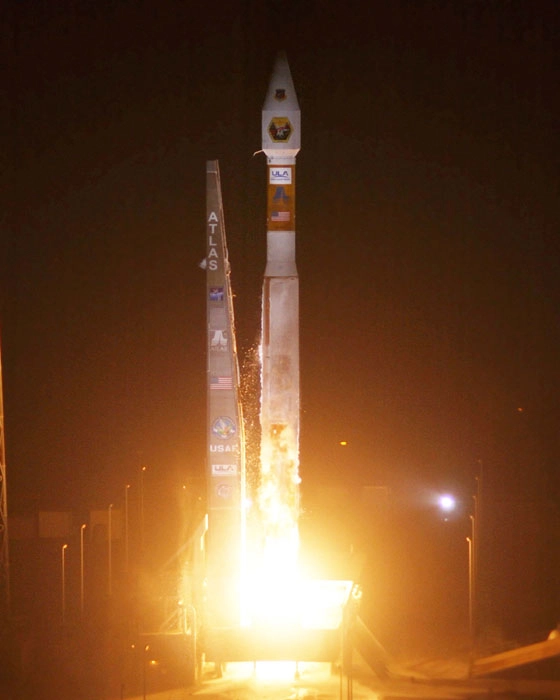
An Atlas 5 rocketlaunched spaceward late Thursday, hauling a clutch of six military research satellites into orbit for the U.S.Air Force.
The United LaunchAlliance (ULA) booster shot into the night sky above Florida's CapeCanaveral Air Force Station at 10:10 p.m. EST (0310 March 9 GMT) carrying two OrbitalExpress spacecraft refueling demonstrators and four experimental microsatellitesunder the Air Force's Space Test Program-1 (STP-1) mission [image].
- VIDEO: Riding Along with Orbital Express
"Thisis a proud moment in our company's history and a significant step forward inproviding our nation assured access to space using the most cost-effectivemeans possible," Michael Gass, ULA president and CEO, said in a post-launchstatement, adding that the space shot marked the first launch of an expendableAtlas booster for the U.S. Air Force.
Thursday's spaceshot occurred about a half hour later than planned due to launch range radiointerference and booster vent valve issues, though both proved only short delays.
OrbitalExpress, microsatellites reach orbit
Theflagship of the STP-1 mission is Orbital Express, a two-spacecraft mission todemonstrate the feasibility of autonomously servicing a satellite in space.
Built forthe Defense Advanced Research Projects Agency (DARPA), the $300 million vehiclesinclude the 2,100-pound (952-kilogram) ASTROservicing satellite and its 500-pound (226-kilogram) target NextSat [image].The spacecraft are expected to spend about three months testingautonomous satellite rendezvous, refueling and component replacement [image]in Earth orbit.
"We're veryproud to be at this point," USAF Lt. Col. Fred Kennedy, project manager forOrbital Express, said in a telephone interview before launch. "We've beenworking a long time to be at this stage."
Shortlyafter the Orbital Express spacecraft were deployed at 10:28 p.m. EST (0328March 9 GMT), the MidStar-1 microsatellite -- built by midshipmen at the U.S.Naval Academy [image]-- successfully reached orbit.
The 265-pound(116-kilogram) satellite carries a series of experiments, including a pairof space computer payloads, the Eclipse experiment to examine electrochemical membranesin space for NASA and Eclipse Energy Systems, and a prototype microdosimetersponsored by the National Space Biomedical Research Institute (NSBRI).
The ULAAtlas 5 rocket also orbited three other small spacecraft:
- STPsat-1: A 343-pound (156-kilogram) satellite carrying two experiments to collect atmospheric data and demonstrate spacecraft technologies for the U.S. Air Force's Space Test Program [image].
- Cibola Flight Experiment (CFEsat): A 350-pound (159-kilogram) satellite built for the Los Alamos National Laboratory to test a series of new technologies, including inflatable boom antennas, a new power supply and a prototype supercomputer designed to process data onboard rather than sending raw information directly to Earth [image].
- FalconSat-3: Built by cadets at the U.S. Air Force Academy, the small, 119-pound (54-kilogram) satellite carries five experiments to study the near-Earth space plasma environment, test new hardware and demonstrate a Micropropulsion Attitude Control System [image].
"STP-1required an extraordinary level of coordination and innovation to achieve themission requirements," Jim Sponnick, ULA vice president of Atlas programs, saidin a statement. "One of those innovations was the mission design to achieve thetwo mission orbits, which was enabled by the development of a very flexible newguidance design."
Thursday's launch markedthe 80th consecutive successful space shot for an Atlas rocket and the ninth flightof the booster family's Atlas 5 variant.
- VIDEO: Riding Along with Orbital Express
- VIDEO: DEPTHX - Autonomous Diver Robot in Action
- IMAGES: Robot Explorers
- Fender Bender: NASA's DART Spacecraft Bumped Into Target Satellite
- All About Satellites
