





WASHINGTON -- Two NASA astronauts successfully upgradedthe InternationalSpace Station's (ISS) cooling system Sunday during the second in a seriesof landmark spacewalks outside the orbital laboratory.
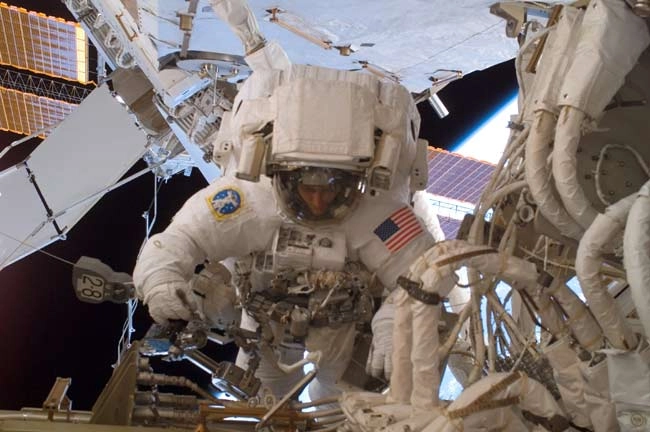
ISS Expedition14 commander MichaelLopez-Alegria and flight engineer SunitaWilliams pushed through more than seven hours orbitalwork despite a minor leak of toxic ammonia coolant that promptedbrief pause for spacesuit inspections [image].
"I don't seeanything that looks like any type of build-up," Williams said.
DerekHassmann, NASA's lead flight director for Expedition 14's U.S.spacewalks, said the leak was so slight it could be seen in video views fromthe crew's helmet cameras. A planned Feb. 8 spacewalk does not in include anyammonia line work, he added.
"I would say that we've got the mostchallenging pieces of this EVA triplet behind us, Hassmann said after thespacewalk. "I couldn't be any more happierwith the crew."
Sunday'sextravehicular activity (EVA) marked the second in nine days for the Expedition14 crew in what is densest period of ISS spacewalks to date without a visitingspace shuttle.
Coolingsystem upgrades
Sunday'sspacewalk began at 8:38 a.m. EST (1338 GMT).
"Goodluck and be careful," ISS Expedition 14 flight engineer MikhailTyurin, who helped the two spacewalkers don their U.S.spacesuits, told his crewmates as they began today's excursion. "I'll seeyou out the window."
Lopez-Alegriaand Williams sped through their ISS cooling system work, reconfiguring four"Loop B" fluid lines that allow liquid ammonia to cool avionics and payloadsystems inside the station's U.S.Destiny laboratory.
Theastronauts switched the cooling system from a temporary set up, on thestation's mast-likePort 6 truss, to its permanent configuration running through Destiny. Theythen helped retract an unneeded radiator extending aft from the Port 6 truss [image].
Thespacewalkers reconfigured the system's other half -- Loop A -- during a Jan. 31spacewalk. The two spacewalks primed the station's cooling system to handlefuture ISSconstruction and prepare the Port 6 element for its eventualrelocation to the port-most edge of the ISS in September.
In both EVAs,the spacewalkers took great care handling the ammonia lines, since the toxiccoolant can be an irritant in small quantities and cause respiratory problemsin larger amounts.
"They'retiny, little, tiny flakes," Lopez-Alegria said of Sunday's ammoniasighting, adding that the bits of toxic frozen flakes were not like those seenduring a Jan. 31 spacewalk that prompted more lengthy decontamination efforts."They look like pinpoints."
Thespacewalkers did have to perform some final minor ammonia decontaminationtests, though Lopez-Alegria held out hope to end that Mission Controllers wouldchange their mind.
"I waswondering if you guys want to give that a second thought since we have afootball game to watch," said Lopez-Alegria, referring to today's SuperBowl contest between the Chicago Bears and the Indianapolis Colts [image].
Despite hispleas, flight controllers opted for the decontamination tests.
"Gosh,it was worth a try," Lopez-Alegria joked.
Settingrecords, other tasks
Williams [image]set an all-time record for female spacewalkers, taking the No. 1 spot aftertoday's EVA -- her third -- and racking up a total of 22 hours and 37 minutes.She surpassed the more than 21 hours of the previous record-holder: former NASAastronaut Kathryn Thornton.
Lopez-Alegria,too, climbed up the ranks of all-time spacewalkers.
He began theEVA in fourth place but ended in third, with a total of 54 hours and 42minutes. NASA astronaut Jerry Ross -- the U.S. spacewalking champion with 58hours and 32 minutes -- and Russian cosmonaut Anatoly Solovyev, who staged 16career spacewalks for a total of 72 hours and 28 minutes, still lie ahead ofLopez-Alegria.
In additionto completing the ISS cooling system overhaul, Lopez-Alegria and Williamsretrieved the second of two fluid lines from a disposable ammonia coolantcontainer.
Lopez-Alegriaalso removed an unneeded thermal cover from a computer relay box outside theISS and conducted a photographic survey of the station's starboard-reachingsolar array extending from the Port 6 truss [image].The survey images will allow engineers on Earth to study the best way toretract the solar array -- its port-reaching counterpart was stowed in NASA'sDecember shuttle flight -- during next month's STS-117construction mission to the ISS.
But the twospacewalkers were unable to completely install a series of electrical cablesthat, when activated this summer, will allow visiting NASA shuttles to draw onthe station's power supply and stay docked at the outpost for longer periods [image].
Sunday'sspacewalk marked the 79th EVA aimed at ISS assembly or maintenanceand the 51st staged from the orbital laboratory itself. It was alsothe 31st spacewalk to begin at NASA's Quest airlock, but won't bethe last.
Lopez-Alegriaand Williams are scheduled to make one last NASA spacewalk together onThursday, Feb. 8 to perform a series of ISS maintenance and construction jobs.That spacewalk, like Sunday's, will also be staged from the Quest airlock.
"We lookforward to one more," Lopez-Alegria said.
The fourthspacewalk in Expedition 14's EVA quartet, a Russian excursion to help free acargo ship's jammed antenna, will begin from the station's Russian-built Pirsdocking compartment on Feb. 22.
The thirdof four Expedition 14 spacewalks is scheduled begin at 9:00 am. EST (1400 GMT)on Thursday, Feb. 8, and will be broadcast live on NASA TV.
- VIDEO: Expedition 14 Feb. 4 Spacewalk Overview
- VIDEO: Expedition 14 Jan. 31 Spacewalk Overview
- ISS Crew Prepares for Record Setting Spacewalks
- Complete Coverage: ISS Expedition 14
- All About the International Space Station
