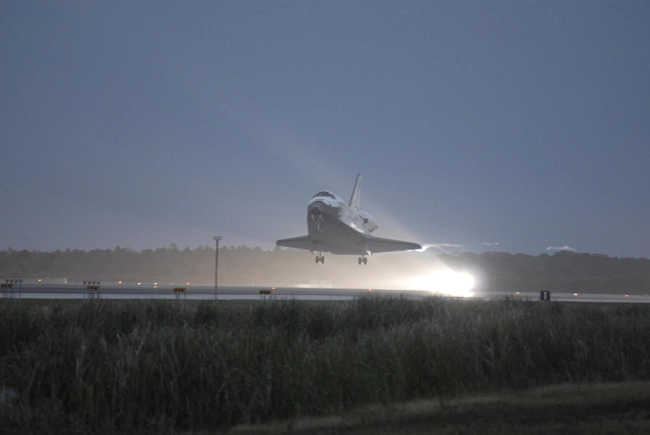
CAPECANAVERAL, Fla -- The space shuttleDiscovery's apparently flawless landingFriday capped a successful construction mission to the International SpaceStation (ISS) and has NASAcelebrating the holidays a bit early, top agency officials said Friday.
"Christmascame three days early for us," NASA launch director Mike Leinbach said afterthe shuttle touched down here at the Kennedy Space Center (KSC). "It was greattiming for us and it was a great Christmas present."
Discovery'sseven-astronaut crew concluded their STS-116mission at 5:32 p.m. EST (2232 GMT), beating a bit of a drizzle and theodds as the shuttletouched down on Runway 15 here at KSC despite weather that was expected toremain unacceptable [image].

"It was agreat landing and a great day," NASA chief Michael Griffin told reporters afterthe landing. "The crew on orbit and the crew on the ground could not have donebetter."
Discovery shuttlecommander Mark Polansky and his crewmates completed a 13-daymission, touted by NASA as the most complicated ever staged, during whichthey installed a newpiece of the ISS, overhauledits power grid from a temporary set up to a permanent system, and ferriedcargo and a new crewmember -- NASA astronaut SunitaWilliams -- to the orbital laboratory.
"Discoveryis a beautiful vehicle, we're happy that we were able to bring her home safely,"Polansky said from the landing strip tarmac after giving the shuttle aonce-over. "This mission is really a demonstration of how well we can work as ateam at NASA."
The STS-116astronauts primed the ISS for the addition of new solar arrays, modules and internationallaboratories, and returned European Space Agency (ESA) astronaut Thomas Reiter to Earth after about sixmonths as an Expedition 13and Expedition14 crewmember.
"We learneda lot not only by the science made by Thomas Reiter, but also about all that welearned about the space station," said Michel Togini, head of the ESA'sAstronaut Office, adding that Reiter's flight prepared his space agency to forthe delivery of its Columbus moduleto the ISS next year and the launch of the Europe's first unmanned stationcargo ship, the AutomatedTransfer Vehicle.
By landingDiscovery at its Florida launch site, rather than at backup landing strips in California and New Mexico, NASA cut down the amount of time, effort and money required toprepare the spacecraft for its next flight: the Columbus laboratory'slaunch to the ISS in October2007.
Discovery'sKSC landing also brought Reiter to a waiting team of physicians poised formedical checks after his extended spaceflight. In addition to Reiter, STS-116mission specialist NicholasPatrick, a first-time shuttle flyer, rested after landing while Polansky, pilotWilliam Oefelein and mission specialists Robert"Beamer" Curbeam, JoanHigginbotham and ESAastronaut Christer Fuglesang -- the firstSwede in space -- looked over their vehicle.
"I am very impressedwith Christer," said Per Tegner, director general of the Swedish Space Agency,adding that Fuglesang's name translates to 'Bird Song.' "He performed very wellwith Beamer and they made a great team."
NASA plansabout 13 more planned orbiter missions to complete thestation by its shuttle fleet's retirementdate of September 2010.
"There'stremendous challenge in front of us," William Gerstenmaier, NASA's associate administratorof space operations, after launch, adding that obstacles will likely arise butit vital to hit them head on. "We'll learn from it and we'll be better for it,and these are things we need to know to do bigger things as far as the Moon and Mars and otheractivities."
Leinbachsaid that beating the weather on landing was a nice book, and lucky, bookend toDiscovery'slaunch on Dec. 9. The orbiter shot spaceward on NASA's first night launchdespite an initial 70 percent chance of poor weather [image].
"It doesn'thurt to be a little lucky every now and then," Leinbach said. "It feels good toget lucky and it's good to have Discovery home."
Discovery's Dec. 22 landing also comes with a bonus: NASA can haul the orbiterinto its hangar and allow its veritable army of workers, astronauts,contractors and engineers time to enjoy the holiday season before once morepreparing the shuttle for flight. That sentiment, it seems, was also echoed butthe shuttle's crew.
"We want tothank everybody and wish everyone a happy holiday and a great New Year," Polanskysaid.
- Images: The Spacewalks of NASA's STS-116
- Images: Discovery's STS-116 Launch Day Gallery
- Mission Discovery: The ISS Rewiring Job of NASA's STS-116
- Complete Space Shuttle Mission Coverage
- The Great Space Quiz: Space Shuttle Countdown
- All About the Space Shuttle
