





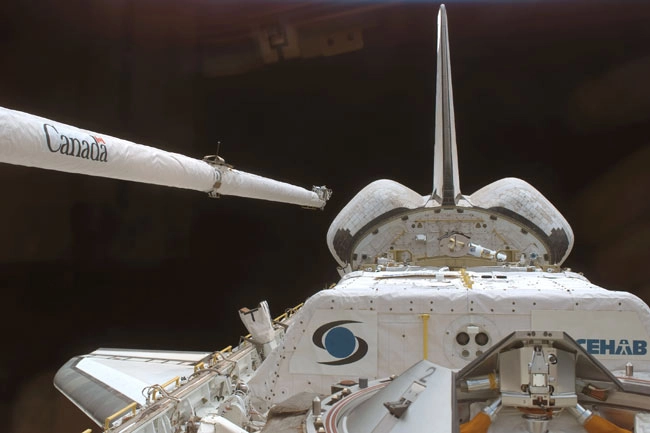
CAPE CANAVERAL, Fla. -- NASAmission managers are eyeing the weather for Friday’s planned landing ofthe space shuttle Discoverywhile awaiting the results from a second look at the orbiter’s heatshield.
“We’re assuming thevehicle is in a go condition for landing unless somebody illuminates an issueout of that data,” Phil Engelauf, NASA’smission operations representative for Discovery’s STS-116flight, said of today’s heatshield inspection during anafternoon status briefing. “But the assumption is everything is fine andwe have no reason to suspect anything other than that for the vehicle as ofthis time.”
Meanwhile, mission managers andflight controllers are going over options for Discovery’s return toEarth, currently set for no earlier than 3:56 p.m. EST (1856 GMT) on Friday.
Discovery’s STS-116 astronaut crew, commanded byveteran spaceflyer Mark Polansky, is due to land here at NASA’s Kennedy Space Centerto conclude a successful 13-day mission that continued assembly of the International SpaceStation (ISS), but only if the weather cooperates.
“If we have‘Go’ weather at Kennedy, than we’ll certainly try to get intoKennedy,” Engelauf said. “If we havequestionable weather at Kennedy and better weather at one of the other sites,then we’ll probably end up going to one of the other sites.”
Current weather forecasts forNASA’s Shuttle Landing Facility here predict low clouds and a hint ofrain that could prevent Discovery’s planned touchdown at KSC, NASAofficials said.
KSC is NASA’s preferredorbiter landing strip since it allows shuttle engineers to turn the vehiclearound for its next flight at the space agency’s launch site morequickly.
The space agency is alsotracking weather at the shuttle’s alternate landing sites at Edwards AirForce Base in California’s MojaveDesert, where high cross winds are expected, and the WhiteSands SpaceHarbor in New Mexico.
“Our intent will be toland somewhere on Friday,” Engelauf said.
If a KSC landing is unavailable,NASA mission managers will shift to either Edwards or White Sands depending onthe weather at each site. In the past, the White Sands site has been viewed aslast resort due to a dearth of orbiter turnaround facilities at the New Mexico installation.
A landing at Edwards, which likeKSC contains the required infrastructure to land anorbiter and ferry it back to NASA’s Florida spaceport, typically adds one extraweek and added cost of about $1.7 million to once more ready a NASA shuttle forflight.
With a White Sands landing at Northrup Strip, returning Discovery back to KSC forturnaround processing could take up to 45 days, NASA officials said.
“It will be longer comingback from there,” Engelauf said.
NASA landed a space shuttle onceat the White Sands facility in 1982 during the STS-3 mission aboard Columbia, but the orbitersuffered contamination from the landing strip's gypsum surface, the spaceagency said.
Engelauf added that some initial infrastructure to handleDiscovery’s post-landing power and purging needs will be flown out to theWhite Sands site in preparation for the site’s potential use.
Discovery’s landingschedule woes stem from the loss of one of two extra days NASA traditionallyadds to each shuttle flight to ensure the orbiter has enough supplies tomaintain its crew until landing.
Discovery launchedDec. 9 on a planned 12-daymission with two days in reserve in case of a systems glitch or poorlanding weather. But mission managers sacrificed one of those spare days Mondayto stagean unplanned spacewalk by STS-116 astronauts RobertCurbeam and Christer Fuglesang to wranglean unrulyISS solar array into its storage boxes.
NASA flight rules stipulate thatthe space agency land somewhere Friday if possible to protect its remainingflight day in the event of an unforeseen systems glitch, though theorbiter’s supplies will only last through Saturday, Engelaufsaid.
Polansky and his STS-116 crewmates are wrapping upsuccessful flight to the ISS, where they installeda new piece of the orbital laboratory, rewiredits power grid and performed an astronautswap for the outpost’s Expedition 14 crew.
The astronauts are due to launcha pair of microsatellites from Discovery’spayload bay, along with a third set on Thursday, beforereturning to Earth on Dec. 22.
- Images: The Spacewalks of NASA’s STS-116
- Images: Discovery’s STS-116 Launch Day Gallery
- Mission Discovery: The ISS Rewiring Job of NASA’s STS-116
- Complete Space Shuttle Mission Coverage
- The Great Space Quiz: Space Shuttle Countdown
- All About the Space Shuttle
