





Two astronauts will step outside the International SpaceStation (ISS) Tuesday afternoon to install a new piece to the orbitallaboratory’s metallic backbone.
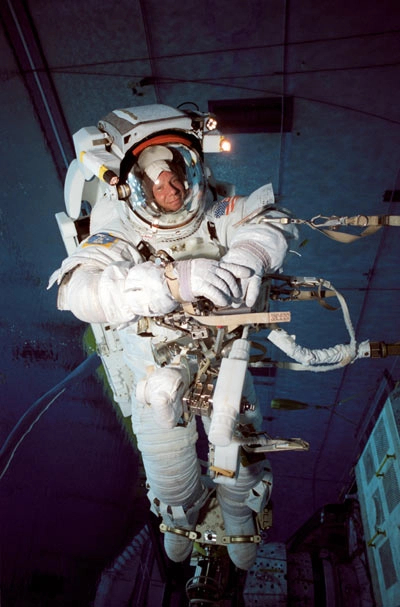
Clad inwhite NASA spacesuits, Discovery shuttle astronauts RobertCurbeam and ChristerFuglesang are expected to exit the space station’s Quest airlock at3:42 p.m. EST (2035 GMT) and spend about six and a half hours working in orbit.
Theirprimary goal is the installation of a new piece of the ISS—the Port5 (P5) spacer—to the portside end of the station’s main truss.
Small, butvital, the boxy P5truss is designed to serve as a bridge between the station’s Port 3/Port4 (P3/P4) solar arrays and the Port6 (P6) solar array element. The P3/P4 extends off to the station’sport side, but the older P6 array reaches upward, mast-likefrom the orbital laboratory’s centerline and will be moved during a latershuttle mission [image].
“Thistruss that we’re bringing up, the P5 truss, is almost like a spider,”said Curbeam, who is the lead spacewalker of STS-116,in a preflight NASA interview. “It allows us to take the P6 truss, whichhas been up there for several years now…and put it in its rightful place,if you will.”
Curbeam’s NASA spacesuit, known as an Extravehicular Mobility Unit (EMU), willsport a red stripe and U.S. flag, while that of Fuglesang—whorepresents the European Space Agency—is all-white and carries a Swedishflag in honor of his homeland. Shuttle pilot WilliamOefelein will coordinate the spacewalkers’ movements from the flightdeck of Discovery.
Today’sspacewalk will mark the fourth extravehicular activity (EVA) for Curbeam and the first for Fuglesang.The EVA is also the first of three planned during their STS-116mission to install P5 and rewirethe space station’s electrical grid.
A tightsqueeze
Discoveryastronauts plucked the two-ton P5 truss out of the shuttle’s payload bayafter dockingat the ISS late Monday. They later it to the end of the space station’srobotic arm, leaving it in a parked position for today’s spacewalk.
Latertoday, STS-116 mission specialist JoanHigginbotham and newly arrived ISS astronaut SunitaWilliams–who rodeup to the station aboard Discovery–will ease P5 into position with adelicate touch, relying on Fuglesang to call out distances and directions asthe truss comes within inches of space station hardware.
“Pictureas if you’re helping a friend park in a very tight spot,” leadSTS-116 spacewalk officer Tricia Mack said of today’s truss installation.“You’re going to want to give them a, ‘Whoa, back a little tothe right, a little to the left.’”
The parkinganalogy is more than apt since, 11 feet (3.3 meters) long, the P5 truss is aboutthe length of a compact car, NASA officials said. Built by Boeing, the trusselement is also 14 feet (4.5 meters) wide and stands about 13 feet (4.2 meters)high.
Higginbothamsaid she will be depending on Fuglesang’s verbal calls to avoid damagingP5 or the ISS.
“Thereare very few cameras on that side of the truss,” Higginbotham said beforeflight, adding that she is especially wary of hitting an electronics box on anearby P3/P4 truss solar array. “We’re coming within inches of thatbox, and it’s a box that, you know, if you hit it, you can causesparks.”
Curbeam andFuglesang will remove a series of launch locks and restraints from P5 before itis in place, then secure it to the ISS via drill-driven bolts.
In additionto installing P5, Curbeam and Fuglesang plan to relocate a grapple fixture on thesegment and replace a broken camera elsewhere on the space station’s maintruss.
ForFuglesang, who is making his first spaceflight as well as his first spacewalksduring the STS-116 mission, today’s EVA debut is a welcome challenge.
“I’msure it’s going to be fantastic,” Fuglesang said in a NASA interview.“But, really, going out, you cannot be more in space than doing aspacewalk.”
- Images: Discovery’s STS-116 Launch Day Gallery
- STS-116 Video: Power is Everything
- STS-116 Video: Building Blocks
- Mission Discovery: The ISS Rewiring Job of NASA’s STS-116
- Complete Space Shuttle Mission Coverage
- The Great Space Quiz: Space Shuttle Countdown
- All About the Space Shuttle
