





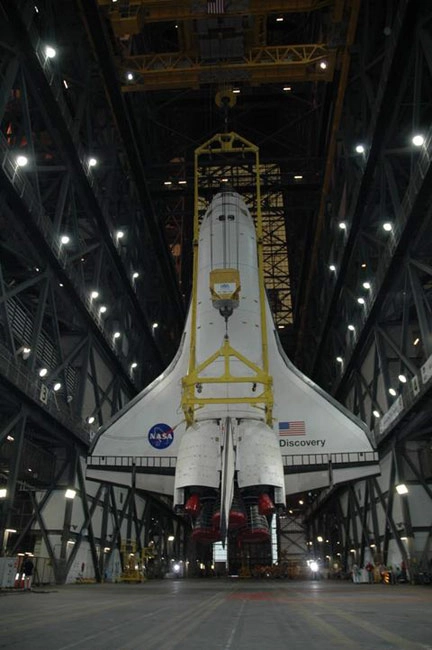
The piecesare coming together for NASA's nextshuttle mission as workers hoisted the space agency's Discovery orbiter towardsits flight position today.
Work crews hauledDiscovery into a vertical position by crane inside NASA's cavernous VehicleAssembly Building at the Kennedy Space Center (KSC) spaceport in Florida. There, the 122-foot(37-meter) orbiter will be mated to the external fuel tank and rocket boosters [image]that will aid its planned Dec. 7 launch towards the International Space Station(ISS).
"Everythingis going smoothly," NASA KSC spokesperson Jessica Rye told SPACE.com,adding that shuttle workers want to make sure nothing is moving on the orbiterbefore they connect it to the external tank [image].
Discovery'sSTS-116mission, commanded by veteran shuttle flyer Mark Polansky, will ferry a SPACEHABcargo module and a new ISS segment--the Port 5(P5) truss--to the orbital outpost in what is expected to be NASA'sthird shuttle flight this year. The STS-116 crew will also stage severalspacewalks to rewire the station's electrical grid.
The Tuesdayshuttle move was delayed severalhours to allow time additional landing gear inspections, NASA official said.
Discoveryrolled out of its hangar-like Orbiter Processing Facility Tuesday night atabout 9:23 p.m. EST (0223 Nov. 1 GMT), making the short trip to the 52-storyVehicle Assembly Building in about 34 minutes, Rye added.
Shuttleworkers are expected to spend about a week mating Discovery to its launch stackand checking their work before the entire assembly and its Mobile LaunchPlatform are hauled to Pad 39B.
Meanwhile, ateam of cargo specialists have installed the 4,110-pound (1,864-kilogram) P5truss [image] into a container for later transport to Discovery's Pad 39Blaunch site. A SPACEHAB cargo pod will be placed into the canister on Nov. 4, withboth elements due for delivery to the Pad 39B's payload changeout room on Nov.6, NASA officials said.
The P5truss runs about 11 feet (3.3 meters) in length and 14 feet (4.2 meters) inwidth and height. The Boeing-built segment is destined for installation on theoutboard edge of the space station's Port 3/Port4 (P3/P4) truss, which NASA'sSTS-115 shuttle crew delivered last month. P5 is designed to serve as botha truss spacer and conduit to allow power, cooling and other vital systems toreach outer ISS segments.
Polanskyand his STS-116 crewmates examinedtheir shuttle and launch stack last month, and are completing final trainingsimulations for their planned December space shot.
"We arereally pleased with all the work that everyone has been doing to support us,"STS-116 mission specialist Joan Higginbotham told SPACE.com in a recent interview.
- Mission Discovery: The ISS Rewiring Job of NASA's STS-116
- Complete Space Shuttle Mission Coverage
- Complete Coverage: ISS Expedition 14
- The Great Space Quiz: Space Shuttle Countdown
