





HOUSTON - The six-astronaut crew of NASA's shuttle Atlantis will not haveto wedge extra inspections into an already packed flight to the International SpaceStation (ISS), NASA officials said late Monday.
"There will be no need for focusedinspections for this mission," NASA commentator Nicole Cloutier-Lemasterssaid of the heat shield look as Atlantis' STS-115 astronauts slept inpreparation for their mission's firstspacewalk on Tuesday.
NASA engineers found 495 areas ofinterest on Atlantis' heat shield from a detailedSunday inspection and high-resolution photographs taken by ISS crewmembersjust before the shuttle dockedat the orbital laboratory today. But nearly all of those areas were cleared byMonday afternoon.
"The baseline plan, because it was alittle more difficult to execute, was not to do a focused inspection," NASA'sdeputy shuttle program manager John Shannon said in a Monday briefing, addingthat he was ready to add an extra day to Atlantis' flight if needed.
The extra day would have been tackedon between the STS-115 crew's first two spacewalks, Shannon said.
Of their initial interest areas onAtlantis wing leading edges and tile-covered belly, engineers dismissed 116outright since they were already on the spacecraft before its Saturday launchtowards the ISS, Shannon said. An additional 318 regions were also found to beno concern, leaving only 61 items under review this afternoon, he added.
"The initial report was that all of the tile on underside of the orbiter looks great," Shannon said.
The imagery did reveal three bits ofceramic cloth, known as gap-fillers, jutting out from between the black tileson Atlantis' underbelly. Each of the shuttle's external tank doors, which opento allow connections between Atlantis and its fuel tank near the orbiter's aft,has a protruding gap-filler, one of which appears to just barely hang on.
"It is almost gone, it is justbarely hanging in there by one little corner," Shannon said of the 1.5-inch (3.8 centimeters)gap-filler on Atlantis' port external tank door.
A second gap-filler appears nearlyripped completely from Atlantis' starboard external tank door while a thirdgap-filler juts about 0.15 inches (0.38 centimeters) from an area under theport wing, Shannon said.
"None of these really concern theteam a great deal at this time," Shannon added.
Engineers will continue to study thegap-fillers to determine how much, if any, extra heating they could generateaft of their locations during landing. But shuttle officials saw a similargap-filler protrusion near one of the external tank doors on the shuttleDiscovery's STS-121spaceflight in July and do not anticipate concern over those aboard Atlantis.
"This process we honed duringSTS-121," Shannon said of the heat shield analysis.
During NASA's first return to flight mission,following the 2003 Columbiaaccident, a spacewalking astronaut did pluck two gap-fillers jutting fromsensitive areas on Discovery's belly as a precaution.
Milestone spacewalk
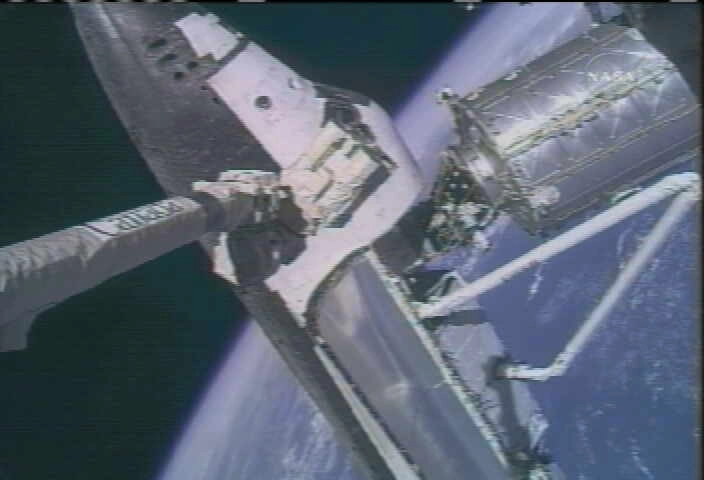
While engineers pored over heatshield images on Earth Monday, Atlantis' crew deliveredthe $372million Port 3/Port 4 (P3/P4) truss segments to the ISS with its twin solararrays folded away in swing-out boxes.
Commanded by veteran shuttleflyer Brent Jett, the STS-115 crew will begin its first spacewalk at 5:15 a.m. EDT (0915GMT) Tuesday to wire up those trusses to the end of the station's Port 1 (P1)segment.
STS-115 spacewalkers JosephTanner and Heidemarie Stefanyshyn-Piperwill also ready the two tightly-packed solar arrays for deployment during the6.5-hour spacewalk. The two astronauts are sleeping inside the space station'sQuest airlock - known as a spacewalk "campout"- to save time preparing for Tuesday's spacewalk.
"The campout is going exceedinglywell," Kirk Shireman, NASA's deputy ISS programmanager, said Monday, adding that STS-115 is the first mission to use theprotocol.
The P3/P4 truss is the first newsegment to be added to the ISS since late2002 and currently sits at the end ofthe space station's robotic arm. The element is expected to be hoisted intoposition by 4:10 a.m. EDT (0810 GMT), with spacewalkers later attaching vital powerlines to ensure its operation.
"We have 34 hours from the time westart our motion until we have the umbilicals to theutilities hooked up tomorrow," Kirk Shireman, NASA'sdeputy ISS program manager, said Monday. "So we've got plenty of margin."
- VIDEO: First Tasks of NASA's STS-115 Mission
- Gallery: Prepping Atlantis
- Complete Space Shuttle Mission Coverage
- NASA's STS-115: Shuttle Atlantis to Jump Start ISS Construction
- The Great Space Quiz: Space Shuttle Countdown
- Complete Coverage: ISS Expedition 13
