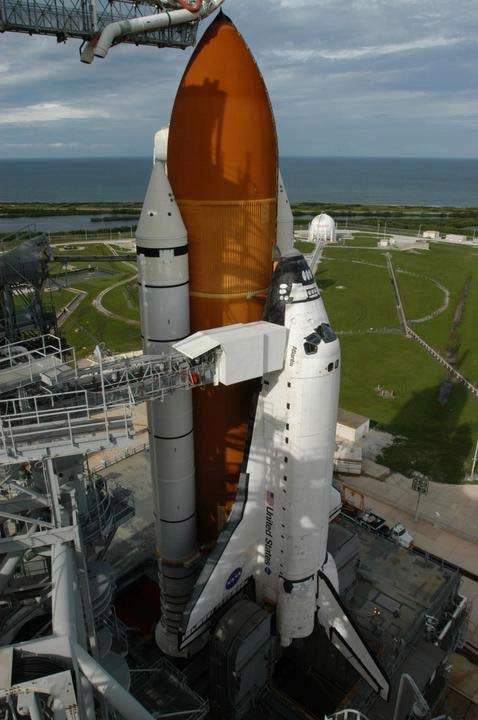
CAPECANAVERAL, Fla. - The spaceshuttle Atlantis is once more poisedto launch toward the International SpaceStation (ISS) carrying a six-astronaut crew determined to resumeconstruction of the orbital laboratory.
Atlantis' STS-115mission is set to launch at 11:40:32 a.m. EDT (1540:32 GMT) to deliver a pair ofmassive trusses and two new solar arrays to the ISS. Today's planned spaceshot is NASA's second launch attempt for Atlantis in three days after an oddfuel cell power reading prompted a Wednesday scrub.
After twodays of scrutiny, engineers concluded Thursday that the glitch would not be asignificant risk to Atlantis' STS-115 mission commanded by veteranshuttle astronaut Brent Jett. The spaceflight's lighted launch window hasdwindled to just two days - today and tomorrow - after several delays due tothe fuel cell issue, poorweather and a launchpad lightning strike.

"We have acouple of days available for launch and if we get the opportunity to go fly, Iwould like to take advantage of those couple of days," shuttle program managerWayne Hale said.
Atlantis ishauling a $371.8 million payload of 17.5-ton trusses and expansive solar arrays.
STS-115spacewalkers JosephTanner, HeidemarieStefanyshyn-Piper, DanielBurbank and StevenMacLean will work two at a time to install the truss segments during thethree planned spacewalks for their spaceflight. First-time flyer ChrisFerguson is serving as Atlantis' pilot.
Lt. KalebNordgren of the 45th Weather Squadron at Cape Canaveral Air ForceStation said Atlantis has a 70 percent chance of acceptable flight conditionstoday, with forecasts improving to 80 percent on Saturday.
Fuelcell confidence
At theheart of Atlantislatest glitch is a short in one of three current phases that power acoolant pump motor in Fuel Cell 1.
Atlantiscarries three fuel cells that use liquid hydrogen and liquid oxygen to generatethe electricity used to power all the space shuttle's systems. That power,delivered along three phase loops - A, B and C - also supports a coolant pumpmotor to prevent each fuel cell from overheating.
It wasPhase A that shorted on Fuel Cell 1, though shuttle officials are confidentthat the other two phases are healthyenough to keep the generator from failing in orbit and cutting Atlantis'11-day mission short.
Two fuelcells can power the shuttle normally, with the third as a backup, Hale saidThursday.
StevePoulos, NASA's orbiter projects manager, said Fuel Cell 1's coolant pump motorhas been in operation for a lifetime total of 3,948 hours - or less than halfof its 10,000-hour certification - despite being nearly 30 years old. A thinwire in Phase A, and possible some degradation over time, are possible sourcesof the current loop's short, he added.
"It's veryrobust, it's very reliable," Hale said of the pump motor technology used inNASA fuel cells. "This is not rocket science, this is 19th centurytechnology."
Hale saidhe marveled at the fact that, despite its age, the motor has shown no other issuesearlier in its lifetime. It was first assembled in 1976, shuttle officials said.
"Here weare, 30 years after we put this little motor together and finally...the first oneout of all the motors we put together 30 years ago has had a little incident,"Hale said. "I wish my car worked that good."
NASAwill provide live coverage of Atlantis' launch preparations beginning at 5:30a.m. EDT (0930 GMT). You are invited to follow the briefing using SPACE.com's NASATV, which is available by clickinghere or using the button at the left.
- VIDEO: First Tasks of NASA's STS-115 Mission
- Gallery: Prepping Atlantis
- Complete Space Shuttle Mission Coverage
- NASA's STS-115: Shuttle Atlantis to Jump Start ISS Construction
- The Great Space Quiz: Space Shuttle Countdown
- Complete Coverage: ISS Expedition 13
