


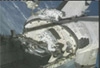
HOUSTON - NASA is more confident in itsability to make minor in-flight repairs to a shuttle's heat shield after asuccessful test during a Wednesdayspacewalk outside the Discovery orbiter, according to one mission manager.
Tony Ceccacci, lead shuttle flight director for Discovery'sSTS-121 mission, said preliminary results from today's spacewalk by astronauts PiersSellers and Michael Fossum are positive, but their repair technique willlikely be confined to the limited types of repairs they performed.
During aseven-hour and 11-minute spacewalk, Sellers and Fossumtested application methods for a sticky, black material dubbed NOAX - short fornon-oxide adhesive experimental - designed to fill in cracks and gouges to thecarbon composite panels that line a shuttle's nose cap or wing leading edges.They applied the NOAX with spatulas and caulk gun-like tools to squares ofreinforced carbon carbon (RCC), the same materialused to protect the shuttle nose and wings from searing reentry temperatures.
"I don'tthink you can ever certify them, I think you can get confidence in thesespecific [damage types]," Ceccacci said during amission update here at NASA's Johnson Space Center (JSC). "We expect some gooddata out of this."
Today'sspacewalk expands on some initialtests conducted during NASA's STS-114 astronauts in July 2005 to determine thebasic behavior of NOAX under actual flight conditions.
"ForSTS-114, the conditions that we did the NOAX repair was more of a scienceproject to see if we could throw it on the piece of RCC and determine what theresults were," Ceccacci said. "For 121, these guyswent through a lot of work to determine exactly how you would repair [damage]."
Instead ofspending one hour testing two heat shield repair methods like their STS-114predecessors, Sellers and Fossum spent a full threehours solely on testing the NOAX material, Ceccacisaid. The astronauts perched themselves on the space station's robotic arm anda shuttle foot restraint in an attempt to recreate the types of positions thatwould likely be used in the event of an actual repair, he added.
Of primeimportance were the surrounding temperatures at the time of the repair tests,NASA officials said.
Groundtests have shown that the deal temperature to begin RCC repairs with the NOAXmaterial is around 140 degrees Fahrenheit, with today's target temperaturestargeted between 35 and 100 degrees Fahrenheit (1.6 to 37 Celsius).
"We want tostart at a higher temperature and work our way down," said TomasGonzalez-Torres, lead spacewalk officer for Discovery's STS-121 mission.
The methodallows astronauts to vent - or outgas - the NOAX by spreading it thin like apancake to bake out volatiles and reduce the amount of bubbling that occursduring application, Gonzalez-Torres added.
Too manybubbles can lead to voids in the NOAX repair that could sabotage the fix bycreating a direct path to a shuttle heat shield's damaged area, NASA officialssaid.
Sellers andFossum hit a peak temperature of about 93 degreesFahrenheit (33 degrees Celsius) and low of 25 degrees Fahrenheit (3.8 degreesCelsius) during their NOAX test, as they worked to time their activities withinthe sunrise-sunset cycle of each orbit,
NASA said.Astronauts aboard Discovery and the ISS see one sunrise and one sunset every 90minutes.
Ofspatulas and tethers
With theend of today's spacewalk, Sellers and Fossum have finisheda marathon session of three extravehicular activities (EVAs)that began with their firstorbital work session on July 8.
"I'm soexcited to be complete with all three EVAs,"Gonzalez-Torres said, crediting the deft handling of the ISS robotic arm bySTS-121 mission specialists Stephanie Wilson and Lisa Nowak for giving theirspacewalking counterparts extra time for a get-ahead task. "This one, just likethe other ones, was very successful."
With thecomplexity of each spacewalk, Ceccacci said the smallhitches - some tether issues for Fossum, Sellers' jetbackpack glitch on Monday and a lost spatula that drifted away from theastronauts this morning - aren't too bad.
"If that'sall that happens, we're happy," Ceccacci said."You're kidding yourself if you think nothing like that is going to happen."
In their firstspacewalk, they bounced, pushed and pulled from the end of Discovery'scombined robotic arm and inspection boom, a 100-foot (30-meter) mechanicalappendage - to prove its potential as a repair platform for orbiter heat shieldrepairs. Initial results from that testwere positive, with Ceccaci and other NASAofficials saying they are now confident the boom could be used to holdastronauts near a shuttle's fragile but precious heat tiles and RCC panels.
On Monday,the Sellers and Fossum wereat it again, this time performing vitalrepairs to restore the space station's Mobile Transporter, a sort ofrailcar platform, to full operations by installing a backup power and datacable reel. The fix was notonly effective, but immediately put to work as ISS managers moved theMobile Transporter to a new worksite just before today's spacewalk.
"We didthat to get configured for the late inspections that we're going to be doing ina couple of days," Ceccacci said.
As a sidenote, NASA's spacewalk has placed Sellers among the Top 10 spacewalkers of alltime, and within the U.S. space agency's Top 5 bracket, witha grand total of 41 hours and 10 minutes over six EVAs.The all-time record holder is Russian cosmonaut Anatoly Solovyev(77 hours and 41 minutes over 16 spacewalks) with NASA astronaut Jerry Ross (58hours and 18 minutes) a distant second.
Fossum,who made his spacewalk debut - and his first spaceflight - with Discovery'scurrent mission, racked up 21 hours and 29 minutes of orbital work.
Discovery'sSTS-121 astronauts are set to have most of the day off on Thursday, with theirISS Expedition 13 counterparts slated for a light day as well, Ceccacci said.
About theonly thing on Thursday's docket is some preparatory work to ready Discovery'scargo pod - the Italian-built Multi-Purpose Logistics Module Leonardo - for itsFriday unberthing from the ISS. The cargo module willcarry more than 4,000 pounds (1,814 kilograms) of unneeded equipment, tools,trash and other items when Discovery returns to Earth Monday.
- Gallery: Shuttle's First Flight
- Gallery: Rare Space Shuttle Images
- Shuttle Discovery: Complete Mission Coverage
- Great Space Quizzes: Space Shuttle Countdown
- Great Space Quizzes: The Space Shuttle
- Great Space Quizzes: Life in Orbit
